
Daniel K. Inouye International Airport (HNL) with Kids: Every Facility, Mapped
The short answer
Daniel K. Inouye International Airport in Honolulu has no children's play area anywhere in its three terminals. What it does have is stronger than most: four lactation pods and twelve family restrooms, three of them on the arrivals level. Mainland-bound families also face a USDA agricultural bag inspection before check-in — a step no other US airport requires.
Every fact on this page checked against official sources on Aug 3, 2026
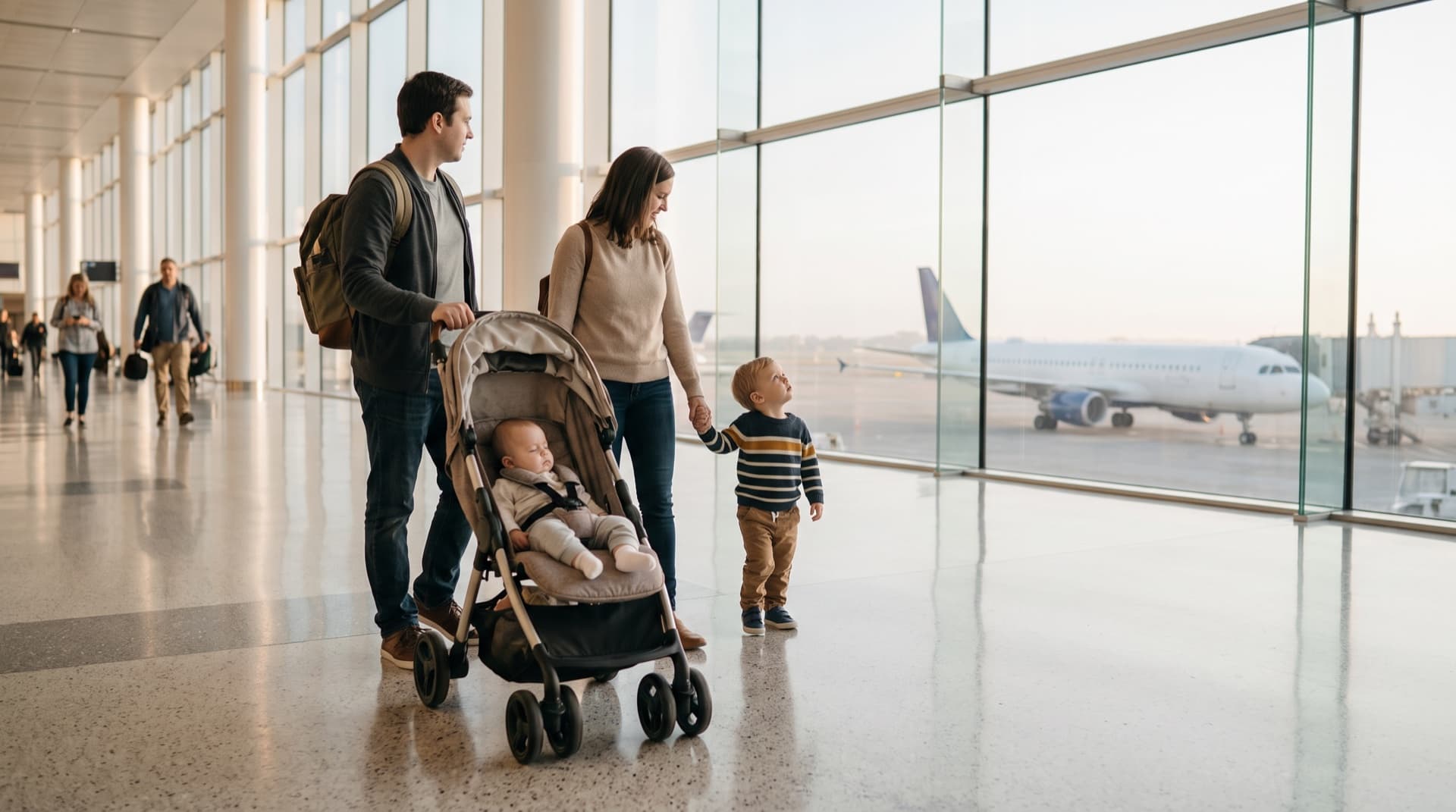
Velivolo family score
Fair
Kids' play areas
None
Cultural Gardens are not a play area
Nursing rooms
4 lactation pods
All post-security, by the gates
Family restrooms
12 locations
3 on the arrivals level
Sensory room
Unconfirmed
No sensory programme published
Stroller rental
Not available
Free baggage carts instead
HNL has no children's play area — its own Things to Do page runs from shopping to the 1962 Cultural Gardens without one. What it does offer is real restroom coverage: twelve family restrooms across both terminals and the arrivals building, three on the arrivals level, plus four lactation pods by the gates. Terminal 1 and 2 connect airside with no re-screening, but Terminal 3, for inter-island flights, means leaving security and clearing it again. There's no sensory room and no stroller rental.
- HNL's four lactation pods sit by the gates: Terminal 1 near Gate A15, and Terminal 2 near Gates C4/C5, between G4/G5, and in the Central Concourse next to Michael Kors.
- HNL has no children's play area anywhere in its three terminals — its Things to Do page confirms only shopping, dining and the Cultural Gardens.
- Three of HNL's twelve family restrooms are on the arrivals level, near Baggage Claims 8 and 9 and between Baggage Claims 26 and 27.
- Every checked and hand-carried bag is inspected by the USDA before check-in on mainland-bound flights out of HNL — a step unique to Hawaii's airports.
- Terminal 1 and Terminal 2 at HNL connect airside on the third level, so a connection between them needs no re-screening; Terminal 3 does not connect airside at all.
Velivolo family score
Fair
Scored on published facilities, not opinion.
No children's play area anywhere at HNL — confirmed against its own Things to Do page, which lists only shopping, dining and the Cultural Gardens.
Four lactation pods and twelve family restrooms, three of them on the arrivals level — genuinely thorough restroom coverage even though HNL's own count of them is internally contradictory.
HNL names no family lane and doesn't confirm one is absent either; departing mainland-bound families also face a USDA bag inspection no other US airport requires.
Terminal 1 and Terminal 2 connect airside with no re-screening, but Terminal 3 requires leaving security entirely — a real complication for inter-island connections.
No restaurant with a kids' menu or high chair is named anywhere on HNL's site.
One confirmed adult changing table and no sensory-friendly programme of any kind; screening support is routed to TSA Cares only.
Facility matrix
Every Family Facility at HNL, at a Glance
Terminal, gate, which side of security, hours and cost — in one place. Where HNL publishes nothing, we say so rather than guess.
| Facility | Status | Terminals | Security side | Hours | Age limit | Cost |
|---|---|---|---|---|---|---|
Children's play area | Not available | — | — | — | — | |
Nursing room / lactation pod 4 locations | Available | T1, T2 | Past security | Not published | — | Free |
Family (unisex) restroom 12 locations | Available | T1, T2, IAB | Both sides | Terminal hours | — | Free |
Baby changing table | Unconfirmed | T1, T2, IAB | Both sides | — | — | Free |
Sensory room | Unconfirmed | — | — | — | — | |
Family security lane | Unconfirmed | — | — | — | — | |
Stroller rental | Not available | — | — | — | — | |
Dedicated family lounge | Not available | — | — | — | — |
Daniel K. Inouye International Airport has no children's play area. Its own Things to Do While You Wait page offers shopping and dining, free Hawaiian entertainment in the Lobby, the Cultural Gardens and the airport art collection — and nothing else. The open-air Cultural Gardens are landscaped garden spaces from 1962, not a play facility, and should not be described as one.
Verified Aug 3, 2026 · HNL — Things to Do While You WaitHNL has four lactation pods, all by the gates: Terminal 1 near Gate A15, and in Terminal 2 near Gates C4 and C5, between Gates G4 and G5, and in the Central Concourse next to Michael Kors. The claim on several aggregator sites that HNL has no dedicated nursing facilities is wrong.
Verified Aug 3, 2026 · HNL — Persons With DisabilitiesHNL lists twelve accessible family (unisex) restrooms across Terminals 1 and 2 and the International Arrivals Building, on both sides of security — including three on the arrivals level, near Baggage Claims 8 and 9, between Baggage Claims 26 and 27, and by Customs in the IAB.
Verified Aug 3, 2026 · HNL — Persons With DisabilitiesHNL confirms one adult changing table — in the Terminal 1 family room on the second floor sterile side, across from Torn Basil Pizza — but publishes no statement about baby changing tables in its family or standard restrooms, and nothing about men's restrooms.
Verified Aug 3, 2026 · HNL — Persons With DisabilitiesHNL publishes no sensory room and no sensory-friendly programme. Its Persons With Disabilities page covers porter services, shuttles, curbside zones, parking, restrooms, lactation pods, telecommunications relay, paging, first aid and service dogs — nothing for sensory needs.
Verified Aug 3, 2026 · HNL — Persons With DisabilitiesHNL names no family security lane anywhere on its site; screening questions are routed to TSA Cares. Note that departing mainland-bound families face an extra step no other US airport has: a USDA agricultural inspection of every checked and hand-carried bag before check-in.
Verified Aug 3, 2026 · HNL — Agriculture InspectionHNL offers no stroller rental. What it does rent is Smarte Carte baggage carts, curbside on the departure level and at baggage claim — and those are free in the International Arrivals Building.
Verified Aug 3, 2026 · HNL — Baggage CartsHNL has no family lounge. The Cultural Gardens — Chinese, Hawaiian and Japanese, laid out by Richard C. Tongg in 1962 around the ticketing lobby and the E gates, plus the C. B. Lansing Garden on the ground level of Terminal 1 near the walkway to Terminal 2 — are the airport's open-air alternative, but they are gardens and nothing more.
Verified Aug 3, 2026 · HNL — Things to Do While You WaitPlay
Kids' Play Areas at HNL
HNL has no open play area. Here is what the airport publishes instead, and what we could not confirm.
Feeding
The Four Lactation Pods at HNL
All 4 locations with the gate each one sits beside — the detail that decides whether you can actually reach it.
Near Gate A15
Terminal 1 · A gates
HNL publishes no access instructions. It calls them lactation pods and does not name a manufacturer, so no app or code requirement is assumed here. The airport describes them only as "a private, comfortable, convenient space for mothers to breastfeed their babies or pump breast milk".
Near Gates C4 and C5
Terminal 2 · C gates
HNL publishes no access instructions and does not name a manufacturer.
Between Gates G4 and G5
Terminal 2 · G gates
HNL publishes no access instructions and does not name a manufacturer.
Next to Michael Kors
Terminal 2 · Central Concourse
HNL publishes no access instructions and does not name a manufacturer.
Changing
All Twelve Family Restrooms at HNL
Near Baggage Claim 8
Terminal 1 · First floor / Baggage Claim
Near Baggage Claim 9
Terminal 1 · First floor / Baggage Claim
Near the middle elevators, past the centre glass doors between Lobby 2 and Lobby 3
Terminal 1 · Second floor / Departures
Across from Torn Basil Pizza
Terminal 1 · Second floor, sterile side
Between Gates A1 and A12
Terminal 1
Between Gates B2 and B3
Terminal 1
Near Gate E6
Terminal 2
Near Gate G4
Terminal 2
Between Gates G7 and G10
Terminal 2
Between Baggage Claims 26 and 27
Terminal 2 · Ground floor / Baggage Claim
Near Customs
Terminal 2 · Ground floor
Sterile side of Checkpoint 3
Terminal 2
Security
Getting Through HNL Security With Kids
Family lane
HNL publishes no family security lane. Its site carries TSA checkpoint hours and TSA travel tips but names no lane signed for families, and the accessibility page routes special screening needs to TSA Cares rather than to an airport lane.
Strollers and car seats
TSA rules apply: strollers, umbrella strollers, carriers, car seats and booster seats go through the X-ray, and anything too large for the belt is inspected by hand. Take your child out and carry them through the metal detector.
Formula, milk and baby food
Formula, breast milk, toddler drinks and baby food are allowed over 3.4 oz (100 ml) and do not have to fit in the quart bag. Declare them at the start of screening and take them out of your bag.
Shoes and jackets
Children 12 and under keep their shoes, light jackets and headwear on during screening.
TSA PreCheck with kids
Children 17 and under can use the PreCheck lane free with an enrolled adult.
HNL With a Stroller, Step by Step
- 1
The agricultural inspection comes first
This is the step no other US airport has. If you are flying to the mainland, every bag — checked and hand-carried — is pre-flight inspected by the US Department of Agriculture before check-in. Be ready to open and close bags and parcels at the inspection station.
Do it before you settle the children: it adds a queue that families elsewhere never plan for.
- 2
Baggage carts
Smarte Carte carts are rented curbside on the departure level and at baggage claim. In the International Arrivals Building they are free.
Arriving international families get carts at no cost right where Customs releases them.
- 3
At the checkpoint
HNL advertises no family lane. Fold the stroller for the X-ray and carry your child through the metal detector; declare formula, breast milk and baby food at the start of screening.
TSA Cares can arrange assistance if you call at least 72 hours ahead.
- 4
Feeding and changing
Four lactation pods sit past security — Terminal 1 near Gate A15, Terminal 2 near Gates C4/C5, between G4 and G5, and in the Central Concourse next to Michael Kors. Twelve family restrooms are listed, and three of them are on the arrivals level, which most airports never document.
The Terminal 1 family room on the second floor sterile side, across from Torn Basil Pizza, is the one with an adult changing table.
- 5
Moving between terminals
Terminals 1 and 2 connect airside on the third level — buses run there between about 6 a.m. and 11:30 p.m., so a T1↔T2 connection needs no re-screening. Terminal 3 is reachable only by the ground-level Wiki Wiki bus, which means leaving the secure area and clearing security again.
Open-air electric trams also link T1 and T2, but only between 10 a.m. and 6 p.m.
HNL publishes no stroller rental. Its Services & Amenities index runs internet services, lost and found, locker and storage, lei greeting, persons with disabilities, banks and ATMs, postal services, baggage carts, medical, smoking, visitor information, the USO and the conference facility — the only wheeled rental is the Smarte Carte baggage cart.
Not published by HNL — set by each airline.
Transfers
Moving Between Terminals at HNL With Children
Wiki Wiki Shuttle
HNL's intra-airport transport is free and comes in three forms. The Wiki Wiki Bus runs daily between Terminals 1, 2 and 3 and the Skyline Rail Station; the ground-level service on the public roadway operates 3 a.m. to 11:45 p.m., with stops at the centre median in front of Terminal 1 and curbside at Terminals 2 and 3, and each bus takes up to two wheelchairs. The airside T1–T2 buses on the third level run between about 6 a.m. and 11:30 p.m. and drop passengers at the C and G gates. Open-air electric trams also link Terminals 1 and 2, 10 a.m. to 6 p.m., each fitting one wheelchair. Electric courtesy carts cover the rest: Terminal 1 between the A and B gates and Terminal 2 between the C, E and G gates, both 5 a.m. to 10:30 p.m.; the third-level roadway between the A, C, D, E, F and G gates, 8 a.m. to 6 p.m.; and the Skyline Rail Station mezzanine on the fourth level, 7 a.m. to 7 p.m. Carts seat four, six or eight passengers depending on the vehicle. HNL does not say whether a stroller can be brought aboard any of them.
Layover playbook
What to Do on an HNL Layover With Kids
What to actually do, by how long you have.
Feed and change before you head to the gate
- 1Clear the USDA agricultural inspection first if you're mainland-bound — it comes before check-in and is easy to forget to plan for.
- 2Fold the stroller at the TSA checkpoint and carry your child through the metal detector; HNL has no confirmed family lane.
- 3If you land near one, use a family restroom on the arrivals level — near Baggage Claim 8 or 9, or between 26 and 27 in Terminal 2.
There's no play area, so plan your own activity
- 1Bring toys or a tablet — HNL has no children's play area, and the 1962 Cultural Gardens are landscaped grounds, not a play space.
- 2Use one of the four lactation pods for feeding: Terminal 1 near Gate A15, or Terminal 2 near Gates C4/C5, G4/G5, or the Central Concourse next to Michael Kors.
- 3The Terminal 1 family room across from Torn Basil Pizza has HNL's one confirmed adult changing table.
Confirm hours before committing to an overnight wait
- 1HNL doesn't publish overnight hours for its lactation pods or family restrooms, so treat access as uncertain late at night.
- 2The Wiki Wiki ground shuttle runs 3 a.m. to 11:45 p.m.; airside T1–T2 buses run roughly 6 a.m. to 11:30 p.m., so plan terminal changes inside those windows.
- 3There's no sensory room to retreat to if a child becomes overstimulated overnight.
Terminal 3 means leaving security and coming back
- 1If your inter-island flight departs from Terminal 3, the only way there is the ground-level Wiki Wiki bus — you'll leave the secure area and clear the checkpoint again.
- 2Terminal 3 boarding is by steps, with lifts or ramps for mobility needs, since it serves smaller propeller and regional-jet aircraft.
- 3Feed or change before you leave Terminal 1 or Terminal 2's secure side, since HNL documents no family facilities inside Terminal 3 itself.
Know your rights
What HNL Owes Your Family by Law
Lactation rooms
Under the FAM Act, part of the FAA Reauthorization Act of 2018, every medium and large hub airport must provide a lactation area in the sterile area of each terminal, with a door that locks, a place to sit, a flat surface, a power outlet and access to a sink or sanitiser. HNL exceeds this minimum with four lactation pods across its two main terminals.
Changing tables
The same law requires a baby changing table in at least one men's and one women's restroom in every passenger terminal, with compliance due by 30 September 2020. HNL confirms only one adult changing table, in the Terminal 1 family room across from Torn Basil Pizza, and does not publish whether its other restrooms carry a standard infant changing table.
Milk and formula
TSA allows formula, breast milk, toddler drinks and baby food in quantities over 3.4 oz (100 ml), and they do not need to fit in the quart bag. Declare them at the start of screening and take them out of your bag.
Boarding
Priority boarding for families is set by your airline rather than by HNL — check your carrier's policy before you fly.
If the facility is not there
If you can't find a lactation pod or family restroom, ask at any HNL information point. For screening-specific support, HNL's own materials point to TSA Cares. The legal requirement gives you grounds to insist a compliant space exists in your terminal.
Verified Aug 3, 2026 · FAA Reauthorization Act of 2018 (PL 115-254), FAM Act provisionsQuestions
HNL With Kids: Common Questions
Does Honolulu airport have a kids' play area?
No. Daniel K. Inouye International Airport has no children's play area anywhere across its three terminals — we checked its own Things to Do While You Wait page, which lists only shopping, dining, free Hawaiian entertainment in the lobby, the airport's art collection and the Cultural Gardens, and none of it is built for children to run or climb. It's worth being specific about the Cultural Gardens, since some sources mistake them for a play space: they're landscaped Chinese, Hawaiian and Japanese gardens designed by Richard C. Tongg in 1962, laid out around the ticketing lobby and the E gates, and they're gardens to walk through, not a play area. If your child needs to move, plan your own activity rather than counting on the terminal to provide one.
Where are the lactation pods at HNL?
HNL has four lactation pods, all past security and all positioned by gate clusters. Terminal 1 has one near Gate A15. Terminal 2 has three: one near Gates C4 and C5, one between Gates G4 and G5, and one in the Central Concourse next to Michael Kors. HNL describes them only as a private, comfortable space for breastfeeding or pumping, and doesn't name a manufacturer, so no app or key-code requirement is assumed — treat them as walk-in until you're there and can confirm otherwise. The airport also doesn't publish opening hours, or confirm a sink or power outlet inside any of the four, so plan around bringing what you need rather than expecting it to be provided.
How many family restrooms does HNL have?
HNL's own accessibility page actually contradicts itself here — it opens by saying the airport has 'seven accessible family (unisex) restrooms' and then lists twelve, each with its own named location. Twelve is the more reliable number, since every one is individually locatable: eight are in Terminal 1 and Terminal 2 near specific gates or baggage claims, one is in the International Arrivals Building near Customs, and three sit on the arrivals level — near Baggage Claim 8, near Baggage Claim 9, and between Baggage Claims 26 and 27 — which most airports don't document at all. Only one, the Terminal 1 family room across from Torn Basil Pizza, is confirmed to have an adult changing table.
Is there an adult changing table at HNL?
Yes, one. HNL confirms a family room on the second floor of Terminal 1, past security on the sterile side, directly across from Torn Basil Pizza, which has an adult-sized changing table. It's the only one the airport documents anywhere across its three terminals — the other eleven family restrooms in HNL's list carry no confirmation either way of a changing table for an adult or an older child. If you specifically need an adult changing table, this Terminal 1 location past security is currently your only confirmed option at Honolulu's main airport, so plan your route with that in mind if you're travelling through Terminal 2 or Terminal 3.
What is the USDA agricultural inspection at HNL?
It's a step families flying out of Hawaii to the US mainland won't find at any other American airport. Every checked bag and every piece of hand-carried luggage is inspected by the US Department of Agriculture before you even reach check-in, to prevent invasive species and agricultural pests from leaving the islands. Be ready to open and close bags and parcels at the inspection station — with young children and a stroller in tow, this adds a queue that most travellers never have to plan for elsewhere. It happens before check-in, so build it into your timing alongside the regular TSA checkpoint rather than assuming your only stop is security.
Does HNL have a sensory room?
HNL publishes no sensory room and no sensory-friendly programme of any kind. Its main accessibility resource, the Persons With Disabilities page, covers porter services, shuttle transportation, curbside pickup and drop-off zones, accessible parking, restrooms, the four lactation pods, telecommunications relay services, paging, first aid and service animal relief areas — but nothing built around quiet time, dimmed lighting or sensory decompression. If your child becomes overwhelmed by airport noise or crowds, HNL's own materials point toward TSA Cares for screening-specific assistance rather than to any physical space inside the terminal. Build in extra time and your own coping strategies rather than counting on a dedicated room.
Can I rent a stroller at Honolulu airport?
No. HNL offers no stroller rental anywhere in its three terminals. Its Services & Amenities index runs through internet services, lost and found, locker and storage, lei greeting, services for persons with disabilities, banks and ATMs, postal services, baggage carts, medical services, smoking areas, visitor information, the USO and a conference facility — the only wheeled item you can rent is a Smarte Carte baggage cart, available curbside on the departure level and at baggage claim, and free of charge in the International Arrivals Building for arriving international passengers. If you need a stroller inside the terminal, bring your own and gate-check it with your airline, since HNL publishes no gate-check policy of its own.
How do I get between terminals at HNL with kids?
It depends which terminals. Terminal 1 and Terminal 2 connect airside on the third level, so a family connecting between them doesn't need to leave security or be re-screened — airside buses run there roughly 6 a.m. to 11:30 p.m., and open-air electric trams also link the two terminals from 10 a.m. to 6 p.m. Terminal 3, used for smaller inter-island flights, is a different story: the only way to reach it is the ground-level Wiki Wiki Bus, which runs 3 a.m. to 11:45 p.m. on the public roadway outside security, meaning you'll clear the checkpoint again on the way back in. HNL doesn't say whether a stroller can be brought aboard any of these buses, trams or courtesy carts.
Does HNL have a family security lane?
HNL doesn't clearly say either way. Its site publishes TSA checkpoint hours and general travel tips but never names a lane signed specifically for families, and its accessibility page routes anyone needing extra screening support to TSA Cares rather than to a dedicated airport lane — so this is recorded as unconfirmed rather than a flat no. What is confirmed and unique to HNL is the USDA agricultural inspection that comes before check-in on mainland-bound flights, checking every bag for prohibited plants and agricultural products. Standard TSA child rules apply at the checkpoint itself: children 12 and under keep shoes and jackets on, and those 17 and under can join the PreCheck lane free with an enrolled adult.
Verification
Sources and Verification
Every figure on this page traces to one of these. Checked Aug 3, 2026.
- 1HNL — Persons With Disabilities
Lactation pods, family restrooms and the adult changing table · 2026
- 2HNL — Things to Do While You Wait
No play area, no family lounge, the Cultural Gardens · 2026
- 3HNL — Agriculture Inspection
The USDA bag inspection for mainland-bound flights · 2026
- 4HNL — Intra-Airport Transportation / Wiki Wiki Shuttle
Terminal connections, hours and airside vs landside routes · 2026
- 5HNL — Baggage Carts
No stroller rental, free carts in the arrivals building · 2026
- 6TSA — Traveling with Children
Screening rules for strollers, car seats, formula and breast milk · 2026
- 7FAA Reauthorization Act of 2018 (PL 115-254)
FAM Act lactation room and changing table requirements · 2018
Lia Tuso
Founder & Family Travel Editor
Lia has flown with her own kids through more than 40 airports and built Velivolo so parents stop guessing what is actually waiting on the other side of security.
Stop guessing what's past security.
Gate-level family facilities for airports worldwide, checked against official sources and dated so you know how fresh they are.