/family-airport-guide
Family travel tips for MCI — nursing rooms, diaper changing stations, family restrooms, stroller-friendly access, and restaurants with children's menus at Kansas City Airport.
Reviewed by:

D. Goren
Head of Content
Updated March, 30
Because airline child policies change — and parents shouldn’t have to hunt for answers.
Kansas City International Airport (MCI) reopened in 2023 after a complete rebuild, replacing the aging original terminals with a single, modern facility. The new MCI is widely praised for its clean design, intuitive layout, and much-improved amenities — representing a dramatic upgrade for family travelers passing through the Midwest.
The rebuilt terminal features nursing suites, updated family restrooms, and baby changing stations in a bright, easy-to-navigate space. Security lanes move efficiently, and the airport's compact new footprint means shorter walks than most comparable airports. The new MCI also brought a significant improvement in dining options — with local Kansas City flavors well-represented and family-friendly restaurant choices available throughout the concourses.
Read on for everything families need to know about the new Kansas City International Airport.
Kansas City International Airport (MCI) is designed with families in mind, and you can generally expect private spaces for breastfeeding or pumping within the terminal. At many U.S. airports (including newer terminals), these are often set up as dedicated lactation/nursing rooms or wellness rooms that provide more privacy than a typical restroom.
Baby changing tables are widely available throughout the terminal. You’ll typically find them in:
Changing stations are usually wall-mounted fold-down tables. For safety, keep one hand on your child and use the strap if provided.
MCI may have designated family-focused spaces depending on current terminal services, and many airports provide a small “baby care” or “family” room beyond standard restrooms. When they exist, these spaces often include:
Even when a dedicated baby care center isn’t present, the combination of family restrooms and lactation/wellness rooms usually covers the same needs in separate locations.
Airports generally do not provide public bottle warmers, so it helps to plan for simple, safe options. At MCI, families typically use these practical approaches:
For hygiene, aim to wash hands first and keep bottle parts contained in a clean zip pouch until you can wash them properly.
In the main food and dining areas at MCI, high chairs are commonly available at many sit-down restaurants and some quick-service spots with seating. Availability can fluctuate during busy times, but staff can usually help you locate one when you order or as you’re being seated.
MCI’s newer terminal design emphasizes a more modern passenger experience, and families generally benefit from spacious corridors, family restrooms, and updated seating and dining areas that make stroller travel and quick stops easier. While exact locations can change with terminal operations, the overall setup is typically supportive for parents traveling with infants and toddlers: private nursing options, wide restroom coverage with changing stations, and plenty of places to sit close to gates when you need a calmer moment.
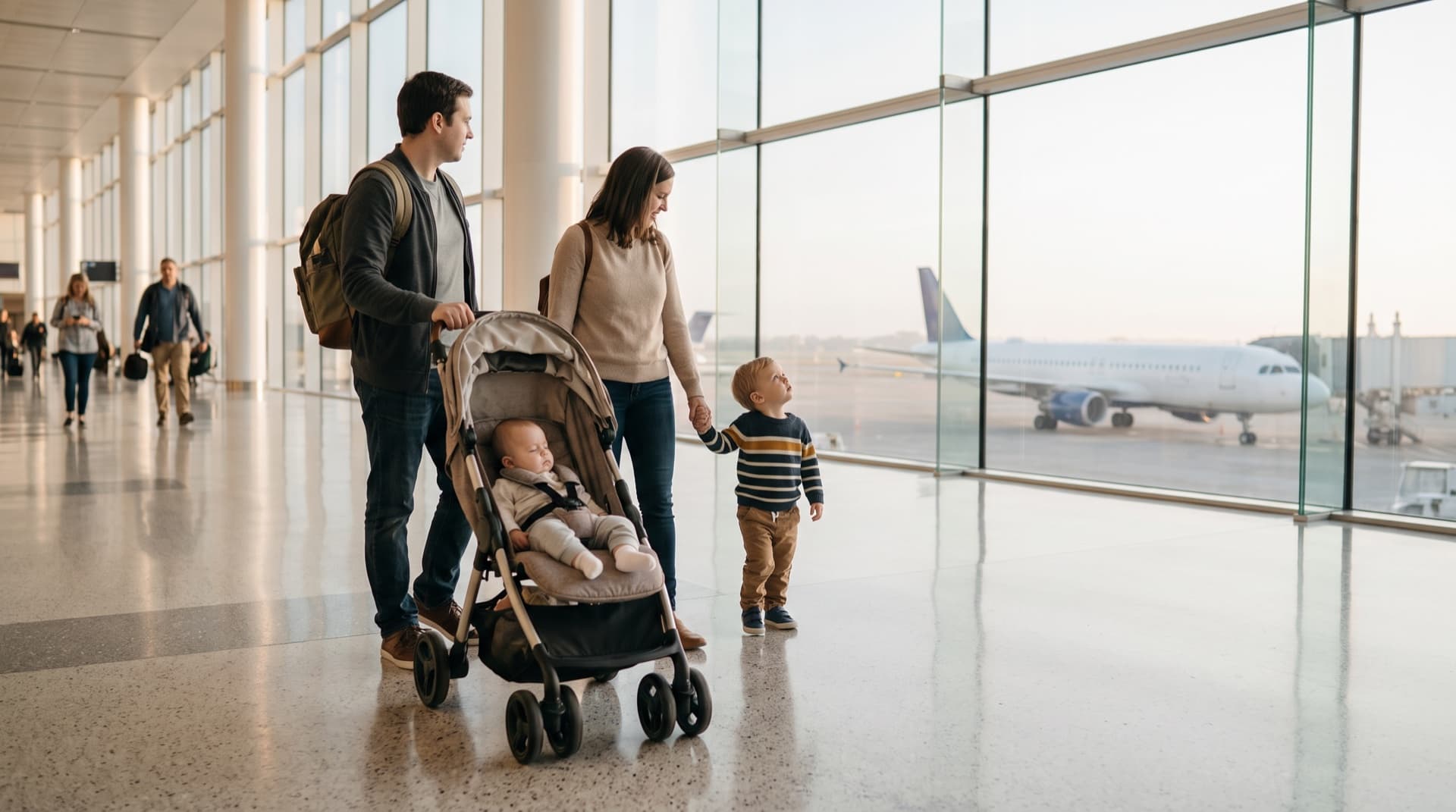
At TSA security, strollers and car seats are allowed, but they usually must be screened separately. You will be asked to take your child out of the stroller and fold the stroller (if it folds) so it can go on the X-ray belt; larger or non-folding strollers may be inspected by hand if they cannot fit through the machine. Car seats are typically placed on the belt for X-ray, and security officers may do an extra check or swab on the item as part of routine screening.
TSA allows baby formula, breast milk, toddler drinks, and baby food in your carry-on in quantities greater than 3.4 oz (100 mL), even if they are liquid. These items do not need to fit in your quart-size liquids bag, but you should be ready to remove them for screening and tell the officer you are carrying them. At the checkpoint, TSA may do additional screening such as visual inspection, swabbing the outside of containers, or testing the liquids; in some cases they may ask you to open the containers. You can bring ice packs, freezer packs, and gel packs to keep these items cool, and they are allowed even when partially melted as long as they are used to cool medically necessary items like breast milk or formula. Packing these items together and in easy-to-reach containers helps keep the screening process quicker and calmer.
Some airports offer Family Security Lanes, which are screening lines intended to make the process smoother for families traveling with young children, but they are not available at every airport or every checkpoint. If your airport has one, you may see signs for “Families” or an officer may direct you there, and you can still use the regular lanes if the family lane is closed or longer. Expect the same TSA screening rules, including having strollers, car seats, and bags screened, and you may be asked to remove your child from the stroller so the stroller can go through the X-ray or be inspected. To help things move calmly, have your child’s items organized so you can place them on the belt quickly, and keep small essentials (like wipes and snacks) easy to reach while you wait. Family lanes are designed to allow a little more time and space for managing kids, but all passengers must still follow officer instructions and standard security procedures.
At TSA security, many children can keep their shoes on: kids age 12 and under are generally allowed to leave shoes on during screening. This means your child will usually walk through the metal detector wearing their shoes, while adults typically remove theirs. If an alarm goes off or the officer needs a closer check, TSA may still ask your child to remove shoes for additional screening. To make this smoother, choose shoes that are easy to take off and put back on, and avoid shoes with lots of metal parts that can trigger the detector. Be ready to briefly lift or guide a toddler as directed, and follow the officer’s instructions if they ask for shoes to come off.

Kansas City International Airport (MCI) is a modern airport, but it is not widely known for having large, landmark kids’ playgrounds the way some big hub airports do. Families can still find child-friendly spaces and small activity spots in the terminal environment, but it’s best to plan as if play options may be limited and more low-key than a full indoor playground.
At most airports like MCI, when kid-focused areas exist they’re generally placed where families naturally gather: near clusters of gates, within sight of seating, and close to restrooms—often with family-oriented facilities nearby. If you don’t see a clearly marked play zone, you can still look for open seating areas with a little extra floor space that are suitable for a short movement break before boarding.
When airports provide dedicated kids’ play areas, they are most commonly airside (past security), so families can use them during a layover or while waiting for boarding without needing to re-clear security. Landside (before security) kids’ zones are less common and typically smaller, since many families prefer to get through screening first and then settle near their gate.
At MCI, expect most family-friendly waiting and movement space to be past security near gate seating. If you have time before going through security, landside spaces are better for a quick snack, diaper change, or sorting bags—then plan on any play time happening airside.
If you come across a children’s play area or kid-focused corner at an airport like MCI, the equipment is usually designed for short, safe bursts of play rather than extended climbing. Common features include:
Because airports prioritize safety and easy cleaning, these areas are typically compact and designed to be supervised closely.
Most airport play areas are primarily aimed at toddlers through early elementary ages. If MCI offers a dedicated play spot, it will most likely feel best suited for:
Older kids often find airport play zones a bit small, but they can still benefit from a short break to move around, especially right before a long flight.
Even when a dedicated “quiet room” isn’t advertised, airports usually have calmer pockets that work well for younger children, nursing parents, or kids who get overwhelmed. At MCI, you can typically create a calmer moment by choosing:
For overstimulated children, the most effective approach is often a simple routine: a snack or drink, a restroom break, then a short, calm activity (books, stickers, or looking out the window) before returning to the gate area.
MCI is not typically highlighted for a signature, must-see children’s attraction (such as large themed playgrounds found in a few major international airports). The most reliable “kid entertainment” tends to be practical, everyday airport experiences: watching planes, exploring safe walking loops near the gates, and taking advantage of spacious seating to spread out briefly with a parent’s supervision.
1
Oklahoma Joe’s Bar-B-Que at Kansas City International Airport brings a slice of Kansas City–style barbecue to the terminal, from a brand that’s widely known among BBQ fans for smoky meats and big, satisfying plates (the restaurant is also known in its home market as Joe’s Kansas City Bar-B-Que). It’s a good fit for families because the vibe is casual, the dining room can handle a little kid energy, and you can typically count on kids’ menu options that keep things simple for picky eaters. Parents often gravitate to burnt ends and other slow-smoked staples, while kids are usually happiest with straightforward BBQ favorites like pulled meat or a sandwich with a side. Service is generally counter-style and move-along friendly for airport timing, with generous portions that can be shared if you’re feeding more than one child. Expect about $15–$25 per adult (less for kids), which is on the higher side for airport food but usually feels like fair value given the portion sizes and the local barbecue pedigree. The name “Oklahoma Joe’s” traces back to the barbecue-world reputation of pitmaster Joe Davidson, and in Kansas City the brand has long been treated as a must-try stop for visitors chasing classic smoked BBQ.
2
Zarda Bar-B-Q at Kansas City International Airport brings a well-known Kansas City–area barbecue name to the terminal, serving classic Midwestern smoked-meat comfort food in a casual, counter-service setup. The brand is best known back home for hearty portions and crowd-pleasers like burnt ends, sliced brisket, pulled pork, and smoked turkey, typically paired with sides such as fries, beans, or coleslaw. For families, it’s an easy fit: the atmosphere is informal and forgiving of kid noise, and the menu naturally includes simple, familiar options; availability of a kids’ menu and high chairs can vary by airport operator and day, but the concept is family-forward and quick to navigate. Kids often gravitate to milder picks like pulled-pork or turkey sandwiches and fries, while parents can go for fuller platters or a combo to sample more than one meat. Service is fast and designed for travelers—order at the counter, food comes out quickly, and portions tend to be filling, which helps when sharing with little ones. Expect about $15–$25 per adult (less for smaller sandwiches or a kid portion), which is typical for airport barbecue and can feel like solid value when a platter feeds a hungry family. As a regional institution with roots in the Kansas City barbecue tradition, Zarda offers a reassuring taste of local flavor without asking families to commit to a long, formal sit-down meal.
3
Winstead’s at Kansas City International Airport (MCI) brings a classic Kansas City–area diner tradition to the terminal, best known for its fast, no-fuss counter-style comfort food—especially burgers, fries, and old-school shakes. The vibe is casual and forgiving for families: quick ordering, plenty of kid-approved basics, and enough ambient airport bustle that a little wiggle and chatter won’t feel out of place, and many locations can accommodate families with kids’ menu-style options and simple swaps. For most travelers, the can’t-miss order is a double cheeseburger with fries, plus a thick milkshake that works as both dessert and distraction for younger kids. Portions are straightforward (think diner-sized rather than oversized), and service is typically fast so you can eat without sacrificing boarding-time peace of mind. Expect about $12–$20 per adult depending on what you order, with kids usually landing lower, making it a solid value for an airport meal compared with pricier sit-down spots. Winstead’s is a long-running local name in the Kansas City metro, and for many locals it’s a nostalgic, “taste of home” stop—an easy, familiar pick when traveling with children.
4
Applebee’s at Kansas City International Airport (MCI) is the airport outpost of a well-known U.S. casual-dining chain that focuses on familiar, crowd-pleasing American comfort food—think burgers, chicken, salads, and shareable appetizers—in a relaxed bar-and-grill setting. For parents, it’s an easy win because the dining room vibe is typically upbeat and forgiving of kid noise, and you can usually count on a kids’ menu with simple staples that don’t require adventurous eating. Families also appreciate the practical setup (booths and tables that work with carry-ons, and high chairs are commonly available), making it a low-stress place to sit down before a flight. Popular picks that tend to satisfy both adults and kids include Bourbon Street Chicken & Shrimp, classic burgers, and the chain’s signature boneless wings and other appetizers that are easy to share. Service is full-service sit-down, but it’s designed for quick decision-making and steady pacing, with hearty portion sizes that can sometimes be split or saved if you’re not rushing. Expect about $15–$25 per adult (plus drinks), with kids’ meals typically cheaper, which can feel like solid value compared with many airport fast-casual options when you want a real table and a reliable menu. As a brand, Applebee’s has been a fixture of American family dining for decades, known more for consistency and familiarity than culinary surprises—exactly what many traveling families want in an airport.
Does Kansas City International Airport have nursing rooms?
Kansas City International Airport (MCI) provides designated nursing/lactation rooms inside the terminals. Locations and access can change, so the most reliable way to find the nearest one is to check the terminal maps and wayfinding signs once you’re inside. You can also confirm current locations with an information desk or airport staff on the day of travel.
Can I bring formula through security at MCI?
Yes—TSA allows breast milk, formula, toddler drinks, and baby food in quantities greater than 3.4 oz when you’re traveling with a child. You should tell the TSA officer at the start of screening that you’re carrying these items so they can be screened separately. They may be tested or screened using additional methods, and you can ask that milk/formula not be opened if alternatives are available.
Does MCI have a kids' play area?
MCI offers family-friendly amenities, but whether a dedicated children’s play area is available can vary by terminal/area and may change over time. Use the airport map and look for “play area” or “kids” icons and follow terminal signage after security. If you don’t see one listed, airport staff can confirm what’s currently available.
Are strollers allowed at Kansas City International Airport?
You can bring a stroller through TSA security at MCI, and it can usually go all the way to the gate. At the checkpoint, strollers typically must be screened (often by X-ray for smaller strollers or by hand inspection for larger ones). Gate-checking a stroller is generally free with most airlines, but policies can vary by carrier, so confirm with your airline.
Does Kansas City International Airport have family security lanes?
TSA does not consistently offer dedicated “family lanes” at every airport or at all times, and availability can depend on staffing and checkpoint setup at MCI. Families can still use standard TSA lanes, and TSA officers can provide directions to the best lane if any special screening options are operating. For check-in, family-friendly service varies by airline rather than the airport, so it depends on your carrier’s counters and staffing.