Reviewed by:

D. Goren
Head of Content
Updated March, 30
Because airline child policies change — and parents shouldn’t have to hunt for answers.
LaGuardia Airport (LGA) has undergone a dramatic transformation in recent years. Once known for outdated facilities and tight spaces, LaGuardia has been largely rebuilt through an extensive redevelopment project — resulting in modern terminals that are significantly more comfortable and family-friendly than the airport of a decade ago.
The rebuilt LGA features nursing rooms, updated family restrooms, and baby changing facilities across its new terminal buildings. Stroller navigation has improved considerably with wider corridors, more elevator access, and better-organized security lanes. Dining options in the new terminals are more varied and include restaurants with children's menus and family-oriented seating arrangements.
Whether this is your first visit to the new LaGuardia or you're returning after years away, this guide walks through what families can now expect — and where to find the amenities you need.
LaGuardia Airport has upgraded family amenities in its newer terminal areas, and private spaces for breastfeeding or pumping are generally available in the passenger (airside) areas. Nursing rooms are designed to give parents more privacy and calm than a standard restroom, but availability can vary by terminal and concourse.
Diaper changing tables are widely available at LaGuardia, most often as fold-down changing stations inside restroom stalls or family restrooms. You’ll typically find them in:
Accessibility: Changing stations are generally installed at an accessible height and in accessible restroom layouts in modernized areas. If you have a larger stroller, family/companion restrooms are usually the easiest option for maneuvering.
Some airports provide dedicated baby care centers, and at LaGuardia you may find family-focused rooms or nursing areas depending on the terminal section. When a dedicated baby care space is available, it usually includes practical basics that make shorter breaks much easier:
Because room layouts and services can differ by terminal and concourse, it’s normal to see more complete baby care setups in newer or recently renovated sections of the airport.
At LaGuardia, dedicated bottle-warming stations are not consistently provided across all areas, so families typically rely on a few practical, airport-standard options:
Handwashing matters: Restroom sinks are typically the primary option for washing hands and rinsing items. Keep in mind that airports generally do not provide sterilizing equipment; if you need sterilization, you’ll want to rely on travel sterilizing bags or similar at-home-approved methods.
High chairs are commonly available at sit-down restaurants and some larger food locations at LaGuardia, but they are not guaranteed at every outlet, especially smaller kiosks or grab-and-go counters.
If you can’t find a high chair, many families use a stroller as a safe seated option while eating (with the stroller brakes on and the child securely buckled).
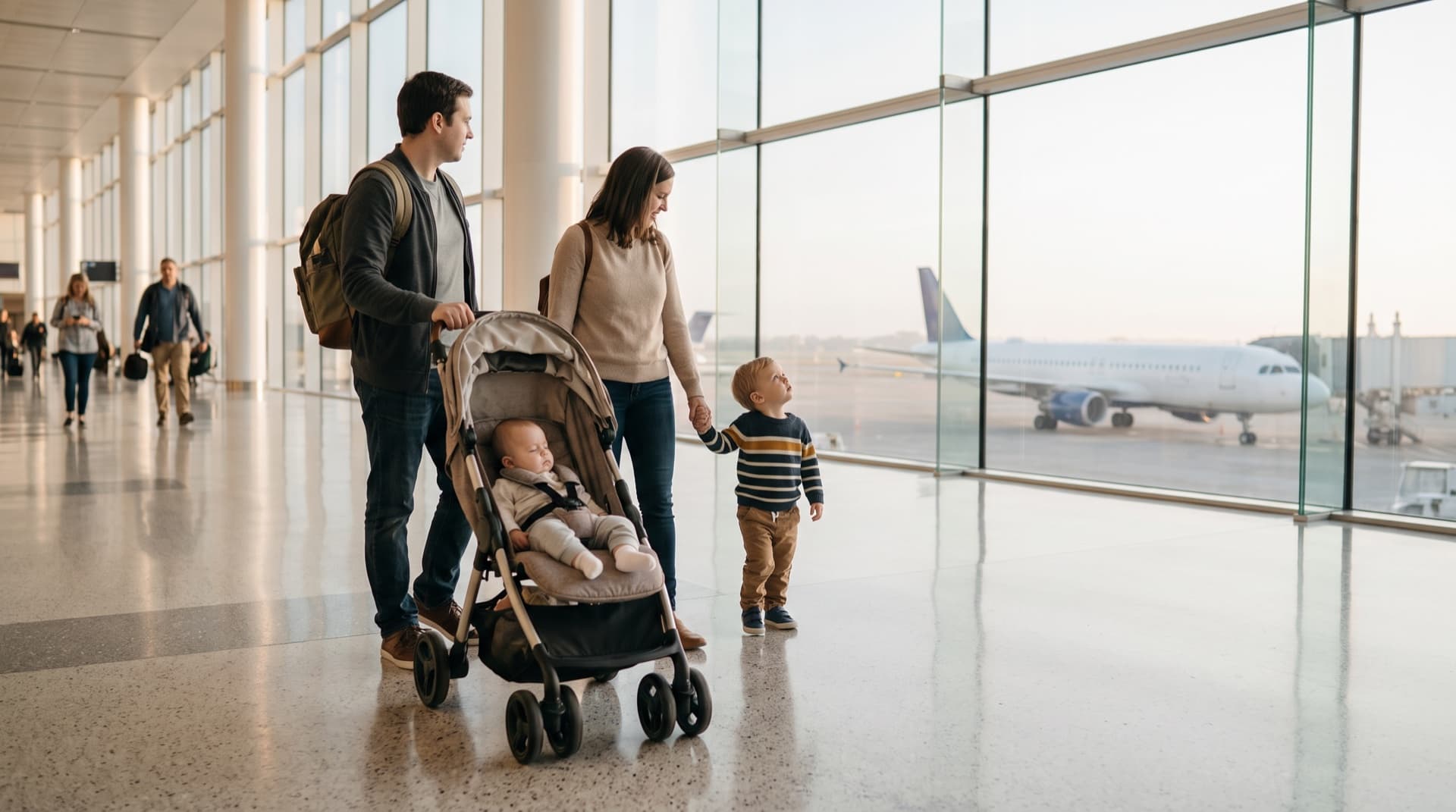
At TSA security, you should expect to take your child out of the stroller and fold the stroller so it can be screened by X-ray or by additional inspection. Most strollers go through the X-ray machine once folded; if it does not fit, a TSA officer will screen it by hand, which may include swabbing parts of the stroller for explosive trace testing. Before you reach the front, remove any bags, cups, toys, or loose items from the stroller so they can be screened separately and nothing falls out while you’re folding it. If your stroller has a basket or compartments, keep them as empty and easy to open as possible, since TSA may need to look inside. If you use an umbrella stroller or a compact, quick-fold model, it usually goes through faster because it fits the belt and is easier to handle.
TSA lets you bring baby formula, breast milk, toddler drinks, and baby food in quantities greater than 3.4 oz (100 mL), even in your carry-on, because they are considered medically necessary for infants and toddlers. These items do not need to fit inside your quart-sized liquids bag, but they should be separated from other liquids so they can be screened more easily. At the checkpoint, tell the officer you are carrying formula or milk, and expect extra screening such as visual inspection, swabbing the outside of containers for residue testing, or additional bag screening. You may bring these in liquid form, as ice packs or gel packs, and in bottles, sippy cups, or pouches; ice packs and similar cooling items are allowed when used to keep these items cold. Be prepared that officers may ask you to open containers in some cases, and screening can take a little longer, so keeping everything together and easy to access helps.
Some airports offer family security lanes (or family-friendly lanes) designed to give parents with young children a little more space and time to get through screening. These lanes are not available at every airport, and they may only operate during certain hours, so you may be directed to the standard line if they are closed or too busy. You should expect the same TSA screening rules as any other lane, including removing items from bags, placing belongings in bins, and completing walkthrough metal detector or body scanner screening. If you see a sign for a family lane, have your group stay together, keep strollers and carry-on items organized for the X-ray, and be ready to fold a stroller if the officers ask. TSA officers will guide you on where to send strollers, car seats, and child items through the X-ray and when to walk through with your child.
In standard TSA screening, children 12 and under can usually keep their shoes on when going through security. Adults and children 13 and older are typically asked to remove shoes and place them in a bin for X-ray. TSA officers may still ask a child to remove shoes in some situations, such as if the shoes alarm during screening or if extra screening is needed. If your child is asked to take shoes off, expect them to go on the conveyor belt with other items, and have socks and easy-on/easy-off shoes ready to make it quicker. If you are using TSA PreCheck, the general expectation is that passengers can keep shoes on, but officers can still request removal if needed for screening.

LaGuardia Airport (LGA) is a busy, family-heavy airport, but it is not widely known for having large, dedicated “kids’ play zones” in the way some mega-hub airports do. Most families find that LGA’s kid-friendly options are more about finding a comfortable corner to move and reset than seeking out a big playground-style area. When play amenities are available, they are typically found airside (past security) near groups of gates, where families spend the most time waiting to board.
Because terminal spaces change over time—and airports may add or remove children’s amenities—plan for a “lighter” play setup rather than a full indoor playground. In many major U.S. airports like LGA, kid activity features are most often:
Landside (before security), space is typically more transitional—check-in, bag drop, and security lines—so it’s less common to find a true play space there. If you do arrive very early, landside seating areas can still be useful for snack time, a stroller break, or calming a toddler before going through security.
If you come across a children’s area at LGA, it’s most likely to be a small, supervised-by-parent spot rather than a staffed playroom. Typical features in U.S. terminals include:
Keep expectations realistic: you’re more likely to find small “activity corners” than a full playground with slides and multiple zones.
Most airport play areas, including the smaller style more typical at LGA, are geared toward:
Older kids and teens generally use these spaces less, but can still benefit from nearby seating, charging access, and room to decompress.
Even without a designated “quiet room,” you can often create a calmer moment at LGA by choosing your spot carefully. Helpful options include:
For children who get overwhelmed, a quiet snack, water, and a familiar comfort item (blanket, stuffed toy, headphones) can make a big difference while staying close to your gate.
If you are hoping to let your child play, it typically works best to do it after you’ve cleared security and confirmed your gate and boarding time.
LaGuardia is not known for a signature, must-see children’s attraction (for example, large themed playgrounds or landmark installations designed specifically for kids). The strength of LGA for families is more about modernized terminal spaces, seating, and services that make it easier to manage young travelers, even when a dedicated play zone isn’t available.
1
Crust offers a casual, modern dining experience centered around artisan pizzas and Italian-inspired comfort food, all served in a relaxed, family-friendly setting. The atmosphere is lively but easygoing, making it a great fit for families—there’s a welcoming vibe where kids feel comfortable, and the environment is typically forgiving of a bit of noise. For ordering, many families gravitate toward wood-fired pizzas, pastas, and simple salads, along with shareable starters like garlic knots or mozzarella sticks that are easy for the table to enjoy. There are usually kid-friendly options available, including smaller pizzas or customizable toppings that work well for younger diners. Service is often fast-casual or relaxed full-service, with food arriving fairly quickly, which is especially helpful when dining with kids. Portions are generous, and pizzas in particular make sharing simple and convenient. Budget-wise, expect around $12–$25 per adult, offering good value for the portion sizes and quality. Overall, Crust delivers a reliable, crowd-pleasing experience with familiar flavors and a comfortable, family-friendly atmosphere.
2
Cavo at LaGuardia is an airport outpost of a modern Greek/Mediterranean concept, leaning into breezy Aegean flavors with a menu built around shareable plates and familiar grilled items that travel well. The room has a polished-but-casual feel that works for families, and the naturally lively terminal energy helps mask kid noise; while a dedicated kids’ menu and available high chairs can vary by operator, the overall setup is stroller- and family-friendly for a sit-down break. Parents typically gravitate to grilled meats or seafood with Greek-style sides, while kids often do best with simpler options like skewers, fries, or plain pita and dips when available. Service runs at an airport pace—order at the table, food comes out efficiently—and portions are generally designed to share, which is helpful when splitting with younger eaters. Expect about $20–$35 per adult before drinks (kids less), which is typical for LGA sit-down dining and can feel like solid value if you share a couple of plates instead of ordering everyone an entrée. As a concept, Cavo trades on the approachable side of Greek cuisine—fresh, grilled, citrusy, and not overly spicy—making it an easy fit for mixed-age groups. It’s not a white-tablecloth destination, but it’s a comfortable, reliable spot for families who want something a step up from fast food without the stress.
3
Parkway Kitchen offers a casual, contemporary dining experience with a menu focused on approachable comfort food and fresh, crowd-pleasing dishes. The atmosphere is relaxed and welcoming, making it a great fit for families—there’s an easygoing vibe where kids feel comfortable, and the setting is simple without being overly basic. For ordering, many families gravitate toward burgers, sandwiches, and hearty mains like chicken dishes or salads, along with shareable sides such as fries or appetizers that work well for the table. There are usually kid-friendly options available, including smaller portions and familiar favorites that appeal to younger diners. Service is typically quick and efficient, often in a fast-casual or relaxed full-service style, so meals arrive without much delay. Portions are generous and satisfying, making sharing a practical option. Budget-wise, expect around $12–$25 per adult, offering solid value for the portion sizes and variety. Overall, Parkway Kitchen delivers a reliable, family-friendly dining experience with familiar flavors and a comfortable, no-fuss atmosphere.
4
Chili’s Grill & Bar at LaGuardia is the airport-friendly version of the well-known American casual-dining chain, loved for its Tex-Mex-leaning comfort food, big flavors, and a laid-back sports-bar vibe. For families, it’s an easy win because it’s typically lively (so little ones won’t feel like they have to whisper), and the restaurant format generally accommodates kids with kids’ menu staples and a setting where spills and wiggles are no big deal. Parents tend to gravitate to classics like fajitas and burgers, while kids usually go for crowd-pleasers like chicken tenders, simple pasta, or smaller burger-and-fries-style plates (availability can vary by airport menu). Service is table-style and geared toward getting travelers fed efficiently, with portions that are usually generous by airport standards, making it easier to share or stretch one entrée for a hungrier child. Expect a mid-range price point—about $20–$35 per adult (kids less), which can feel like solid value at LGA when you want a sit-down meal instead of fast food. Chili’s is a long-running national brand that started in Texas in the 1970s and built its reputation on approachable Southwestern-inspired fare, friendly bar-and-grill energy, and consistent family appeal.
Where is the nursing suite at LaGuardia Airport?
LaGuardia has dedicated nursing rooms in several terminals; you can confirm exact locations and access hours on the airport’s terminal maps or by asking an information desk. You may also find single-user family restrooms in multiple areas, which can be helpful for breastfeeding and diaper changes. If you need a quieter space after security, ask a gate agent or guest services for the nearest lactation room in your terminal.
Do I need to declare formula at LGA security?
Yes. TSA allows formula, breast milk (including pumped milk), toddler drinks, and baby food in reasonable quantities through security, even if they exceed the usual 3.4 oz (100 ml) liquid limit. These items should be removed from your carry-on for screening, and officers may test containers; you can request that screening be done without opening sealed containers when possible, though TSA may still need to screen them. Ice packs, freezer packs, and gel packs are allowed when used to cool these items, even if partially melted.
What is there to do for kids at LaGuardia Airport?
LaGuardia is more focused on general seating, dining, and gate hold areas than dedicated children’s play zones, and amenities can vary by terminal and concourse. You may find family-friendly seating areas and larger gate hold rooms with space for kids to move a bit, but there isn’t a consistently designated “kids’ play area” across all terminals. Check the terminal directory or airport maps for any current family areas or kids-focused installations.
Can I rent a stroller at LaGuardia Airport?
You can bring a stroller through the terminal and all the way to the gate, where most airlines allow gate-checking for strollers. Gate-checked strollers are commonly returned at the aircraft door after arrival, but some routes return them at baggage claim depending on airline and airport procedures. Fees and size rules are set by the airline, though gate-checking a stroller is typically free; confirm with your carrier if you have an oversized or specialty stroller.
Does LGA have a family lounge?
LaGuardia follows standard TSA screening procedures, and dedicated “family lanes” are not consistently available across checkpoints. TSA PreCheck lanes may be available if you’re eligible, but they aren’t specifically designed as family lanes. Some airlines may offer family or priority check-in lines depending on ticket type and status, but there isn’t a universal family check-in line across all carriers at LGA.