Reviewed by:

D. Goren
Head of Content
Updated March, 30
Because airline child policies change — and parents shouldn’t have to hunt for answers.
Miami International Airport (MIA) is one of the busiest international airports in the United States, connecting South Florida to destinations across Latin America, Europe, and beyond. As a hub for both American Airlines and LATAM, MIA handles a large and diverse family traveler base — from domestic vacationers to families relocating internationally.
MIA is a large, horseshoe-shaped terminal with three concourses (D, E, and F/G), which means some walks between gates can be long. That said, the airport provides a solid range of family amenities throughout its footprint. Nursing suites and baby care rooms are accessible on the airside, family restrooms offer additional space for parents, and several concourses feature seating areas that work well for families with young children. The international food court near Concourse E is a popular stop for families seeking variety before a long flight.
This guide walks you through MIA's family-relevant facilities — so you can locate what you need quickly and focus on keeping your trip on track.
Miami International Airport has options for breastfeeding parents, but the level of privacy can vary by area. You’ll generally find two types of spaces:
Airside (past security) is usually the most convenient place to look if you have a connection or are already at your gate. Landside (before security) may also have family restrooms and changing areas, but availability can be more limited depending on the terminal and renovation status. If you prefer more privacy, look for clearly marked nursing spaces, lactation pods, or a nearby family restroom rather than using a standard restroom stall.
Diaper changing tables are commonly installed in restroom areas throughout MIA. In most airports, including Miami, you’ll typically see them in:
For parents traveling solo or with multiple children, family restrooms can be the easiest option because they offer a single, private room with more space to manage bags and a stroller. Most changing stations are designed to be used with one hand while keeping the other on your baby; still, it helps to bring a small changing mat for comfort and cleanliness.
MIA’s family amenities can vary by terminal and concourse, and not every area will have a full “baby care center.” When an airport does offer a baby care or nursing suite, these are the features parents typically find:
If you don’t see a dedicated baby care center in your immediate area, a family restroom can function as a practical alternative for feeding, changing, and regrouping—especially when traveling with toddlers who need a calmer, more contained space.
Most airports, including MIA, do not provide public bottle warmers as a standard facility. For warming a bottle, parents typically rely on:
For pumping parents, privacy and a clean surface are usually more important than specialized equipment. A dedicated nursing space (when available) or a family restroom can give you a more controlled environment for handling pump parts and storage bags.
Many sit-down restaurants and some food court vendors at MIA have high chairs, but availability depends on the specific venue and how busy it is. High chairs are typically more common at restaurants with table service than at quick-grab counters. If high chairs aren’t available, staff may be able to offer a booster seat, or you may need to keep a toddler in a stroller at the table where permitted by the seating layout.
Miami International Airport is a large, multi-concourse airport, so family facilities can feel inconsistent from one area to another. The most reliable, broadly available options are:
If you’re moving between concourses, plan on using facilities when you find them—especially right after clearing security—because the next cluster of restrooms or a family restroom may be a walk away.
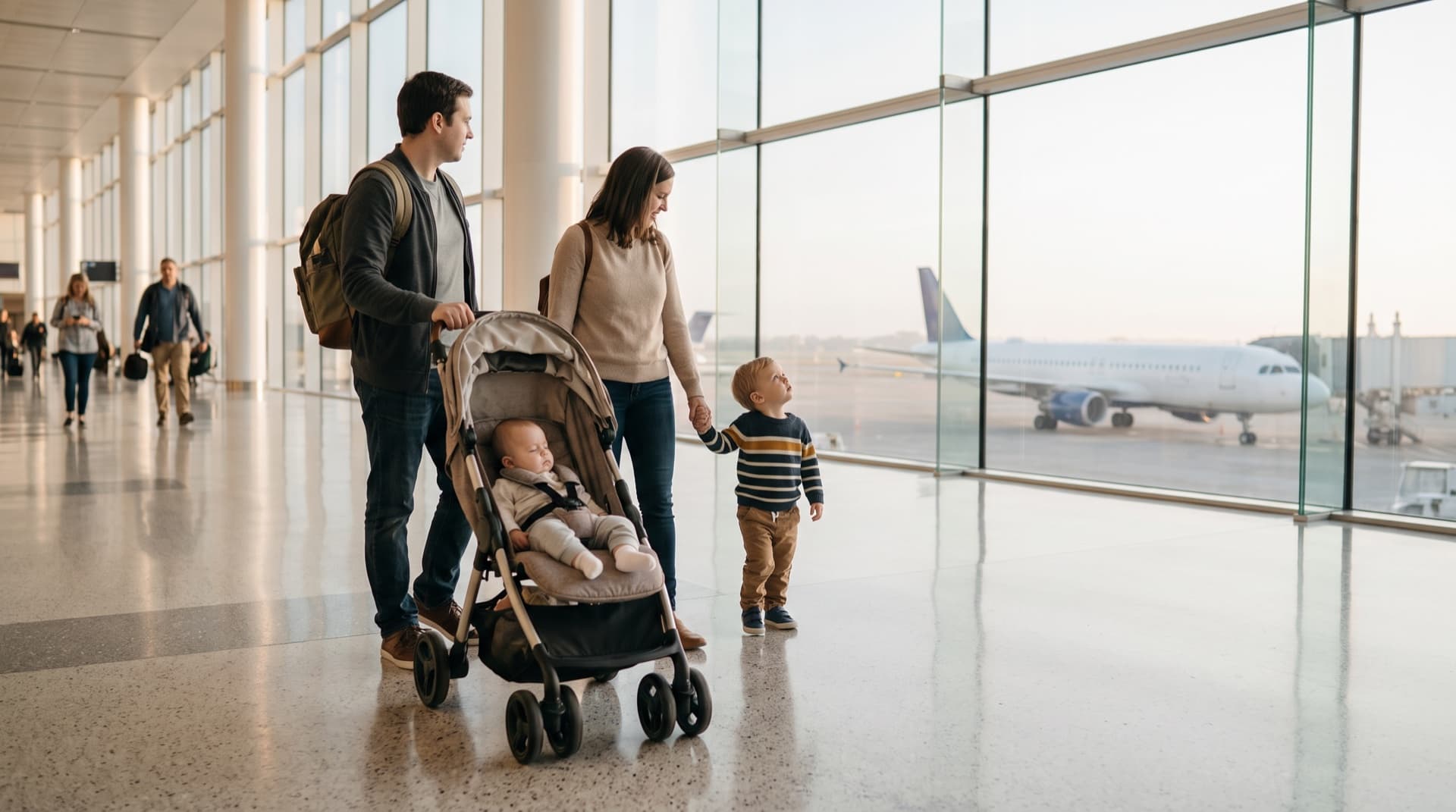
At TSA security, you should expect to take your child out of the stroller and fold the stroller so it can be screened. Most strollers go through the X-ray if they fit; if yours is too large, TSA will inspect it by hand and may test it for trace amounts of explosives (this can include a quick swab). Before you reach the belt, be ready to remove any bags, toys, blankets, and loose items so nothing falls out and everything can be screened separately. If your stroller has attachments (like a snack tray, parent console, or travel system seat), they may need to be removed and placed in a bin or sent through the X-ray separately. Keep in mind that gate-check tags and airline handling happen later at the gate—at security, the focus is simply folding and screening the stroller safely and completely.
TSA allows infant formula, breast milk, toddler drinks, and baby food in amounts greater than 3.4 oz (100 mL) in carry-on bags when traveling with your child. These items are considered medically necessary liquids, so they do not have to fit in a quart-sized bag. At the checkpoint, tell the officer you are carrying these items, and be prepared for them to be screened separately using methods like X-ray, additional testing of the container, or visual inspection. You can carry these items with ice packs, freezer packs, gel packs, and other accessories needed to keep them cool, and those cooling items are allowed even if partially melted. To help screening go smoothly, keep formula and milk easy to reach and, if you prefer, bring them in clearly sealed containers or manufacturer packaging.
Some airports provide family security lanes designed to make screening easier for travelers with young children, but they are not available at every airport or every checkpoint. If a family lane is open, follow the signs or ask an officer where to enter, and expect the same TSA screening rules as other lanes. You will still place allowed items on the X-ray belt, and strollers and baby carriers typically go through screening as well, which may mean folding the stroller and removing your child. Tell the officer if you are traveling with infant formula, breast milk, toddler drinks, baby food, or ice packs, since these are allowed in reasonable quantities and may need extra screening. Family lanes often move more calmly, but setup can take time, so have bags organized and keep small items contained for easier screening.
In standard TSA screening, children 12 and under can keep their shoes on while going through the checkpoint. Adults and older children are usually asked to remove shoes unless they are in TSA PreCheck, where shoes can generally stay on. Even when kids keep shoes on, TSA may still do additional screening if something alarms (for example, bulky footwear). If your child is wearing high-top shoes, boots, or shoes with lots of metal, be ready in case the officer asks for a quick shoe check. In practice, you’ll typically just walk your child through the metal detector with shoes on and follow the officer’s directions at the checkpoint.

Miami International Airport (MIA) is a very busy, large airport, but it is not especially known for having multiple, highly publicized dedicated kids’ play zones in the way some family-focused hubs are. Families should plan for the possibility that play options may be limited, small, or located only in certain concourses, and that availability can change with renovations. When play spaces do exist at major airports like MIA, they are most commonly found airside (past security), because that’s where families spend the longest waiting for departures and connections.
Any children’s play space you find at MIA is most likely to be inside the terminal after security, near clusters of gates, food seating areas, or wider corridor “nodes” where there is room for families to stop without blocking foot traffic. Landside (before security), space is typically focused on check-in lines and baggage areas, so kid-specific play areas are less common there.
If you do come across a play area at a major airport, it’s usually designed for quick, safe movement in a small footprint. Typical features families might see include:
Because airports must keep walkways and emergency routes clear, these areas are usually compact rather than playground-sized, and they’re meant for short bursts of play while staying close to your gate.
Most airport play installations are geared toward toddlers through early elementary ages. Equipment is generally low to the ground and designed for independent play with adult supervision nearby.
If you can’t find a dedicated play zone at MIA, you can still create a calmer break. In busy terminals, overstimulation is common—bright lighting, announcements, and crowds. Look for:
Even without a formal “quiet room,” many families find that choosing a calmer spot and doing a low-energy activity (books, stickers, small toys) works better than trying to keep kids settled in a crowded boarding area.
MIA is better known for being a major international gateway than for headline children’s attractions. Unlike airports that advertise big themed play zones, MIA’s family experience is typically built around finding the most convenient space near your gate and using general terminal amenities. If you do spot child-friendly installations, treat them as a helpful bonus rather than something to plan your entire layover around.
1
La Carreta at Miami International Airport is a well-known Miami-area Cuban restaurant brand, popular with locals for hearty, classic Cuban comfort food served in a casual, diner-like setting. For families, it’s an easy win: the atmosphere is lively and forgiving, seating is straightforward for groups, and kids’ menu availability may vary by the airport location, but the core menu has plenty of simple, shareable options that work for picky eaters. Parents often gravitate to Lechón Asado and other Cuban staples, while kids tend to like milder choices such as rice-and-beans plates, fried snacks like empanadas or croquetas, and sweet café con leche and pastries for a treat. Service is typically counter-order or fast-casual depending on the concourse setup, with food coming out quickly and portions that are usually generous enough to split. Expect a mid-range airport check: about $15–$25 per adult (more with drinks), which can feel like solid value for families when you share sides and larger plates. The brand has local significance in South Florida as a longtime go-to for traditional Cuban flavors at all hours, and its MIA outpost brings that familiar Miami taste into the terminal.
2
At Miami International Airport, Coral Cafe is a casual, grab-and-go style cafe geared toward travelers who want familiar, straightforward food without a long wait. It’s a practical stop for families because the setup is quick and informal, making it easier with strollers and wiggly kids, though seating and noise levels will feel like typical airport dining rather than a cozy restaurant. You’ll generally find kid-friendly basics like pastries, sandwiches, and simple breakfast items, which work well when you need something most children will actually eat. For parents, the appeal is convenience and a reliable caffeine stop, with coffee and baked goods being the most common comfort picks on the run. Service is counter-order with food coming out fast, portions are modest, and it’s best approached as a snack or light meal rather than a full sit-down experience. Expect about $10–$20 per person depending on whether you’re grabbing just drinks and pastries or adding sandwiches, and value is mostly about speed and simplicity. While Coral Cafe isn’t widely known as a major national chain with a big public backstory, at MIA it functions as a dependable airport cafe option when families need something easy and familiar.
3
The Cafeteria offers a relaxed, self-service dining experience with a wide variety of familiar comfort foods, making it an especially practical choice for families. The atmosphere is casual and bustling, with an easygoing vibe where kids can move through the line and pick what they like, which often makes meals smoother for parents. For ordering, families typically gravitate toward classic hot plates, pasta, roasted meats, or simple sides, along with desserts that feel like a treat. One of the biggest advantages is the flexibility—there are plenty of kid-friendly options, so even picky eaters can find something they enjoy. Service is cafeteria-style, meaning you select items as you go and get your food quickly, which is ideal when time or patience is limited. Portions can vary depending on selections, but it’s easy to mix and match or share dishes. Budget-wise, expect around $10–$20 per adult, making it one of the more affordable and convenient options. Overall, The Cafeteria delivers a straightforward, family-friendly experience with lots of choice and minimal wait time.
4
Chili’s at Miami International Airport is the familiar, family-friendly American grill and bar known for crowd-pleasing Tex-Mex-leaning comfort food, generous portions, and a casual “everyone can find something” menu. For parents, it’s an easy win because the dining room vibe is upbeat and forgiving of kid energy, and you can typically count on a kids’ menu plus kid-friendly seating like high chairs (availability can vary at busy airport times). Most families gravitate to the brand’s staples—Baby Back Ribs, burgers, chicken tenders, and quesadillas—while adults often appreciate hearty combo-style plates and shareable starters that make it simple to feed a group. Service is full-service sit-down, but paced for travelers, with food that tends to come out without a long wait compared with many independent airport restaurants. Expect mid-range airport pricing—roughly $15–$30 per adult (kids less), and it usually feels like solid value when you’re hungry and want a reliable, filling meal before a flight. Chili’s is a long-running U.S. chain that started in Texas in the 1970s and has built its reputation on approachable, casual dining that translates well to airports when you want something predictable. Overall, it’s best for families looking for comfort-food familiarity, quick-to-understand options for picky eaters, and portions that can be shared when you’re juggling boarding time and appetites.
Where are the nursing rooms or breastfeeding pods at Miami International Airport (MIA)?
Miami International Airport has a dedicated Nursing Suite in Concourse E (Central Terminal). Additional lactation rooms may be available in other concourses, but locations and access can change, so it’s best to confirm on airport maps or with an information desk once you arrive. These spaces are intended for breastfeeding and pumping and provide privacy away from the terminal.
Can I bring formula, breast milk, and a cooler through TSA security at MIA?
Yes. TSA allows formula, breast milk, and juice for infants and toddlers in quantities greater than 3.4 oz, and they do not have to fit in a quart-size bag. You can bring these items through security at MIA, including ice packs, freezer packs, gel packs, and other accessories needed to keep them cool. Tell the TSA officer you’re carrying these items before screening; they may be subject to additional inspection.
Are there any kids’ play areas at Miami International Airport (MIA) to burn off energy before a flight?
Miami International Airport does not have widely advertised, dedicated children’s play areas like indoor playgrounds. Families typically use open gate areas and seating zones to let kids stretch and move while staying close to the boarding area. Availability varies by concourse and gate layout.
What is the stroller policy at MIA—can I take a stroller through security and gate-check it?
You can bring a stroller through TSA security at MIA, and it will need to be screened (often by X-ray if it fits, or by manual inspection if it doesn’t). Most airlines allow you to use a stroller in the terminal and then gate-check it at the gate, with the stroller returned either at the jet bridge after landing or at baggage claim depending on the flight and airline. Policies can vary slightly by airline and aircraft, so follow the carrier’s instructions at the gate.
Does Miami International Airport (MIA) have family security lanes or a family check-in line for parents traveling with kids?
Miami International Airport may offer dedicated family/security assistance at certain times, but there is not a consistently available, airport-wide “family security lane” guaranteed in every checkpoint. TSA screening lanes and staffing can vary by terminal and time of day, and officers may direct families to the most appropriate lane on arrival. Family check-in lines, if available, are typically airline-specific rather than provided by the airport.