/family-airport-guide
Family travel guide to MSP — nursing rooms in Terminal 1 and Terminal 2, kids' play areas, baby changing stations, and dining with children's menus at Minneapolis Airport.
Reviewed by:

D. Goren
Head of Content
Updated March, 30
Because airline child policies change — and parents shouldn’t have to hunt for answers.
Minneapolis-Saint Paul International Airport (MSP) is a Delta Air Lines hub and one of the primary airports serving the Upper Midwest. With two terminals connected by a tram, MSP is known for being clean, well-organized, and consistently ranked among the more pleasant airports in the country — attributes that translate well for family travelers.
MSP has a strong reputation among frequent travelers, and families are part of the reason why. The airport features dedicated nursing suites, baby changing stations in both terminals, and family restrooms that provide extra space for parents. Kids' play areas give younger travelers somewhere to move between flights, and the dining options throughout the airport — particularly in the Lindbergh Terminal — cover a wide range of preferences, including solid choices for children.
Below, find a complete overview of every family-focused amenity at MSP — organized to help you get where you need to go as efficiently as possible.
Minneapolis-Saint Paul International Airport (MSP) offers options for breastfeeding and pumping in quieter, more private areas. In most airports like MSP, you’ll find designated nursing/pumping rooms inside the secure area (airside) so you can use them without leaving your gate area and re-clearing security. You may also find similar spaces before security (landside), which can be helpful if you’re meeting family, arriving early, or waiting on checked baggage.
These rooms are intended to provide privacy and a calm break from the terminal. While layouts vary by terminal and concourse, typical features include:
Baby changing stations are widely available at MSP in restrooms throughout the terminals. They are most commonly found in family/unisex restrooms as well as in many men’s and women’s restrooms. For parents traveling as a team or solo with more than one child, family restrooms can be especially helpful because they typically offer more space for a stroller and carry-on bags.
What parents can generally expect:
In addition to basic changing tables in restrooms, large U.S. airports like MSP often provide baby care rooms or family care spaces that go a step further than a standard restroom setup. When available, these areas are designed for quick, practical baby needs in a more comfortable setting.
Typical amenities you may find in a baby care room or family care space include:
At MSP, as at most airports, dedicated bottle-warming machines are not guaranteed in the terminal. However, you can generally plan for these realistic options:
Formula preparation is easiest when you have access to a sink and a flat surface, which is why a baby care room (when available) or a family restroom is usually more comfortable than a standard restroom stall.
Many MSP terminal restaurants and food courts typically offer high chairs, especially in larger sit-down locations. Availability can vary by time of day and how busy the terminal is, so it helps to choose eateries with more seating space when traveling with a toddler. In compact grab-and-go spots, high chairs may be limited or not offered.
MSP is a major hub airport, and families generally benefit from a wide spread of restrooms across concourses and a strong mix of dining options, which usually makes it easier to find changing stations and places to sit with a child without walking too far. Nursing and baby care facilities, when provided in a terminal, are typically located inside security to support connecting families, with additional restroom-based changing options available throughout the airport.
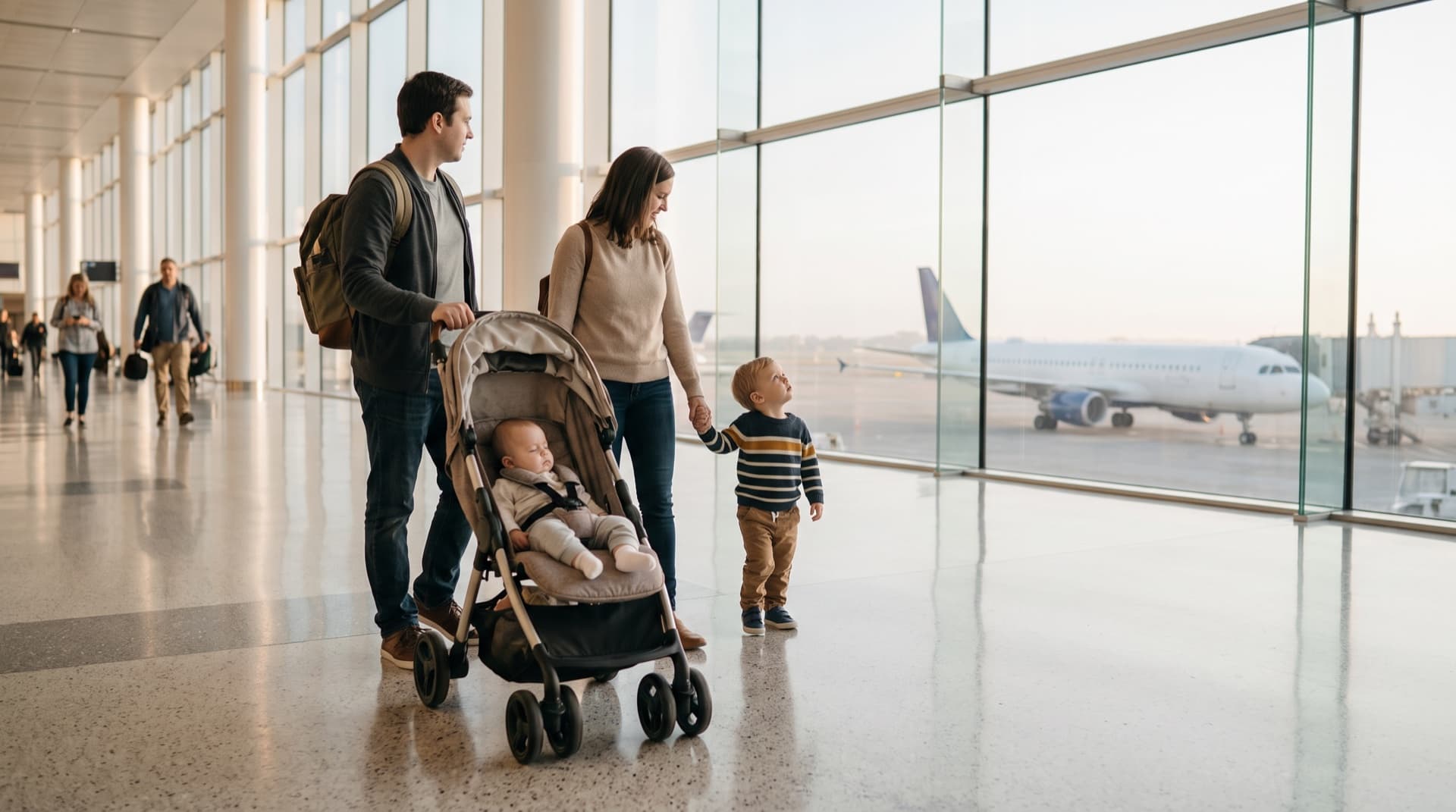
You can bring a stroller through the airport to help your child get to the gate, but at the TSA checkpoint the stroller must go through screening. Most strollers are placed on the X-ray belt if they fit; if they do not fit, TSA will inspect it by hand and may do a brief swab test for explosives residue. Be ready to take your child out and remove any bags, blankets, toys, or accessories attached to the stroller so it can be screened properly. If your stroller has a one-hand or quick-fold feature, use it to help keep the line moving and make screening easier.
When you travel with a baby or toddler, baby formula, breast milk, toddler drinks, and baby food are allowed in carry-on bags in quantities greater than 3.4 oz (100 mL) because they are considered medically necessary. You should tell the TSA officer you are carrying these items before screening, and remove them from your bag for inspection if asked. These liquids may be screened by X-ray or additional checks, and officers may ask you to open containers or perform extra testing; you can request alternative screening, but some testing may still require opening. Ice packs, gel packs, and freezer packs are allowed in your carry-on to keep these items cold, even if partially melted, as long as they’re used to cool baby-related liquids or food. Keeping items in clearly labeled containers and grouping them together makes inspection quicker and helps avoid delays.
Some airports offer dedicated family lanes at TSA screening to help travelers with young children move through security with a little more space and time. These lanes are not available at every airport or checkpoint, and they may be open only during certain hours depending on staffing and passenger volume. If a family lane is available, you can expect the same TSA screening rules as any other lane, but often with a calmer pace and staff used to strollers, car seats, and diaper bags. You may still need to remove items like laptops and liquids (unless you’re in TSA PreCheck), and you’ll be asked to send strollers and child gear through the X-ray or for additional screening as needed.
At TSA security, children 12 and under may keep their shoes, light jackets, and headwear on during screening in standard lanes. Parents and accompanying adults generally must remove shoes unless they are in TSA PreCheck (if eligible). Even when kids can keep shoes on, TSA may still do additional screening, such as a quick visual check or hand swab, depending on the alarms or the officer’s instructions. To make things smoother, choose simple, easy-on shoes and avoid footwear with lots of metal or bulky parts that can trigger alarms. If an officer asks for shoes to come off for a specific check, follow their directions and keep your child close while items go onto the X-ray belt.

Minneapolis–Saint Paul International Airport (MSP) is family-friendly, and parents will generally find that kids’ areas are located inside the terminals after security (airside), where families spend most of their time waiting to board. At many large U.S. airports like MSP, children’s play spaces are typically placed near clusters of departure gates and seating so adults can supervise while staying close to their flight.
Because exact locations can change with renovations or seasonal operations, the most reliable approach is to look for “play area” or “family” signage once you’re past security, or ask an airport staff member at an information desk.
Airport play areas are designed for short, high-energy breaks rather than long play sessions. At MSP, you can expect the style and equipment common to major airports, which may include:
These spaces are usually open to the terminal area (not fully enclosed), so you can keep eyes on a child while also tracking boarding announcements.
Most airport play zones are geared toward toddlers through early elementary kids—typically ages about 2 to 8. The equipment is usually sized to be approachable for smaller bodies and short attention spans. Older kids may still enjoy a quick stop, but they often prefer walking around, window-watching aircraft, or a snack break.
If you’re traveling with a baby, you may find that these spaces are better for older siblings while you keep the baby in a stroller or carrier nearby.
Not every child wants an active play space—especially during early mornings, after a long car ride, or when the terminal is busy. While dedicated “quiet rooms” vary by airport and may not be labeled specifically for children, families at MSP can usually create a calmer break by aiming for:
If your child becomes overwhelmed, stepping into a less crowded seating area and lowering stimulation (snack, water, a familiar show with headphones at low volume, or a comfort item) often works better than pushing through a loud play zone.
At MSP, as in many major airports, the play options parents most commonly use are airside (past security). This is helpful because you can let kids burn energy without worrying about re-clearing security afterward. Landside (before security), space is often more focused on ticketing, baggage, and quick circulation, so play areas there are less common.
If you have a long wait before security, consider using landside time for a snack, diaper change, and stroller walk, then rely on airside areas for the active play break once you’re committed to your gate area.
MSP is best known for being a well-run, comfortable airport rather than for one single headline children’s attraction. That said, families often appreciate airports like MSP for the practical “little things” that make traveling with kids easier—such as family restrooms, good seating, and concourses where you can take a stroller-friendly walk. Even without a giant signature playground feature, a reliable play zone plus room to move can make a big difference during a delay or layover.
1
Ike’s Food & Cocktails at Minneapolis–Saint Paul International Airport is an easygoing American bar-and-grill style spot with a full cocktail program, designed for travelers who want a sit-down meal that feels a bit like a neighborhood restaurant rather than just “airport food.” It’s a solid choice for families because the dining room is typically lively enough that little-kid chatter won’t feel out of place, and you can usually get straightforward options plus kids’ menu-style picks that are familiar to picky eaters. Parents often gravitate to hearty comfort fare like burgers and other grill staples, while kids tend to do well with simple, recognizable plates and sides. Service is table-service and paced like a casual restaurant, so it’s best when you have a little time before boarding; portions are generally filling, which can make sharing workable for younger children. Expect about $15–$30 per adult (less for kids), with prices reflecting airport markups but still delivering decent value if you want a real meal and a break from the concourse. Overall, it’s a practical “everyone can find something” stop when you want comfort food for the kids and a drink or more substantial entrée for the grown-ups.
2
French Meadow Bakery & Café at MSP brings the Twin Cities’ well-known, organic-minded bakery-café vibe into the airport, with a menu centered on wholesome breakfasts, sandwiches, soups, salads, and plenty of pastries. The brand has a long-standing Minnesota following for its bakery roots and health-forward approach, and the airport outpost keeps that same grab-and-go-friendly feel with counter service. For families, it’s an easy fit thanks to an informal atmosphere and quick ordering, and it’s a practical stop if you need something reliably kid-acceptable without a long wait; ask about a kids’ menu and kid-friendly sides when available. Parents often gravitate toward the hearty breakfast plates and bakery items, while kids tend to happily settle for a fresh-baked muffin or other pastry paired with milk or juice. The experience is fast-paced and casual—order, find a table, and dig in—so it works well for tight connections and wiggly little travelers, with portions that generally land in the satisfying, lunchbox-plus range. Expect about $12–$20 per adult (less if you’re doing coffee-and-pastry, more for a full meal), which can feel like fair value in an airport for organic-leaning food and a family-friendly bakery selection.
3
Stone Arch Brewery offers a relaxed, rustic brewpub experience centered around classic comfort food and house-crafted beers, with a welcoming atmosphere that works well for families. The setting is casual and lively without feeling overwhelming, making it easy for parents and kids to settle in—there’s usually plenty of space, and the overall vibe is friendly and unpretentious. On the menu, families often gravitate toward burgers, sandwiches, and hearty plates like mac and cheese or flatbreads, along with shareable starters such as pretzels or fries that pair well with the brewery’s offerings. There are typically kid-friendly options available, and staff are generally accommodating with simple substitutions or smaller portions. Service is full-service but relaxed, with a steady pace that lets you enjoy the meal without feeling rushed. Portions are generous, making it easy to share or take leftovers. Budget-wise, expect around $14–$28 per adult (more with drinks), offering solid value for the portion sizes and casual setting. Overall, Stone Arch Brewery delivers a comfortable, family-friendly dining experience with familiar flavors and a laid-back atmosphere that appeals to a wide range of tastes.
4
Chili’s at Minneapolis–Saint Paul International Airport (MSP) is the airport-sized version of the familiar casual-dining chain known for Tex-Mex–leaning American comfort food, a lively bar-and-grill vibe, and reliably crowd-pleasing portions. For families, it’s an easy fit: the room is typically upbeat and a bit noisy (in a good, kid-forgiving way), and there’s a kids’ menu at most locations with simple, recognizable choices; staff are generally used to accommodating little ones, and high chairs are commonly available. Parents and kids alike tend to gravitate to Chili’s standbys like Chicken Crispers, burgers, and quesadillas, which travel well from kitchen to table even in a busy terminal setting. Service is full-service sit-down, but the pace can feel brisk compared with a neighborhood Chili’s—helpful when you’re watching boarding time—while still letting you pause for a real meal instead of grab-and-go. Portions are typically generous and shareable, which can ease sticker shock when feeding a family on the road. Expect about $15–$25 per adult (often more with drinks and airport pricing), with kids’ meals usually lower, making it a solid value when you want dependable food and a comfortable place to regroup. As a long-running U.S. chain that started in Texas in the 1970s, Chili’s has built its reputation on consistency and familiar flavors—exactly what many traveling families appreciate between flights.
Where are the nursing rooms or breastfeeding pods at Minneapolis–Saint Paul International Airport (MSP)?
MSP has designated nursing mothers rooms in Terminal 1 (Lindbergh) and Terminal 2 (Humphrey). Use airport maps/signage to find the closest one, or ask an information desk for directions.
Can I bring formula or breast milk through TSA security at MSP, and do I need to declare it?
TSA allows formula, breast milk, and juice for infants/toddlers in reasonable quantities through MSP security even above the 3.4 oz limit. Declare them to the TSA officer before screening; expect possible additional screening/testing and requests to open containers.
Are there any kids’ play areas or playgrounds inside MSP airport terminals?
MSP has kid-focused play areas inside the terminals. Locations/availability can change; check terminal maps or signage after security to find the nearest play area.
What’s the stroller policy at Minneapolis–Saint Paul International Airport (MSP)—can I gate-check it or bring it through security?
You may bring a stroller through TSA at MSP; it must be screened (usually X-ray). Remove your child and any items attached that don’t fit. Airlines typically allow gate-checking or checking at the counter, subject to carrier rules; return may be at jet bridge or baggage claim.
Does MSP have a family security lane or family check-in option to make screening with kids easier?
Family-friendly screening lanes may be available depending on staffing/checkpoint setup, but aren’t guaranteed. Family-specific airline check-in counters aren’t standard, though staffed desks can assist families.