Reviewed by:

D. Goren
Head of Content
Updated March, 30
Because airline child policies change — and parents shouldn’t have to hunt for answers.
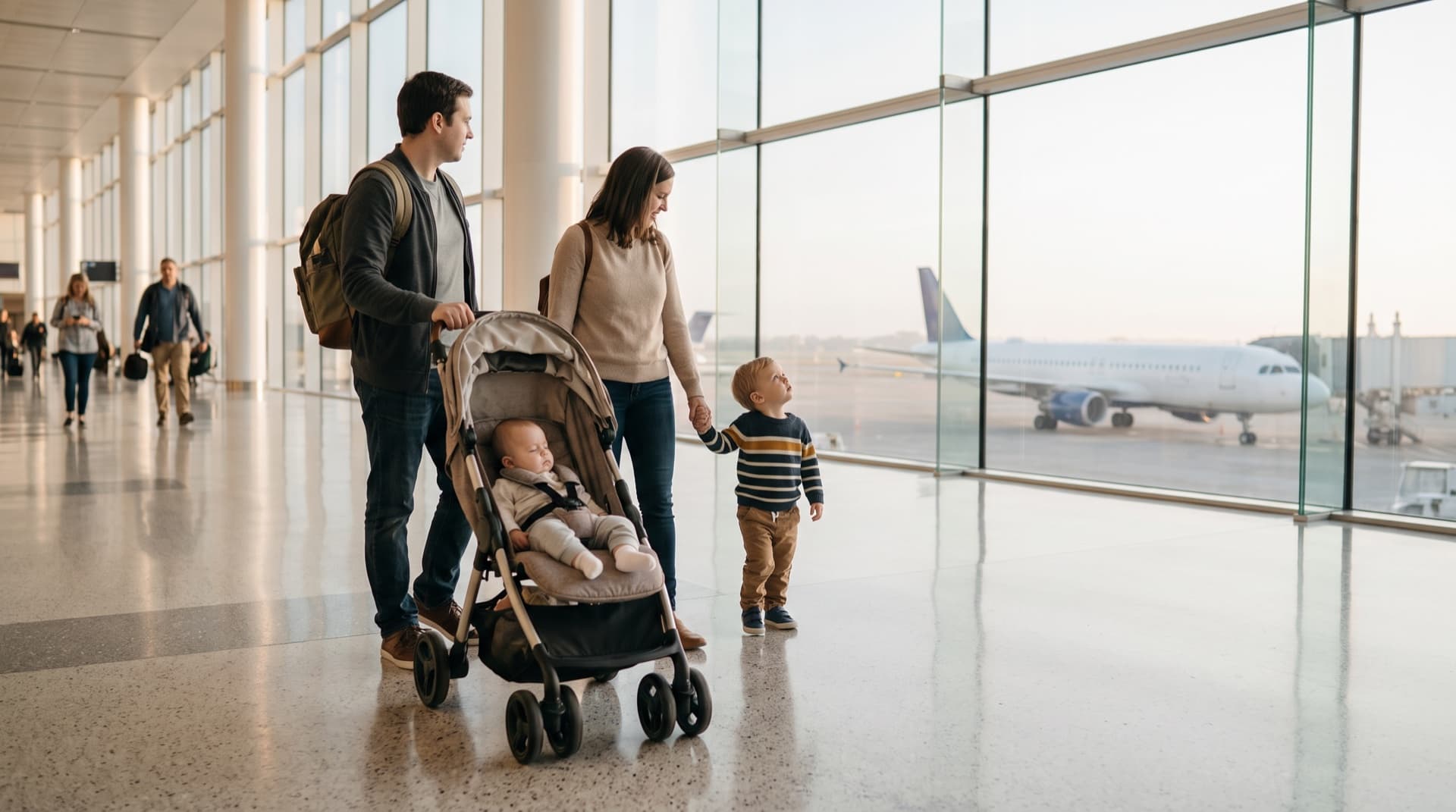
O'Hare International Airport (ORD) is one of the largest and most complex airports in North America, with four terminals and dozens of gates spread across a wide footprint. As a major hub for both domestic and international travel, it sees enormous family traffic — particularly during school holidays and summer peak season.
Navigating O'Hare with children requires a bit of planning, but the airport offers solid family infrastructure once you know where to look. Nursing rooms and family restrooms are available in multiple terminals, and the ATS (Automated Train System) connects terminals quickly — useful when you have a tight connection and a little one in tow. Several concourses also feature kids' play areas designed to help children decompress before or between flights.
Use this guide to map out your route through ORD in advance, from family-friendly security lanes to the best spots for a quick meal with children.
O’Hare International Airport is a large, busy airport and generally provides multiple options for feeding your baby comfortably. Families can typically find private lactation/nursing rooms in the terminal areas, and these are usually intended for breastfeeding or pumping in a quieter, more private space than a public seating area.
In most airports of this size, nursing rooms are most helpful when they are post-security (airside) so you can use them while waiting to board without needing to exit and re-clear security. O’Hare has had dedicated nursing/lactation spaces available in terminal areas, and you may also see family-focused rooms or wellness rooms signed for nursing use. Privacy varies by room: some are fully enclosed with a locking door, while others may be a small dedicated room with privacy features. If a dedicated room is in use, you can still breastfeed anywhere you’re permitted to sit, and airport staff can help you locate the nearest private option.
Baby changing stations are commonly found in restroom areas throughout O’Hare’s terminals. You’ll typically see them in:
Accessibility is usually good, especially in companion/family restrooms, which can provide a little more space to maneuver. For parents traveling alone, these restrooms can be especially practical when you need to keep your child close and the stroller nearby.
Many major U.S. airports offer some form of baby care center or designated lactation room setup. Where available, these spaces commonly include:
At O’Hare, you may also find family-oriented rooms and facilities in terminal areas that serve similar purposes even if they aren’t labeled as a “baby care center.” Signage and terminal maps are the most reliable way to confirm what’s available on the day you travel.
Most airports, including O’Hare, do not reliably provide public bottle warmers. A practical approach in the terminal is to use what is typically available:
When preparing formula, having a clean surface and access to water makes it easier. If you’re using ready-to-feed formula, it can reduce the need for mixing in the terminal. If you prefer warmed bottles, ask a food outlet for a cup of hot water rather than microwaving, as microwaves can heat unevenly and are not consistently available.
In a large airport like O’Hare, many sit-down restaurants and some quick-service locations typically have high chairs, though availability can vary by outlet and time of day. During peak travel periods, high chairs can be in high demand or temporarily unavailable, so it helps to ask as soon as you’re seated. Some spots may also offer booster seats instead of traditional high chairs.
O’Hare is designed to handle a high volume of travelers, and families often benefit from:
Because facilities can change with renovations and temporary closures, the most dependable approach at O’Hare is to look for on-site signage and terminal maps and to ask an information desk or airport staff member to confirm the nearest nursing room or family restroom in your specific terminal area.
At TSA security, strollers are allowed, but they must be screened by X-ray or inspected, so you will usually need to take your child out before the stroller goes through. Most strollers are folded and placed on the X-ray belt; if a stroller is too large or cannot fit, TSA will screen it by manual inspection and may use additional checks such as swabbing for explosives. Expect to remove any bags, blankets, toys, or loose items from the stroller and send them through the X-ray separately. If your stroller comes apart (for example, seat and frame), those pieces may be screened separately, so having it ready to fold helps. Keep in mind that screening requirements can vary slightly by checkpoint setup, but you should plan for the stroller to be separated from your child briefly during screening.
When you’re traveling with a baby or young child, baby formula, breast milk, toddler drinks, and baby food (including purées and pouches) are allowed in amounts larger than the usual 3.4 oz/100 mL limit because they are considered medically necessary. You can bring these items in your carry-on, and they do not need to fit in the single quart-size liquids bag. At security, remove these items from your bag and tell the TSA officer you have infant/toddler liquids; they may be screened separately using X-ray, visual inspection, and sometimes additional testing of the containers. You may bring ice packs, freezer packs, and gel packs to keep these items cold, including partially frozen packs, as long as they’re being used to cool infant or child-related liquids/food. Try to keep infant/toddler liquids and foods together in one easy-to-reach bag area so screening is quicker and less stressful.
Many airports offer family lanes or accessible (assistance) lanes at security, which may be a better fit when you’re traveling with strollers, car seats, breast milk/formula, or young children who need extra time. These lanes are usually marked with signs, but they are not available at every checkpoint, and access can depend on staffing and how the checkpoint is set up that day. If a family or accessible lane is open, you can ask a TSA officer where to enter, and they may direct you to the most appropriate line based on your situation. Expect the same security screening rules as other lanes, with a little more space and time to organize your items. Even in a family or accessible lane, you’ll still need to place bags and allowed liquids for children on the belt and follow officer instructions for screening strollers and baby gear.
At TSA security, children 12 and under usually do not need to remove their shoes during screening. Your child can typically keep shoes on while walking through the metal detector, while adults and older kids may be asked to take theirs off. TSA officers may still ask for shoes to be removed if the shoes alarm, look bulky, or need extra screening, so it helps to be ready either way. If shoes come off, expect them to be placed in a bin and sent through the X-ray machine just like other items.

O’Hare is a very large, busy hub airport, so it has plenty of family-friendly spaces—but it is not as widely known for multiple dedicated, built-in children’s play zones the way some newer airports are. At ORD, families often rely on a mix of kid-friendly public areas (open seating with space to move), family restrooms, and—when available—small play spots or interactive features inside the terminals. Because airport facilities can change over time, it helps to plan for flexible “play options” rather than counting on a single big playground.
When an airport does offer a kids’ play area, it’s most commonly located airside (past security), because that’s where families spend the most time waiting to board. Any dedicated play nook at a major airport like O’Hare is typically placed near:
Landside (before security), “play” usually looks more like roomy public seating areas where toddlers can stretch their legs under close supervision, rather than a dedicated playground.
At big U.S. airports, play areas—when present—tend to be designed for quick bursts of energy and easy cleanup. The most common types of features families may find include:
Because O’Hare is a multi-terminal airport with varied concourses, the feel of these spaces can range from a true small play zone to a kid-tolerant waiting area with room to move.
Most airport play areas are designed primarily for toddlers and preschoolers who need movement breaks and can’t comfortably sit still for long. In practical terms:
Even when a dedicated play area isn’t available—or when it’s crowded—O’Hare still has ways to help kids reset. For younger children or anyone becoming overstimulated, look for:
In general, the most calming spaces are those with less foot traffic and fewer announcements. Midday and late evening often feel quieter than early-morning rush periods.
For most families, airside play options are the most useful because once you’re through security you can relax and let kids move without worrying about re-clearing screening. Landside areas can still help if you arrive very early, but keep in mind that once your child has “burned energy,” you’ll still need to go through security and then walk to the gate—so many parents prefer to save active play for after security whenever possible.
O’Hare is better known for its public art and long connecting corridors than for headline-making children’s attractions. While it may not have a signature, airport-famous playground feature, families often find that the sheer amount of space for walking and exploring indoors can work in your favor—especially during weather that makes outdoor breaks impossible.
1
Tortas Frontera at O’Hare (ORD) is chef Rick Bayless’s fast-casual Mexican spot, widely praised in Chicago and by travelers for turning airport food into something genuinely craveable, with griddle-pressed sandwiches (tortas), tacos, and bright salsas made with serious attention to flavor. It works well for families because it’s order-at-the-counter, quick to navigate with kids, and the lively, casual setting is forgiving of little voices; while it’s not a formal sit-down place, you can usually find seating nearby and keep the meal moving on a tight connection. For a dependable crowd-pleaser, the torta is the signature—warm, crisp bread with fillings like chicken, steak, or pork—plus simple tacos and chips-and-salsa that many kids happily snack on. Parents tend to appreciate the fresher, less greasy feel compared with typical fast food, and portions are satisfying without being unwieldy for travel. There isn’t a big, formal kids’ menu in the traditional chain-restaurant sense, but the straightforward tacos, beans, rice, and quesadilla-style options make it easy to order something mild for younger eaters. Expect a fast pace and grab-and-go service, with staff focused on moving the line efficiently rather than table service. Price-wise, plan on about $12–$20 per person depending on what you order, and it’s solid value for families who want a high-quality meal in the terminal from one of Chicago’s best-known Mexican-cuisine names.
2
Billy Goat Tavern at O’Hare brings a slice of Chicago airport dining history to the terminal, serving a no-frills menu built around classic, greasy-spoon burgers and simple counter-style comfort food. The brand is best known for its iconic Chicago roots and its “cheezborger” fame, making it a fun, local-feeling stop for visitors and a nostalgic pick for Midwestern families. For kids, it’s an easy win: the atmosphere is casual and inherently a bit noisy (good for wriggly travelers), seating is straightforward, and while a dedicated kids’ menu isn’t a core part of the Billy Goat identity, the menu is simple enough to share and customize for picky eaters. The signature order is the cheezborger (often enjoyed as sliders), with crinkle-cut fries and shakes or soft drinks rounding out a classic, kid-friendly combo. Service moves at an airport pace—order, eat, and get back to your gate—portions are hearty for what it is, and the experience prioritizes speed and familiarity over ambiance. Expect about $15–$25 per person depending on what you order, which is typical for airport pricing, but many families find the value in the satisfying portions and reliably straightforward food. Billy Goat Tavern is a Chicago institution with multiple locations in the area, and its ORD outpost keeps that plainspoken, local burger-joint spirit alive for travelers passing through.
3
Wicker Park Seafood delivers a casual, coastal-inspired dining experience focused on fresh, approachable seafood favorites in a laid-back, family-friendly setting. The vibe is easygoing and welcoming, making it a comfortable stop with kids—there’s usually flexibility in seating, and the atmosphere is relaxed enough that families don’t feel out of place. On the menu, most parents and younger diners gravitate toward familiar options like fried shrimp, fish and chips, or grilled salmon, alongside shareable bites such as calamari or seafood baskets that are easy to split. While offerings can vary, there are often kid-friendly choices or simple dishes that work well for picky eaters, and staff are typically accommodating with basic requests. Service is counter or fast-casual style, so meals tend to come out quickly, which is especially helpful when dining with children. Portions are generous, and many dishes can be shared without much hassle. Budget-wise, expect roughly $15–$28 per adult, making it a solid mid-range option for seafood without feeling overly indulgent. Overall, Wicker Park Seafood strikes a nice balance between quality and convenience, offering straightforward, crowd-pleasing dishes in a relaxed environment that works well for families.
4
Chili’s at Chicago O’Hare (ORD) brings the familiar, family-friendly casual-dining vibe of the national chain known for Tex-Mex-meets-American comfort food, big flavors, and dependable crowd-pleasers. It’s an easy fit for families because the atmosphere is upbeat and forgiving of kid energy, and you can typically count on a kids’ menu with simple, recognizable options plus high chairs when available. Parents often gravitate to staples like Baby Back Ribs, burgers, fajitas, and chicken tenders, while kids tend to be happiest with classic grilled cheese or mac-and-cheese-style choices when offered. Service is sit-down and paced for a full meal rather than a quick grab-and-go, which can be a relief before a long flight, and portions are usually generous for sharing. Expect a mid-range price point of roughly $15–$25 per adult (more with appetizers and drinks), which can feel like solid value when you’re feeding hungry travelers. As a long-running U.S. chain that started in Texas and expanded widely, Chili’s is best known for delivering a consistent, no-surprises meal—exactly what many families want in a busy airport.
Does O'Hare International Airport have a nursing room airside?
O’Hare has lactation/nursing rooms in multiple terminals, generally post-security near gate areas; locations vary, so check terminal maps or ORD’s official website. For pre-security options, ask an information desk or your airline.
What are the rules for baby food at ORD security?
Baby formula, breast milk, and toddler drinks are allowed through TSA in reasonable quantities even over 3.4 oz. Declare them before screening; they may get additional screening and can be packed with ice/gel packs.
Where can kids play at O'Hare International Airport?
ORD does not consistently offer dedicated children’s play zones in every terminal; amenities can change. Check current terminal maps/amenities for your concourse on the day of travel.
Where do I pick up a stroller at ORD?
You can bring a stroller through TSA; it will be X-rayed if it fits or inspected if not. Most airlines allow gate-checking strollers, but pickup location and size rules vary—confirm with your airline.
Are there high chairs at O'Hare International Airport restaurants?
TSA generally doesn’t provide dedicated family security lanes at ORD; expect regular lanes unless directed otherwise. Any priority/special-assistance lines vary by checkpoint and airline; no universal ORD-wide family check-in line.