
Oklahoma City (OKC) Airport with Kids: Every Family Facility, Mapped
The short answer
OKC Will Rogers World Airport has one Mother's Room and one adult changing room in the Center Concourse, but publishes no confirmed children's play area and no sensory room. Its single terminal and single TSA checkpoint make it genuinely simple to navigate, even though exact facility positions live only on an interactive map the airport does not put in writing.
Every fact on this page checked against official sources on Aug 4, 2026
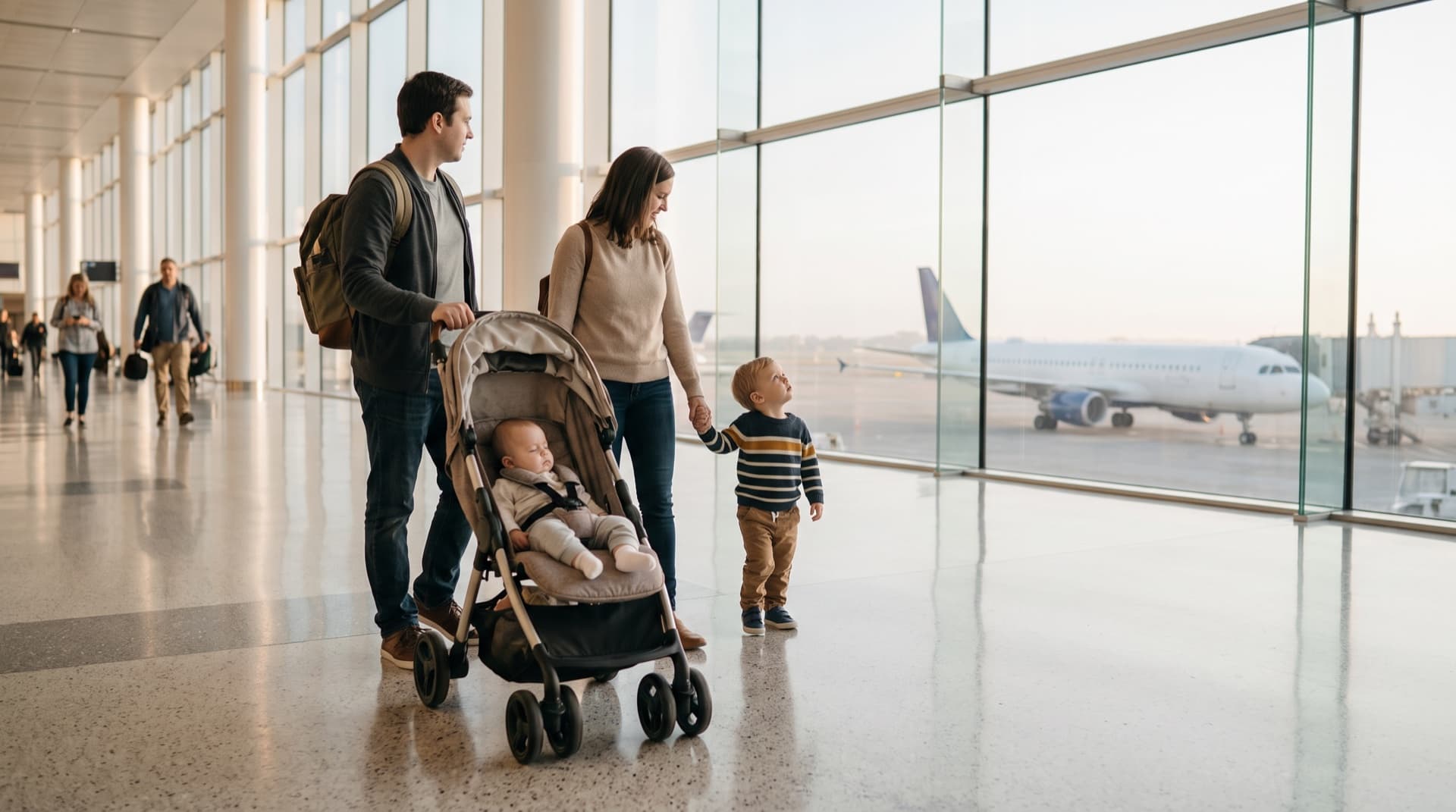
Velivolo family score
Fair
Kids' play areas
Not confirmed
No official listing found
Nursing rooms
1 Mother's Room
Location not published in text
Family restrooms
Throughout the terminal
Exact count not published
Sensory room
None
Sunflower lanyards instead
Stroller rental
Not available
Skycaps are, though
Will Rogers World Airport is a single terminal with three concourses behind one TSA checkpoint, which makes it one of the easier airports to navigate with young children — nothing to get lost in. What it documents for families is thin: one Mother's Room somewhere past security, and an adult changing room in the Center Concourse across from Hatch Early Mood Food. OKC publishes nothing confirming a play area exists, and has no sensory room, offering Hidden Disabilities Sunflower lanyards instead.
- OKC's Mother's Room location is published only as a pin on the airport's interactive map — the accessibility page gives no gate reference in text.
- OKC's one confirmed adult changing room sits in the Center Concourse, directly across from Hatch Early Mood Food, and can be entered from either the men's or women's side.
- OKC has a single TSA checkpoint on the east side of the terminal, just past the Delta ticket counter, open 4 a.m. until about 10 p.m.
- OKC publishes nothing confirming a children's play area exists anywhere in the terminal.
- Free Hidden Disabilities Sunflower lanyards are available at OKC from the volunteer information booths in baggage claim and on the ticket counter level, or from any airline agent.
Velivolo family score
Fair
Scored on published facilities, not opinion.
OKC publishes nothing confirming a children's play area — its FAQ walks concourse by concourse without naming one.
One Mother's Room and one adult changing room are real, but neither has a published location in text, only a map pin.
No family lane, but a single checkpoint means there is only ever one queue to choose.
One terminal, three concourses, one checkpoint — genuinely hard to get lost in with a stroller.
Three named restaurants in the Center Concourse, but no kids' menu or high-chair information for any of them.
No sensory room, but the Hidden Disabilities Sunflower programme and a documented adult changing room are genuine.
Facility matrix
Every Family Facility at OKC, at a Glance
Terminal, gate, which side of security, hours and cost — in one place. Where OKC publishes nothing, we say so rather than guess.
| Facility | Status | Terminals | Security side | Hours | Age limit | Cost |
|---|---|---|---|---|---|---|
Children's play area | Unconfirmed | Not published | — | — | Unknown | |
Nursing room / lactation pod 1 locations | Available | Main Terminal | Not published | — | Free | |
Family / companion care restroom | Available | Throughout the terminal | Terminal hours | — | Free | |
Baby changing table | Unconfirmed | Not published | — | — | Unknown | |
Sensory room | Not available | — | — | — | — | |
Family security lane | Not available | — | — | — | — | |
Stroller rental | Not available | — | — | — | — | |
Dedicated family lounge | Not available | — | — | — | — |
OKC publishes nothing about a children's play area. Its accessibility page and its FAQ both go concourse by concourse through restaurants, shops and services and never mention one; the claim of a West Concourse play area rests on a travel aggregator, not on the airport.
Verified Aug 4, 2026 · OKC — Frequently Asked QuestionsOKC has a Mother's Room for nursing or pumping in private, but publishes its position only as a pin on the interactive airport map, with no gate reference and no statement of which side of security it is on.
Verified Aug 4, 2026 · OKC — Accessible Travel ServicesOKC states that family restrooms are located throughout the terminal building and are all wheelchair-accessible, but gives no count and publishes the positions only on its interactive map.
Verified Aug 4, 2026 · OKC — Accessible Travel ServicesOKC describes the adult changing table in detail but publishes nothing at all about baby changing tables, in family restrooms or anywhere else.
Verified Aug 4, 2026 · OKC — Accessible Travel ServicesOKC has no sensory room. Its support for non-visible disabilities is the Hidden Disabilities Sunflower programme, with free lanyards from the volunteer information booths in baggage claim and on the ticket counter level, or from an airline agent.
Verified Aug 4, 2026 · OKC — Accessible Travel ServicesOKC has one passenger screening checkpoint and no family lane; it points travellers who need help through screening to the TSA Cares programme instead.
Verified Aug 4, 2026 · OKC — Frequently Asked QuestionsOKC rents no strollers and lists no luggage carts among its services; skycaps in the ticket lobby and baggage claim are the only carrying help it publishes.
Verified Aug 4, 2026 · OKC — Accessible Travel ServicesOKC has no family lounge; the Mother's Room is the only dedicated private space it publishes for families.
Verified Aug 4, 2026 · OKC — Accessible Travel ServicesPlay
Kids' Play Areas at OKC Will Rogers
OKC has no open play area. Here is what the airport publishes instead, and what we could not confirm.
Feeding
The Mother's Room at OKC
One published location, with the gate it sits beside — the detail that decides whether you can actually reach it.
Not published in text — OKC gives the position only on its interactive Airport Map
Main Terminal
OKC publishes no access instructions.
Changing
Family and Adult Changing Restrooms at OKC
Not published in text — locations are given only on the interactive Airport Map
Main Terminal
Post-security, across from Hatch Early Mood Food
Main Terminal
Security
Getting Through OKC Security With Kids
Family lane
OKC has a single TSA passenger screening checkpoint, on the east side of the terminal just past the Delta ticket counter, and advertises no family lane. It opens daily at 4 a.m. and closes 30 minutes after the last scheduled departure, generally around 10 p.m. OKC does run the Hidden Disabilities Sunflower programme — free lanyards from the volunteer information booths in baggage claim and on the ticket counter level, or from your airline agent at the ticket counter — and points families to TSA Cares for help through screening.
Strollers and car seats
Strollers, umbrella strollers, baby carriers, car seats and booster seats all have to go through the X-ray. Anything too large for the machine gets a visual and physical inspection instead. Take your child out and carry them through the walk-through metal detector — you cannot be screened by the body scanner while holding a child.
Formula, milk and baby food
Formula, breast milk, toddler drinks and baby food including puree pouches are allowed in quantities over 100 ml and do not have to fit inside a quart bag. Your child does not have to be travelling with you to bring breast milk. Tell the officer at the start of screening and take the items out of your bag for separate screening; ice packs, freezer packs and gel packs are allowed too.
Shoes and jackets
Children 12 and under can keep their shoes, light jackets and headwear on during screening.
TSA PreCheck with kids
Children 17 and under use the TSA PreCheck lane free alongside a parent whose boarding pass carries the PreCheck indicator, without needing their own Known Traveler Number.
OKC With a Stroller, Step by Step
- 1
Parking with a car seat
Height limits matter if you drive a van. The Blue Garage has no van-accessible spaces at all because of a 6 ft 8 in height restriction; van-accessible parking is in the Red Garage (8 ft 1 in) and in all the shuttle lots, which are served by lift-equipped wheelchair-accessible buses.
Parking shuttles do not pick up in the garages, only in the surface lots.
- 2
One checkpoint, one queue
OKC has a single TSA checkpoint, on the east side of the terminal just past the Delta ticket counter. It opens at 4 a.m. and closes about 30 minutes after the last departure.
There is no family lane, so an early-morning flight means the general queue.
- 3
At the checkpoint
The stroller goes through the X-ray and you carry your child through the metal detector. Children under 18 do not need their own ID.
Ask for private screening at any point — TSA grants it on request.
- 4
After security
The three concourses — Center, West and East — all sit past the one checkpoint. The adult changing room is in the Center Concourse opposite Hatch Early Mood Food, and the Mother's Room is marked on the interactive airport map.
The indoor pet relief area is also airside, next to Vino Volo in the East Concourse.
- 5
At the gate
OKC publishes no gate-check policy of its own; whether you gate-check or check the stroller at the counter is set by your airline.
OKC rents no strollers. Skycaps are available inside the ticket lobby for all airlines and in baggage claim, where they will collect your luggage from the carousel and carry it kerbside — which is the closest thing OKC offers to hands-free help.
OKC publishes no gate-check policy — this is set by each airline.
Transfers
Getting Around OKC With Children
Walking (single terminal)
The Rental Car Facility is a few minutes from the terminal by solid-blue shuttle bus, boarding at the east end of the Ground Transportation Plaza; all those buses are wheelchair accessible with kneel-down capability. Parking shuttles are lift-equipped but cannot serve the garages because of height limits. Language interpretation by phone or video is available at the ticketing counters through Language Services Associates.
Layover playbook
What to Do on an OKC Layover With Kids
What to actually do, by how long you have.
One checkpoint, one queue — plan around that simplicity
- 1Clear the single TSA checkpoint on the east side of the terminal, just past the Delta counter.
- 2Check the interactive Airport Map for the Mother's Room location before you land airside, since OKC gives no gate reference in text.
- 3Grab a bite at Freddy's or Tropical Smoothie in the Center Concourse before heading to your gate.
Use the adult changing room and bring your own entertainment
- 1If travelling with someone who needs an adult changing table, it's in the Center Concourse across from Hatch Early Mood Food.
- 2There's no confirmed play area at OKC, so plan on quiet activities of your own for younger kids.
- 3Ask at the baggage-claim or ticket-counter information booths for a free Hidden Disabilities Sunflower lanyard if it would help.
OKC publishes little for an overnight wait
- 1OKC does not publish overnight hours for the Mother's Room or the adult changing room.
- 2There's no lounge, play area or sensory room to retreat to for the night.
- 3Confirm your airline's own overnight policies before planning to wait it out at the gate with young children.
Know your rights
What OKC Owes Your Family by Law
Lactation rooms
Will Rogers World Airport is not confirmed as a medium or large hub under the FAM Act's traffic thresholds, so the federal lactation-room mandate is not confirmed to apply here the way it does at bigger airports. OKC nonetheless runs its own Mother's Room, whose exact location and fittings the airport does not publish beyond a map pin.
Changing tables
The FAM Act's changing-table requirement is written for medium and large hub airports, so it is not confirmed to apply at OKC. The airport documents one adult changing room in the Center Concourse on its own initiative, but publishes nothing about baby changing tables anywhere else.
Milk and formula
TSA's national rule applies everywhere, including OKC: formula, breast milk, toddler drinks and baby food over 100 ml are allowed and do not need to fit in the quart bag, and your child does not have to be travelling with you. Declare the items at the start of screening and take them out of your bag for separate inspection.
Boarding
Priority boarding for families is set by your airline, not by OKC — check your carrier's policy before you fly.
If the facility is not there
OKC publishes no dedicated contact for family-facility questions in text; the airport routes location questions to its interactive Airport Map. Skycaps are available in the ticket lobby and baggage claim for carrying help.
Verified Aug 4, 2026 · TSA — Traveling with ChildrenQuestions
OKC With Kids: Common Questions
Does OKC Will Rogers Airport have a kids' play area?
We could not confirm one. No page on flyokc.com mentions a children's play area — not the accessibility page, not the frequently asked questions page, which walks concourse by concourse through restaurants, shops and services without naming one, and not the general at-the-airport or services pages. A claim circulating on third-party travel aggregator sites that OKC has a West Concourse play area could not be verified against any official airport source, so it is not carried forward here as fact. If a play area is important for your layover, the honest answer is to plan around bringing your own activities for younger children rather than expecting one at the airport, since nothing in OKC's own published materials supports its existence.
Where is the Mother's Room at OKC?
OKC has one Mother's Room, but the airport's accessibility page gives its position only as a pin on the interactive Airport Map rather than in written text — there is no gate reference, no concourse name and no statement of which side of security it sits on. What OKC does confirm is that the room exists and is described for nursing or pumping in private. The airport also publishes no opening hours, no information about a sink or power outlet, and no access instructions such as a key or code. The practical approach is to pull up the Airport Map on your phone once you land at OKC and search it directly, since the written accessibility page will not get you there on its own.
Are there adult changing tables at Oklahoma City's airport?
Yes. OKC has one confirmed Adult Changing Room, located post-security in the Center Concourse, directly across from Hatch Early Mood Food. The room sits between the men's and women's restrooms and can be entered from either side, and both doors lock. This is one of the more detailed facilities OKC publishes — the airport is specific about the cross-access design and the locking doors, which is more than it offers for most of its other family amenities. What OKC does not say is whether the changing table itself is height-adjustable or what its dimensions are. If you need this facility, use Hatch Early Mood Food as your landmark once you're through the single TSA checkpoint and into the Center Concourse.
Does OKC have family restrooms?
OKC states that all public restrooms and family restrooms are wheelchair accessible and located throughout the terminal building, which confirms family restrooms exist, but the airport gives no count and no list of specific locations — positions are published only on the interactive Airport Map rather than in text. This differs from a documented "none": OKC is affirmatively saying family restrooms exist, just not specifying where beyond the map. If you need one during a connection, pull up the Airport Map before you land airside rather than relying on gate signage alone, since the accessibility page itself will not point you to a specific concourse or gate.
Does OKC have a sensory room?
No, Will Rogers World Airport has no dedicated sensory room. What it runs instead is the Hidden Disabilities Sunflower programme, with free lanyards available from the volunteer information booths in baggage claim and on the ticket counter level, or from an airline agent directly at the ticket counter. Wearing a lanyard signals to airport staff that a traveller may need extra patience or assistance, though it is not a security fast-track. OKC also points families needing help through screening specifically to TSA Cares, the federal programme for travellers who need extra support at the checkpoint. If a calming, purpose-built sensory space matters for your child's travel, OKC does not offer one, and the Sunflower lanyard is the closest documented accommodation.
Can I rent a stroller at OKC?
No. OKC rents no strollers of any kind, and the airport lists no luggage cart rental among its services either — the accessibility page names skycaps, available in the ticket lobby for all airlines and in baggage claim, as the only carrying help OKC offers. Skycaps will collect your luggage from the carousel and carry it kerbside, which is useful but not a substitute for a stroller if you're travelling with a toddler who needs to sit through a connection. If you need a stroller inside the terminal, plan to bring your own from home and gate-check it, since OKC publishes no gate-check policy of its own — that decision rests entirely with your airline.
Does OKC have a family security lane?
No, OKC has one passenger screening checkpoint, on the east side of the terminal just past the Delta ticket counter, and advertises no dedicated family lane. The checkpoint opens daily at 4 a.m. and closes about 30 minutes after the last scheduled departure, typically around 10 p.m. For families needing extra help through screening, OKC points travellers to the TSA Cares programme rather than to any airport-specific lane. Standard TSA child rules still apply: children who appear 12 and under can keep their shoes, light jackets and headwear on, and children 17 and under can use the PreCheck lane free alongside an enrolled adult without needing their own Known Traveler Number.
What restaurants at OKC are good for kids?
OKC publishes no kids' menu or high-chair information for any of its restaurants, so nothing here is officially confirmed as child-specific. What we can tell you is what's available and where: Freddy's Frozen Custard and Steak Burgers sits in the Center Concourse and is the most predictable option for a fussy eater, offering familiar burger-and-custard fare. Tropical Smoothie Cafe, also in the Center Concourse, is useful when a toddler will drink but won't eat a full meal. Hatch Early Mood Food is worth knowing as a landmark as much as a restaurant, since OKC's one confirmed adult changing room sits directly across from it — helpful for planning your route through the concourse even if the menu itself isn't documented for families.
Is OKC easy to get through with young children?
Yes, more than the thin amenity list might suggest. Will Rogers World Airport is a single terminal with one TSA checkpoint on the east side, just past the Delta ticket counter, and three concourses — Center, West and East — all reachable on foot from that one checkpoint with no re-screening required. That structural simplicity matters more than it sounds: there's no risk of clearing the wrong checkpoint or missing a connecting shuttle between terminals, which is a genuine headache at larger, multi-terminal Southern hubs. The trade-off is that OKC is thin on documented family amenities beyond the single Mother's Room and one adult changing room, and it publishes no confirmed play area or sensory room, so the ease here comes from the airport's small size rather than from purpose-built family facilities.
Verification
Sources and Verification
Every figure on this page traces to one of these. Checked Aug 4, 2026.
- 1OKC — Accessible Travel Services
Mother's Room, adult changing room, family restrooms, checkpoint hours · 2026
- 2OKC — Frequently Asked Questions
Concourse-by-concourse dining list and play-area absence · 2026
- 3TSA — Traveling with Children
Federal screening and liquids rules as applied at OKC · 2026
- 4TSA — PreCheck for Families
Children 17 and under using the PreCheck lane with an enrolled adult · 2026
Lia Tuso
Founder & Family Travel Editor
Lia has flown with her own kids through more than 40 airports and built Velivolo so parents stop guessing what is actually waiting on the other side of security.
Stop guessing what's past security.
Gate-level family facilities for airports worldwide, checked against official sources and dated so you know how fresh they are.