
Omaha Eppley Airfield (OMA) with Kids: Every Family Facility, Mapped
The short answer
Eppley Airfield in Omaha has no children's play area and no sensory room. Its official terminal maps mark a Mother's Room on both levels and a Family Restroom before security, but publish no count, position or fittings for any of them. The airport is temporarily split into North and South Terminals for construction, each with its own checkpoint.
Every fact on this page checked against official sources on Aug 4, 2026
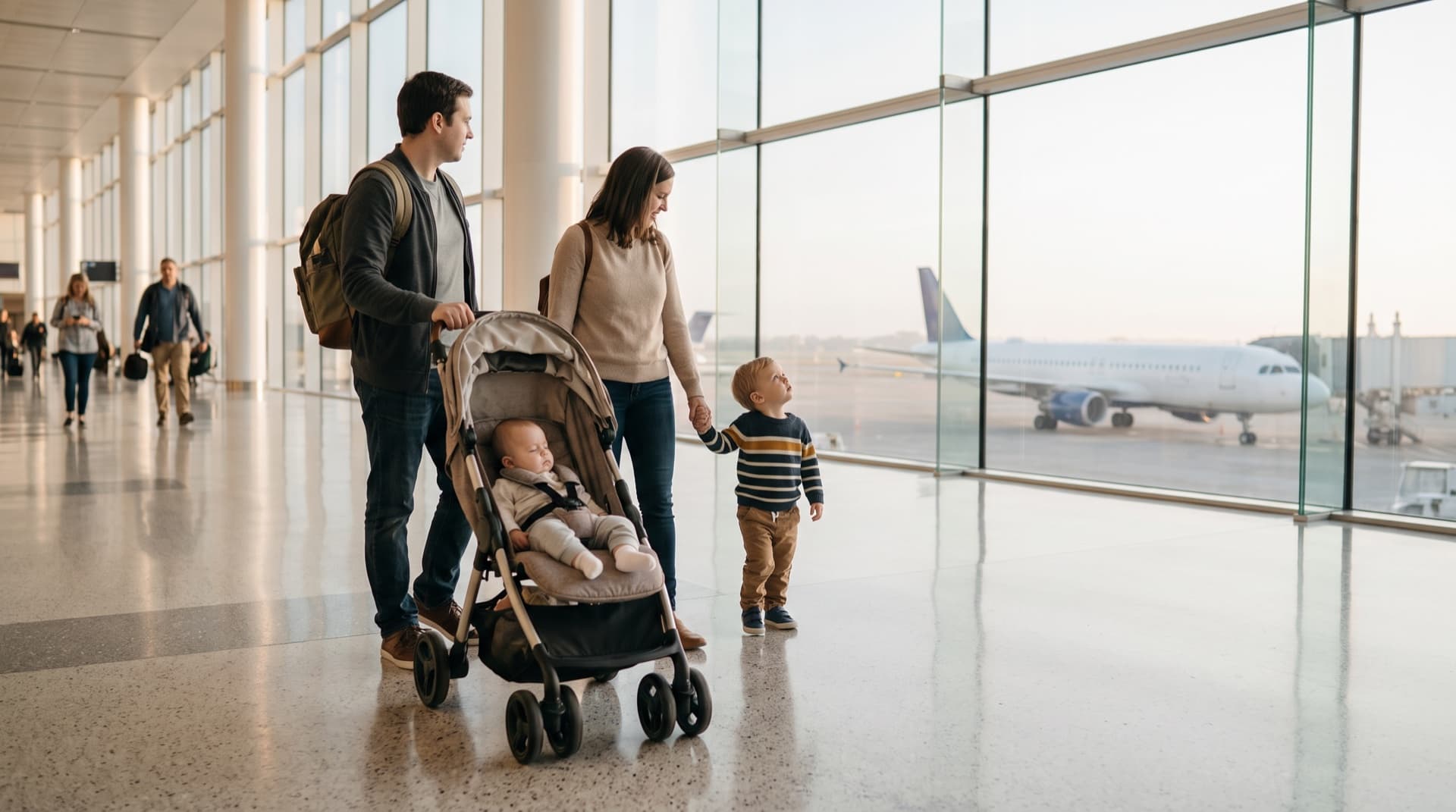
Velivolo family score
Poor
Kids' play areas
None
No play area anywhere
Nursing rooms
2 marked, uncounted
1 pre-security, 1 post
Family restrooms
1 marked, Level 1
Position not published
Sensory room
None
Sunflower lanyards available instead
Stroller rental
Not documented
Only Smarte Carte luggage carts
Eppley Airfield publishes almost nothing about its own family facilities beyond symbols on its terminal map legend. There is a Mother's Room before security and another past it in the concourses, plus a Family Restroom before security — but no counts, exact positions or descriptions for any of them. There is no children's play area and no sensory room. Construction has split the terminal into North and South buildings with separate checkpoints, so knowing your airline's terminal matters more here than at most airports.
- Eppley Airfield's Mother's Room on Level 1 sits among the ticket counters and baggage claim, before security.
- Eppley's second Mother's Room sits on Level 2, in the concourses past security, serving both the North and South Terminals.
- Eppley Airfield has no children's play area anywhere in the terminal.
- During Build OMA, Southwest and United use the North Terminal while Alaska, Allegiant, American, Delta and Frontier use the South Terminal.
- Free Hidden Disabilities Sunflower lanyards are handed out at the mobile information booths across from the North and South baggage claims at Eppley.
- Eppley's Central Terminal, between the North and South buildings, is closed while the Central Pavilion and Unified Concourse are built.
Velivolo family score
Poor
Scored on published facilities, not opinion.
Eppley Airfield has no children's play area — its terminal maps carry no play-area symbol and no page on flyoma.com mentions one.
A Mother's Room is marked on both the Level 1 and Level 2 maps, but Eppley publishes no count, exact position or description of either room.
No family lane at either of the two temporary checkpoints, and Eppley states plainly that a Sunflower lanyard does not fast-track security.
The terminal is temporarily split into North and South buildings for construction, each with its own checkpoint, and the Central Terminal between them is closed.
Only three interim outlets exist during the construction period, and Eppley publishes no kids' menu or high-chair detail for any of them.
No sensory room, but the Hidden Disabilities Sunflower programme and an autism social narrative are genuine, documented accommodations.
Facility matrix
Every Family Facility at OMA, at a Glance
Terminal, gate, which side of security, hours and cost — in one place. Where OMA publishes nothing, we say so rather than guess.
| Facility | Status | Terminals | Security side | Hours | Age limit | Cost |
|---|---|---|---|---|---|---|
Children's play area | Not available | — | — | — | — | |
Nursing room / lactation pod | Available | Level 1 and Level 2 | Both sides | Not published | — | Free |
Family / companion care restroom | Available | Level 1 | Before security | Terminal hours | — | Free |
Baby changing table | Unconfirmed | Not published | — | — | Unknown | |
Sensory room | Not available | — | — | — | — | |
Family security lane | Not available | — | — | — | — | |
Stroller rental | Unconfirmed | — | — | — | Unknown | |
Dedicated family lounge | Not available | — | — | — | — |
Eppley Airfield has no children's play area. Its official terminal maps enumerate every amenity on both levels and carry no play area symbol, and no page on flyoma.com mentions one.
Verified Aug 4, 2026 · OMA — Official terminal maps (PDF, May 2026)Eppley Airfield marks a Mother's Room on both the Level 1 and Level 2 official terminal maps, so there is one before security and one in the concourses, but the airport publishes no count, no position in words and no description of the fittings.
Verified Aug 4, 2026 · OMA — Official terminal maps (PDF, May 2026)Eppley Airfield marks a Family Restroom on the Level 1 terminal map, before security among the ticket counters and baggage claim. The symbol does not appear in the Level 2 concourse key, so a family restroom past security is not evidenced.
Verified Aug 4, 2026 · OMA — Official terminal maps (PDF, May 2026)Eppley Airfield publishes nothing about baby changing tables — not on its accessibility page, not in its FAQ, and not in the legends of its terminal maps.
Verified Aug 4, 2026 · OMA — AccessibilityEppley Airfield has no sensory room. For travellers on the autism spectrum it publishes a social narrative written with the Autism Action Partnership, and it runs the Hidden Disabilities Sunflower programme with lanyards, buttons and bracelets from the Level 1 information booths.
Verified Aug 4, 2026 · OMA — AccessibilityEppley Airfield advertises no family security lane at either of its two temporary checkpoints, and states explicitly that a Sunflower lanyard does not guarantee fast-tracking through security.
Verified Aug 4, 2026 · OMA — AccessibilityEppley Airfield publishes no stroller rental and no statement that none exists; the only wheeled help on its maps is Smarte Carte luggage carts, marked in the Level 1 legend.
Verified Aug 4, 2026 · OMA — Official terminal maps (PDF, May 2026)Eppley Airfield has no family lounge. The Mother's Rooms marked on the terminal maps are the only private spaces it publishes for families.
Verified Aug 4, 2026 · OMA — Official terminal maps (PDF, May 2026)Play
Kids' Play Areas at Omaha Airport
OMA has no open play area. Here is what the airport publishes instead, and what we could not confirm.
Feeding
The Mother's Rooms at Eppley Airfield
All 2 locations with the gate each one sits beside — the detail that decides whether you can actually reach it.
Marked in the legend of the official Level 1 terminal map; the exact position is not published in text
Eppley Airfield terminal
OMA publishes no access instructions.
Marked in the legend of the official Level 2 terminal map; the exact position is not published in text
Eppley Airfield terminal · North Concourse (B11–B20) / South Concourse (A1–A10)
OMA publishes no access instructions.
Changing
Family Restrooms at Omaha Airport
Marked in the legend of the official Level 1 terminal map; the exact position is not published in text
Eppley Airfield terminal · Level 1 — Ticketing and Baggage Claim
Security
Getting Through OMA Security With Kids
Family lane
Eppley Airfield is temporarily split into two separate terminals while the Central Pavilion and Unified Concourse are built, so there are two TSA checkpoints — one on Level 2 of the North Terminal and one on Level 2 of the South Terminal — and you must use the one that matches your airline. Neither advertises a family lane. OMA does run the Hidden Disabilities Sunflower programme: adults and children can pick up a lanyard, button or bracelet at the mobile information booths pre-security across from the North and South baggage claims on Level 1, and OMA states plainly that wearing one does not fast-track you through security.
Strollers and car seats
Strollers, umbrella strollers, baby carriers, car seats and booster seats all have to go through the X-ray. Anything too large for the machine gets a visual and physical inspection instead. Take your child out and carry them through the walk-through metal detector — you cannot be screened by the body scanner while holding a child.
Formula, milk and baby food
Formula, breast milk, toddler drinks and baby food including puree pouches are allowed in quantities over 100 ml and do not have to fit inside a quart bag. Your child does not have to be travelling with you to bring breast milk. Tell the officer at the start of screening and take the items out of your bag for separate screening; ice packs, freezer packs and gel packs are allowed too.
Shoes and jackets
Children 12 and under can keep their shoes, light jackets and headwear on during screening.
TSA PreCheck with kids
Children 17 and under use the TSA PreCheck lane free alongside a parent whose boarding pass carries the PreCheck indicator, without needing their own Known Traveler Number.
Eppley Airfield With a Stroller, Step by Step
- 1
Go to the right terminal
During Build OMA the terminal is split in two and each airline sits in one of them. Southwest and United use the North Terminal; Alaska, Allegiant, American, Delta and Frontier use the South Terminal. Going to the wrong one means a walk outside with the pushchair.
The North Garage is the recommended parking for the North Terminal, the South Garage for the South Terminal.
- 2
Kerbside during construction
Passenger pick-up and drop-off has moved to Level 1 of the South Garage. Travellers with disabilities may use that area or the front-drive lane designated for commercial vehicles; ring the Airport Communications Center on 402-661-8100 for help.
Ride app pickup and taxis are on the ground floor of the South Garage in Section D3 — four to six minutes' walk from the North Terminal.
- 3
Before the checkpoint
Level 1 is where the ticket counters and baggage claim are, and the official terminal map marks both a Family Restroom and a Mother's Room on this level. Sunflower lanyards are at the mobile information booths across from the North and South baggage claims.
OMA does not publish exactly where the Level 1 family restroom is — check the map screens or ask at the booth.
- 4
At the checkpoint
Checkpoints are on Level 2 of each terminal and typically open at 4:00 a.m. There is no family lane. The stroller goes through the X-ray and you carry your child through the metal detector.
Ask for private screening at any point — TSA grants it on request.
- 5
After security
The North Concourse holds Gates B11–B20 and the South Concourse Gates A1–A10, and the official Level 2 map marks a Mother's Room in the concourses. The Central Terminal between them is closed for construction.
Interim dining is thin: a bar and grill, an OMA Market and a Hudson News in each concourse.
- 6
At the gate
OMA publishes no gate-check policy of its own; whether you gate-check or check the stroller at the counter is set by your airline.
OMA publishes nothing about stroller rental either way. The official Level 1 terminal map does mark Smarte Carte luggage carts, but the airport does not publish a price or a location list for them.
OMA publishes no gate-check policy — this is set by each airline.
Transfers
Getting Around Omaha Airport With Children
Walking (terminal split — North and South Terminals)
Both terminals follow the same layout: ticket counters and baggage claim on Level 1, TSA checkpoint and gates on Level 2, connected to the garages by skywalks. Rental car counters are in the Customer Service Building inside the North Garage — three to five minutes' walk from the North Terminal, seven to eight from the South. Seven video relay service kiosks are spread through the terminal and concourses, TTY phones sit at five points including the Level 1 central hallway by Gate 21, and Eppley is an Aira Access Location, so blind and low-vision travellers get the service free on site. The Autism Action Partnership has written a social narrative walking a traveller through the whole airport process, published as a PDF on OMA's accessibility page.
Layover playbook
What to Do on an OMA Layover With Kids
What to actually do, by how long you have.
Confirm your terminal before you leave the house
- 1Check whether your airline uses Eppley's North Terminal (Southwest, United) or South Terminal (Alaska, Allegiant, American, Delta, Frontier) — the two are not connected airside.
- 2Clear the checkpoint on Level 2 of your terminal; neither advertises a family lane.
- 3If you need to feed or change, the Level 2 Mother's Room in the concourses is your only past-security option.
There isn't much to fill the time — bring your own
- 1There's no play area or sensory room at Eppley, so pack activities for a toddler before you arrive.
- 2Pick up a free Hidden Disabilities Sunflower lanyard at the mobile information booth across from your terminal's baggage claim if it would help.
- 3Eat at your concourse's interim bar and grill or OMA Market — Eppley publishes no kids' menu or high-chair information for either.
- 4Ask airport staff directly if you need the Level 1 Family Restroom, since Eppley doesn't publish exactly where it sits.
Eppley itself never closes, but its family facilities aren't built for a long wait
- 1Eppley Airfield operates 24 hours a day, 365 days a year, though checkpoints typically open around 4:00 a.m.
- 2Neither Mother's Room has published hours, and there's no lounge, play area or sensory room to retreat to overnight.
- 3Confirm your airline's own overnight policies before committing to wait it out at the gate with young children.
Know your rights
What OMA Owes Your Family by Law
Lactation rooms
Eppley Airfield is a small hub rather than a medium or large one, so the federal FAM Act's lactation-room mandate is not confirmed to apply here the way it does at bigger airports. Eppley nonetheless marks a Mother's Room on both the Level 1 and Level 2 terminal maps, though it publishes no count, exact position or description of the fittings inside either one.
Changing tables
The FAM Act's changing-table requirement is written for medium and large hub airports, so it is not confirmed to apply at Eppley. The airport marks one Family Restroom on its Level 1 map, before security, but does not say whether it has a baby or adult changing table, and no equivalent symbol appears in the Level 2 concourse key.
Milk and formula
TSA's national rule applies everywhere, including at Eppley: formula, breast milk, toddler drinks and baby food including puree pouches are allowed over 100 ml and do not have to fit inside a quart bag, and your child does not have to be travelling with you. Declare the items at the start of screening and take them out of your bag for separate inspection.
Boarding
Priority boarding for families is set by your airline, not by Eppley Airfield — check your carrier's policy before you fly.
If the facility is not there
Call the Airport Communications Center on 402-661-8100 for help finding a facility during the terminal split, or ask at either of the mobile information booths across from the North and South baggage claims.
Verified Aug 4, 2026 · TSA — Traveling with ChildrenQuestions
Omaha Airport With Kids: Common Questions
Does Omaha airport have a kids' play area?
No. Eppley Airfield has no children's play area anywhere in the terminal — its official terminal maps, published in May 2026, enumerate every amenity on both levels and carry no play-area symbol, and no page on flyoma.com mentions one either. This is true across both the North and South Terminals created by the current construction split. If a play area is important to your trip, plan on bringing your own toys or activities, because Eppley has nothing built into the terminal for younger children to burn off energy in. The airport's family accommodations run instead toward the Mother's Rooms and the Hidden Disabilities Sunflower programme, neither of which functions as a play space.
Where is the nursing room at Omaha airport?
Eppley Airfield marks a Mother's Room on both its Level 1 and Level 2 official terminal maps, so there is one before security among the ticket counters and baggage claim, and another past security in the concourses serving both the North and South Terminal split. Beyond that symbol on the map legend, the airport publishes nothing in writing — no exact position, no opening hours, and no description of whether the room has a sink, a power outlet, or space for a stroller. If you need to find one on arrival, check the map screens in the terminal or ask at an information booth, since Eppley gives no walking directions of its own.
Does Omaha airport have a sensory room?
No, Eppley Airfield has no sensory room. What it does offer travellers on the autism spectrum is a social narrative written with the Autism Action Partnership, published as a PDF on the airport's accessibility page, which walks through the whole airport process step by step before you travel. Eppley also runs the Hidden Disabilities Sunflower programme, with lanyards, buttons and bracelets available free from the mobile information booths across from the North and South baggage claims — though the airport is explicit that wearing one does not fast-track you through security. If your child needs more support than that, the airport's own contact for help is the Communications Center on 402-661-8100.
Are there family restrooms at Omaha airport?
Eppley Airfield marks one Family Restroom on its Level 1 terminal map, in the pre-security area among the ticket counters and baggage claim, but the airport publishes no exact position for it and no equivalent symbol appears in the Level 2 concourse key — so a family restroom past security is not evidenced. If you need one before you reach the checkpoint, check the map screens in the terminal or ask at one of the mobile information booths across from baggage claim, since Eppley gives no written directions of its own. Past security, your best documented option is the Level 2 Mother's Room, marked on the concourse map but similarly undescribed.
Does Omaha airport have a family security lane?
No. Eppley Airfield is currently split into two temporary terminals for construction, with a separate TSA checkpoint on Level 2 of each — North Terminal for Southwest and United, South Terminal for Alaska, Allegiant, American, Delta and Frontier — and neither advertises a family lane. The airport does run the Hidden Disabilities Sunflower programme, with lanyards available from the mobile information booths at each terminal's baggage claim, but Eppley states plainly that wearing one does not guarantee faster screening. Standard TSA rules for children still apply: kids 12 and under keep shoes, jackets and headwear on, and children 17 and under can join an enrolled adult's PreCheck lane for free.
Can I rent a stroller at Omaha airport?
Eppley Airfield doesn't say, in either direction. The airport neither offers stroller rental nor states that it has none, which leaves the question genuinely open rather than answered — don't assume one will be available when you land. What the official Level 1 terminal map does confirm is Smarte Carte luggage carts, though Eppley publishes no price or exact location for them. If a stroller matters to your trip, the safest plan is to bring your own and gate-check it with your airline, since Eppley also publishes no gate-check policy of its own for strollers.
Which terminal do I use at Omaha airport?
It depends on your airline, and getting it wrong during the current construction means a walk outside with a stroller. Southwest and United passengers use the North Terminal; Alaska, Allegiant, American, Delta and Frontier passengers use the South Terminal. Both follow the same basic layout — ticket counters and baggage claim on Level 1, the TSA checkpoint and gates on Level 2 — but the Central Terminal that would normally join them is closed while Eppley builds its new Central Pavilion and Unified Concourse. Passenger pick-up and drop-off has also moved to Level 1 of the South Garage during this period, so confirm your terminal and parking plan together before you arrive.
How do I get through Omaha airport security with a stroller?
Fold the stroller and put it through the X-ray at whichever checkpoint matches your terminal — Level 2 of the North or South Terminal — the same applies to umbrella strollers, carriers, car seats and booster seats, with anything too large for the machine given a visual and physical inspection instead. Take your child out and carry them through the walk-through metal detector, since you can't be screened by the body scanner while holding a child. Formula, breast milk, toddler drinks and baby food including puree pouches are allowed over 100 ml and don't have to fit in a quart bag; declare them at the start of screening. You can request private screening at any point if your child finds the process difficult.
Is Omaha airport easy to navigate with young children?
It's more complicated than usual right now because of construction. Eppley Airfield is temporarily split into North and South Terminals, each with its own ticket counters, baggage claim and checkpoint, and there's no confirmed airside link between the two — going to the wrong one during a connection likely means walking outside and re-screening. Within a single terminal the layout is simple: Level 1 for check-in and bags, Level 2 for security and gates, connected to the garages by skywalks. Once the Central Pavilion and Unified Concourse open, this should simplify significantly, but for now, confirming your airline's terminal before you leave home matters more at Eppley than it does at most airports.
Verification
Sources and Verification
Every figure on this page traces to one of these. Checked Aug 4, 2026.
- 1OMA — Official terminal maps (PDF, May 2026)
Mother's Room and Family Restroom legend symbols, terminal layout, dining · 2026
- 2OMA — Frequently Asked Questions
Checkpoint hours, Sunflower programme, security lane status · 2026
- 3OMA — Find Your Way at OMA
Terminal split, rental car counters, accessibility kiosks · 2026
- 4OMA — Accessibility
No sensory room, autism social narrative, changing table gap · 2026
Lia Tuso
Founder & Family Travel Editor
Lia has flown with her own kids through more than 40 airports and built Velivolo so parents stop guessing what is actually waiting on the other side of security.
Stop guessing what's past security.
Gate-level family facilities for airports worldwide, checked against official sources and dated so you know how fresh they are.