/family-airport-guide
Your family guide to PHX — nursing rooms in multiple terminals, baby changing stations, stroller-friendly routes, and restaurants with children's menus at Sky Harbor.
Reviewed by:

D. Goren
Head of Content
Updated March, 30
Because airline child policies change — and parents shouldn’t have to hunt for answers.
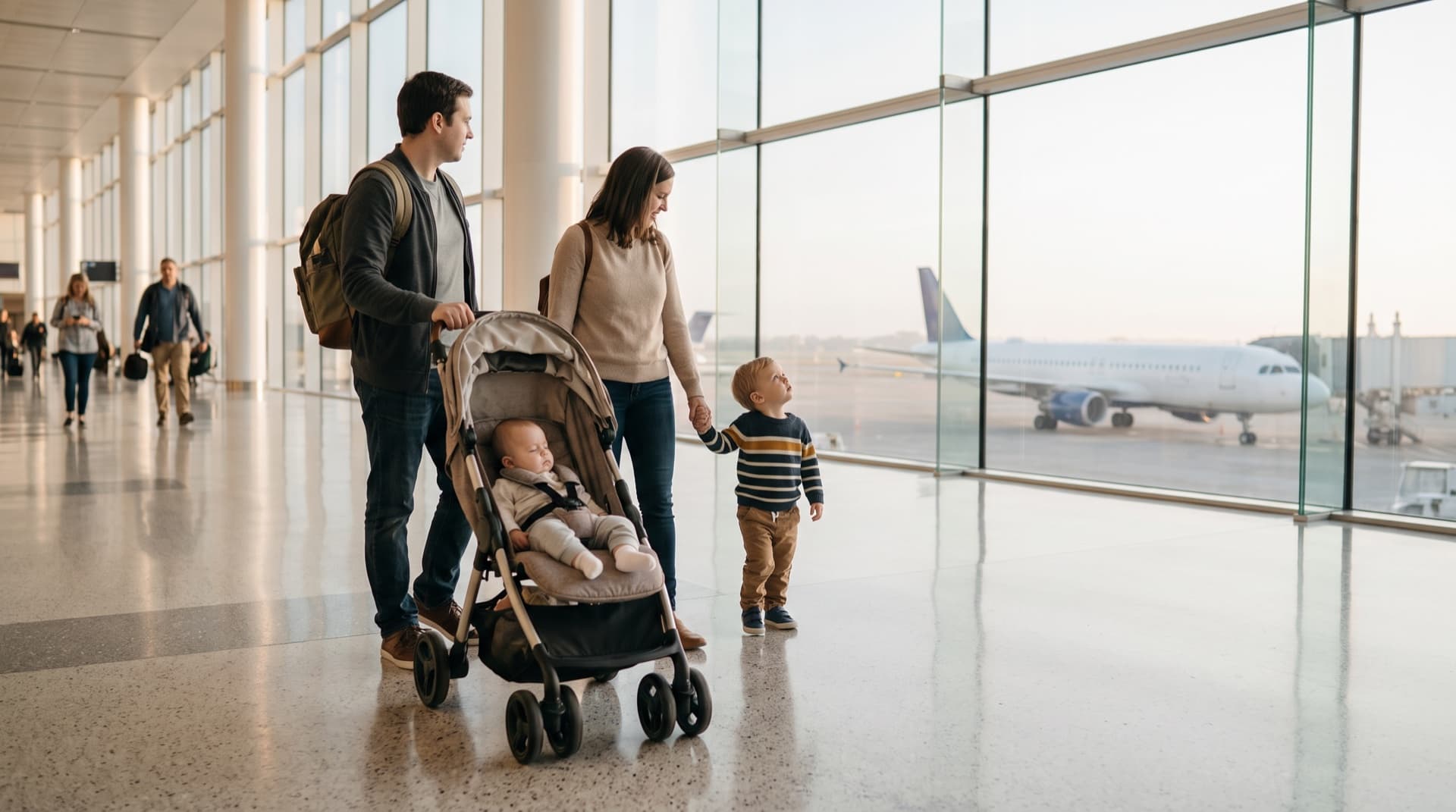
Phoenix Sky Harbor International Airport (PHX) is one of the ten busiest airports in the United States and the primary hub for Southwest Airlines in the Southwest region. With three terminals and excellent signage throughout, PHX is known for being one of the easier large airports to navigate — a real advantage when you're managing children, bags, and boarding passes at the same time.
PHX offers a well-rounded set of facilities for traveling families. Nursing suites and baby changing stations are available in all three terminals, and family restrooms are easy to find with clear signage. The airport has invested in children's play areas in select terminal areas, providing a welcome outlet for younger travelers. Dining options are plentiful across all terminals, with plenty of family-friendly choices available both pre- and post-security.
Below, we've mapped out every family-relevant resource at PHX — by terminal — so you know exactly where to go before you arrive.
Phoenix Sky Harbor International Airport (PHX) is generally family-friendly, and parents will find options for breastfeeding in a more private setting. Nursing rooms/lactation spaces are available in the terminal areas, and they are typically positioned after security (airside) so you can use them while waiting for your flight. Some airports also provide similar spaces before security (landside), but availability can vary by terminal area and may change over time.
These rooms are meant to give you privacy and a calmer environment than the main concourses. You can usually expect:
When a dedicated nursing room is busy or not nearby, family restrooms can be another practical option for more space and privacy than standard restrooms.
Baby changing stations are commonly available throughout PHX in public restrooms. They are typically found in men’s, women’s, and many family/companion restrooms, so either parent can handle diaper changes without having to search for a specific facility.
What you can generally count on:
Airports may describe baby-focused spaces in a few different ways (for example, nursing rooms, lactation rooms, or family rooms). Where PHX provides a dedicated baby care space, it is typically designed to support the basics of feeding and changing in one place. A baby care center or family room usually includes:
Because amenities and layouts can vary between terminal areas, it’s normal for one location to feel more spacious or better equipped than another.
At PHX, as in most major airports, there is not always a public, dedicated bottle-warming station in every concourse. The most reliable approach is to plan for self-service warming and mixing using what is commonly available:
For safety, avoid using very hot water directly in formula, and always test the temperature before feeding. If you use ready-to-feed formula, it can reduce the amount of mixing needed while you’re on the go.
Many sit-down and family-oriented restaurants and some food court vendors at PHX have high chairs, but availability depends on the specific location and how busy it is. During peak meal times, high chairs can be in short supply, and some smaller grab-and-go counters may not stock them.
Phoenix Sky Harbor is a large, well-developed airport, and the overall setup supports families with young children through multiple restroom clusters, family/companion restroom options, and dedicated nursing/lactation spaces in terminal areas. Since PHX is spread across multiple terminal areas and concourses, the facilities closest to you will depend on where your gate and airline are located, but you should be able to find diaper-changing and a quieter feeding option without needing to leave the secure area.
At TSA security, strollers can go through screening, but they must be checked by officers before you can take them to the gate. In most cases, you’ll be asked to remove your child, take out any bags or loose items from the stroller, and place those items on the X-ray belt. The stroller will usually go through the X-ray if it fits; if it doesn’t fit or can’t be folded, TSA will typically screen it by hand (which may include a visual inspection and a quick swab test for trace explosives). Expect TSA to ask you to fold the stroller and send it through the machine when possible, so it helps to know how your stroller locks and collapses. Keep small items like cups, toys, blankets, and snacks picked up and packed so the stroller can be screened smoothly without loose pieces falling out.
When traveling with a baby or young child, breast milk, formula, toddler drinks, and baby food (including purées and pouches) are allowed through TSA security in quantities larger than the usual 3.4 oz limit. Tell the officer at the start of screening that you have these items, and be ready to take them out for inspection. These liquids may be tested or screened separately, and TSA may ask you to open the container or may screen it without opening when possible, depending on the item and checkpoint procedures. Ice packs, freezer packs, and gel packs are allowed to keep these items cold, even if partially melted, as long as they are used to cool baby or toddler supplies. Pack them in a way that makes them easy to remove and re-pack so the check goes smoothly.
Some airports offer a Family Lane or an Accessible Lane at TSA screening, designed to give families and travelers who need extra time a little more space and a calmer pace. If it’s available, you may be directed there by TSA, or you can politely ask a TSA officer which lane is best for a stroller, infant, or multiple small children. In these lanes, expect the same security rules, but typically with more room to handle items like diaper bags, formula, and baby gear while you prepare bins. You will still need to place most items on the X-ray belt, and strollers must be screened (often by X-ray if they fit, or by additional inspection if they don’t). If a family or accessible lane is not offered at that checkpoint, you will use the standard screening lanes and TSA will still screen your family as needed.
At TSA screening, children 12 and under can usually keep their shoes on, even when adults are asked to remove theirs. Your child will still need to pass through the metal detector or body scanner with you, and TSA may ask to check shoes if something alarms or looks unusual. Shoes that are bulky, have metal parts, or are hard to see through on the X-ray may draw extra attention, so be ready in case TSA asks for a closer look. If your child’s shoes do need to come off, they will go in a bin on the belt like other items, and you can help your child step safely onto the floor mat until they can put them back on.

Phoenix Sky Harbor International Airport (PHX) is a very family-friendly airport, but it is not widely known for having multiple dedicated, purpose-built children’s playrooms like you might see in a few famously kid-focused airports. Instead, many families use a mix of open seating areas for movement, kid-friendly public art to look at, and (when available) the airport’s more general passenger comfort spaces. When a dedicated play spot is offered in an airport like PHX, it is most commonly found airside (past security) so families can let kids move around without worrying about re-clearing security.
In general, if PHX has a designated children’s play area operating at the time you travel, it’s most likely to be located:
When airports provide children’s play corners, they usually focus on quick, safe, short-burst play rather than full playground-sized equipment. If a play area is available at PHX during your trip, the features are most often similar to these:
Interactive screens are becoming more common in airports, but they are not guaranteed, and when they exist they may be intended for general passenger information rather than kid-focused games.
Most airport play areas are designed mainly for toddlers through early elementary ages. In practical terms:
Even in a dedicated play spot, airport installations are typically compact, so they work best for short play sessions rather than long, playground-style play.
If your child is overwhelmed, a busy play corner may not help. While PHX may not always offer a designated “kids quiet room,” it does provide calmer options that families commonly use:
For younger children, a calm corner with a snack, water, and a familiar comfort item can be just as effective as a play area—especially close to boarding time.
For most families, airside (past security) play is the most useful, because you can let kids move and still be close to your gate and boarding announcements. Landside (before security) areas in U.S. airports are generally focused on ticketing and check-in, so they’re less likely to have dedicated kids’ zones and can be harder to enjoy if you still need to go through security afterward.
PHX is better known for being efficient and comfortable rather than for a headline children’s attraction. It does not have a widely recognized, signature feature like large indoor slides or an airport-sized children’s museum. That said, families often find that aircraft viewing opportunities from terminal windows and the airport’s public art displays can serve as a simple, enjoyable “activity” for kids while you wait.
1
Matt’s Big Breakfast is a well-loved Phoenix-born breakfast spot known for a straightforward, diner-style menu that focuses on classic American morning comfort food done well, and its PHX outpost brings that local favorite vibe into the airport. For families, it’s an easy win: the setting is casual and bustling, staff are used to travelers, and while a dedicated kids’ menu can vary by airport operator, the simple breakfast staples are naturally kid-friendly and easy to share. Parents often go for the Hog & Chick (eggs with bacon or sausage) and sweet options like pancakes or French toast, while kids usually gravitate to eggs, toast, and breakfast potatoes. Service is typically counter/fast-casual airport dining rather than a long, leisurely brunch, with hearty portions that can make splitting practical if you’re wrangling little ones and carry-ons. Expect about $15–$25 per adult at the airport (less for simpler plates), which is on the higher side but generally feels like solid value for the quality and filling portions. In its home market, Matt’s built its reputation on being a no-fuss neighborhood breakfast institution—popular with locals and visitors alike—and the airport location is a nice taste of Phoenix between flights.
2
Chelsea’s Kitchen at Phoenix Sky Harbor brings a well-loved Phoenix restaurant into the terminal, known around town for its approachable, ingredient-driven Southwestern comfort food and relaxed neighborhood vibe. The menu leans into crowd-pleasers like green chile stew, tacos, and hearty sandwiches, with plenty that suits both cautious kid eaters and more adventurous parents. For families, it’s an easy fit: the dining room is casual and not overly hushed, staff are used to travelers, and there’s typically a kids’ menu plus the kind of simple sides that make ordering for little ones straightforward. Service is sit-down but designed for airport timing—meals come out at a reasonable pace, portions are generous, and it’s a good place to reset with a real plate before a flight. Expect $18–$35 per adult depending on what you order (kids less), which can feel like solid value for families when you share starters or split a sandwich. Chelsea’s Kitchen is part of the local Fox Restaurant Concepts family, and in Phoenix it has a reputation as a dependable, welcoming “everyone can find something” spot—exactly the kind of energy that translates well to an airport meal.
3
Barrio Café at Phoenix Sky Harbor (PHX) brings a taste of one of Phoenix’s best-known Mexican restaurants into the airport, with chef Silvana Salcido Esparza’s reputation for regional Mexican cooking and bold, creative flavors. It’s a solid family pick because the vibe is lively and casual enough for kids, and you can ask for high chairs when available, with seating and background noise that won’t make a little chatter feel stressful. While a dedicated kids’ menu can vary by airport location, the menu generally offers approachable options for young eaters alongside more adventurous plates for parents. For a crowd-pleasing order, many families gravitate to shareable starters and tacos, and parents often look for the restaurant’s celebrated cochinita pibil when it’s on the airport menu. Service is typical airport sit-down speed—orders move efficiently, portions are satisfying, and it works well for a meal that feels like a break rather than a rush. Expect $18–$35 per adult depending on whether you add a drink, with kids often eating for less by sharing or choosing simpler items. In Phoenix, Barrio Café is locally significant as a long-running, widely acclaimed spot in the city’s dining scene, and the PHX outpost is a welcome way to sample that hometown favorite between flights.
4
Chili’s at Phoenix Sky Harbor International Airport (PHX) brings the familiar, crowd-pleasing American casual-dining formula the chain is known for: Tex-Mex-leaning comfort food, big flavors, and a laid-back bar-and-grill vibe. For families, it’s an easy fit thanks to a lively, forgiving atmosphere where kid noise won’t stand out, and a dependable kids’ menu that keeps picky eaters covered. Parents often stick with Chili’s classics like fajitas or burgers, while kids gravitate to simple options such as chicken tenders or macaroni and cheese that match the brand’s straightforward, comforting style. Service is sit-down and paced for an actual meal (not a grab-and-go), portions tend to be generous, and it’s a reliable place to sit, reset, and let everyone refuel between flights. Expect a mid-range airport tab—roughly $15–$30 per adult (plus drinks and add-ons)—which can feel like decent value for families when you’re sharing appetizers and those larger portions. Chili’s is a long-running U.S. chain that’s widely recognized for consistent, approachable food rather than destination dining, making the PHX outpost a practical “everyone can find something” stop in the terminal.
Does Phoenix Sky Harbor International Airport have a nursing room airside?
Phoenix Sky Harbor has nursing rooms in multiple terminals, including locations both before and after security. Post-security options are available in the concourses so you can nurse without leaving the secure area. Exact room locations can vary by terminal and concourse, so it’s best to confirm on the airport’s terminal maps or with an information desk once you arrive.
What are the rules for baby food at PHX security?
Yes—formula, breast milk, and related items (including ice packs, freezer packs, and gel packs) are allowed through TSA at PHX in reasonable quantities. These items are considered medically necessary and do not have to fit within the 3-1-1 liquids limit. Tell the TSA officer you’re carrying them for separate screening, and be aware they may be tested or inspected.
Where can kids play at Phoenix Sky Harbor International Airport?
PHX does not have a dedicated children’s play area or indoor playground comparable to the large “kids zone” facilities found at some airports. Families typically rely on gate-area seating and space in the concourses. If any temporary exhibits or small activity areas are present, availability can change by terminal and season.
Where do I pick up a stroller at PHX?
You can generally take a stroller through TSA screening at PHX, but it must be screened (often by X-ray or separate inspection), and you’ll need to remove your child and any loose items. Most airlines allow you to gate-check a stroller so you can use it through the terminal up to boarding. Whether gate-checking is free depends on your airline’s policy, but it is commonly included for standard strollers on most U.S. carriers.
Are there high chairs at Phoenix Sky Harbor International Airport restaurants?
PHX does not consistently advertise dedicated “family security lanes” or a permanent family check-in line across all terminals. TSA screening is handled through standard checkpoints, and families use the regular lanes unless special lanes are in operation at that time. For airline check-in, families use the usual counters or kiosks, with any priority lines based on the airline’s own programs rather than a universal family line.