Reviewed by:

D. Goren
Head of Content
Updated March, 30
Because airline child policies change — and parents shouldn’t have to hunt for answers.
Punta Cana International Airport (PUJ) is the primary gateway to the Dominican Republic's eastern coast — home to some of the Caribbean's most popular all-inclusive family resorts. As an airport almost entirely oriented around leisure and vacation travel, PUJ has a relaxed, welcoming atmosphere that immediately signals the holiday to come.
PUJ handles an enormous volume of family travelers and has developed practical infrastructure to support them. Nursing rooms and baby changing stations are available in the main terminal areas, and the airport's vacation-oriented character means staff are accustomed to helping families navigate arrival and departure procedures. Dining options include Caribbean cuisine and international staples, with family-friendly choices available in the terminal concourses.
This guide covers key family resources at Punta Cana International Airport so your Caribbean family vacation starts from the moment you land.
Punta Cana International Airport (PUJ) is a busy, family-heavy leisure airport, so you will generally find basic options for feeding your baby, but the setup can vary by terminal area and may not look like a single, clearly branded “mothers’ room.” In many airports like PUJ, the most reliable places for a calmer feed are quieter corners near restrooms, seating areas slightly away from the main walkway, or any designated family/assistance rooms if available on the day.
Baby changing tables are most typically found in restroom areas. At airports like PUJ, they are usually installed in at least some women’s restrooms, and may also be available in family/unisex or selected men’s restrooms depending on the specific location.
Some airports provide a dedicated baby care or family care room (sometimes part of an assistance or family facility). When available, these rooms typically aim to give parents a cleaner, calmer spot for care tasks beyond a quick change.
At PUJ, signage and availability can differ by area; if you don’t see a clearly marked family room, your most dependable alternative is usually the nearest larger restroom block and a calmer seating area close by.
It’s best to plan for limited dedicated bottle-warming facilities at most airports, including leisure-focused airports. Restaurants and cafés may be willing to help with a cup of warm water (policies and food-safety rules vary), but they may not be able to microwave bottles or heat formula directly.
Within the food and beverage areas, high chairs are commonly available in sit-down restaurants and some larger cafés, especially in family-travel airports. Availability can depend on how busy the terminal is and how many families are traveling at the same time.
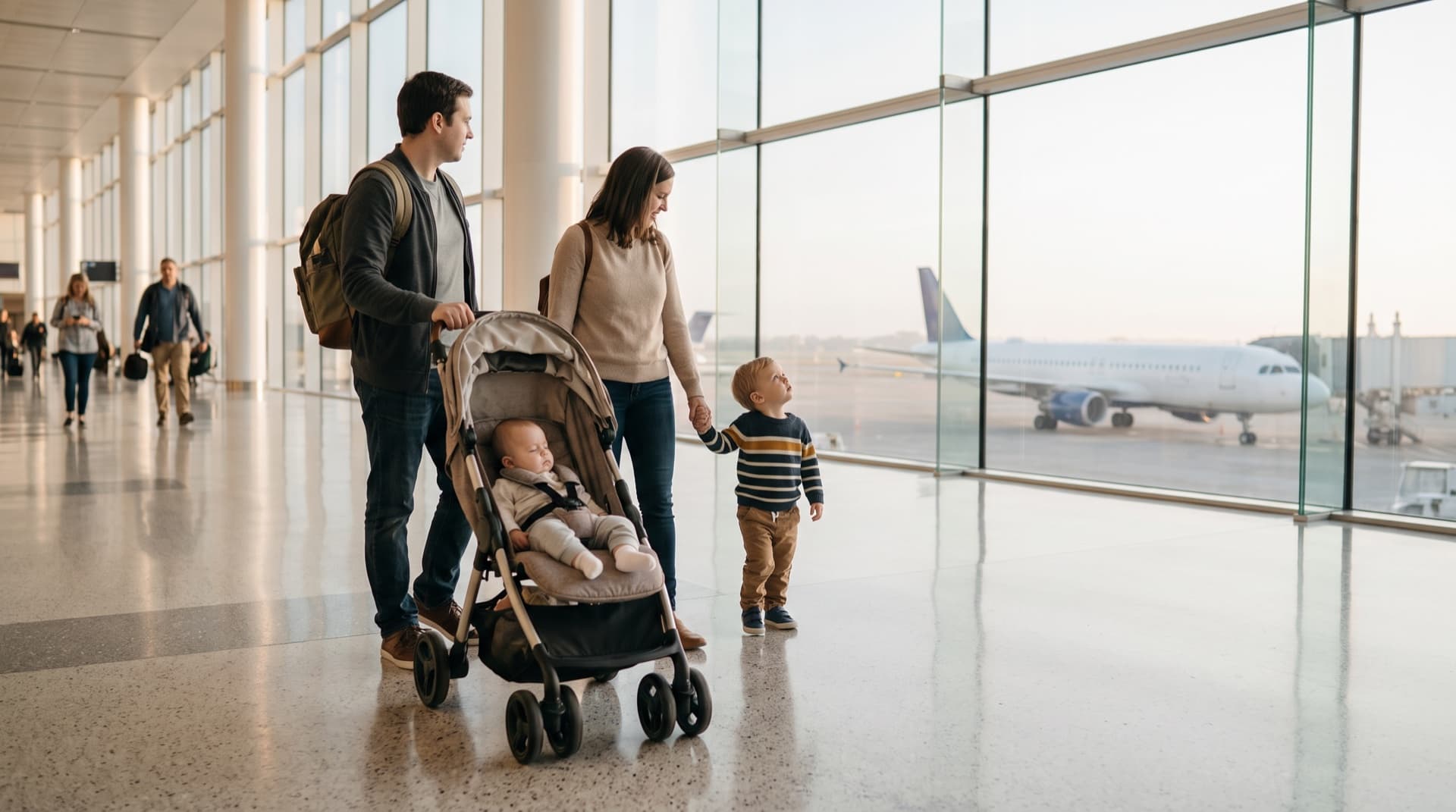
PUJ is known as a high-volume vacation airport, so you’ll typically see stroller-friendly passenger flow (wide walkways in many areas) and plenty of restrooms throughout the terminal spaces. As with many tropical-destination airports, terminal areas can feel warm and busy at peak times, so parents often find the calmest care spots near less-congested gate areas or quieter restroom corridors rather than in the main central halls.
You can bring a stroller to the TSA checkpoint, but it must be screened before it can go into the secure area. In most cases, you’ll be asked to take your child out, then fold the stroller and place it on the X-ray belt; if it doesn’t fit, TSA may inspect it by hand and may use additional screening like swabbing for trace detection. Remove loose items (blankets, toys, snacks, cups, parent bags) so the stroller can be checked clearly, and send those items through the X-ray separately. If your stroller has a removable seat, bassinet, or accessories, those parts may need to go through the X-ray as separate pieces. Expect to walk through the metal detector without the stroller while TSA screens it, then you’ll pick it up on the other side once screening is complete.
When you’re traveling with a baby or young child, TSA allows baby formula, breast milk, toddler drinks, and baby food in quantities larger than the usual 3.4 oz (100 mL) limit for carry-on liquids. You should tell the TSA officer at the start of screening that you have these items, and they may ask you to separate them for inspection. These liquids will be screened, which can include X-ray or additional testing, and you may be asked to open containers—but TSA does not require you to taste breast milk or formula. Ice packs, freezer packs, and gel packs are allowed to keep these items cold, even if partially melted, as long as they’re used to cool infant or toddler needs. Keep these items easy to reach in your bag so you can take them out quickly if asked.
Some airports offer Family or Accessible lanes at TSA security, which are designed to give families with small children and travelers who need extra time a little more space and a calmer pace. These lanes are not available at every checkpoint, and eligibility and access can vary by airport and staffing, so you may be directed to the standard lane. If a Family or Accessible lane is offered, you can usually expect TSA officers to allow a bit more time for strollers, car seats, baby carriers, and diaper bags to be screened. Even in these lanes, the same screening rules apply: you’ll still place items on the conveyor belt and follow officer instructions for any needed checks. When you arrive at the checkpoint, look for posted signs or ask a TSA officer which lane is best for traveling with young children.
At TSA security checkpoints, children 12 and under usually do not need to remove their shoes during screening. In practice, your child can normally keep shoes on while you place items (like snacks, jackets, and stroller accessories) in the bins and walk through the scanner together. TSA officers may still ask for shoes to come off if extra screening is needed, if the shoes set off an alarm, or if the footwear is bulky and needs a closer look. To keep things simple, choose easy-on, easy-off shoes and avoid complicated laces so you can respond quickly if asked. If your child is being carried, you may be asked to briefly adjust how you’re holding them so the officer can complete the screening safely.

Punta Cana International Airport (PUJ) is best known for its open-air, tropical-style design rather than for large, dedicated children’s playrooms. Families should not expect the kind of extensive, branded “kids zones” found at some major hub airports. That said, many parents still find ways for kids to move around and reset energy in the terminal by using open seating areas, quieter corners, and family-friendly facilities.
Where play spaces are most likely to be found (when available): Airports that do have children’s play corners typically place them airside (past security) near clusters of departure gates, where families spend the most time waiting. Some airports also place small children’s areas landside, but these are generally less common. At PUJ specifically, any child-friendly corner tends to be more limited and may vary by terminal zone or operational changes.
If an airport provides a children’s area, it is usually designed for short bursts of play rather than long, supervised play sessions. At PUJ, if you do come across a kid-friendly corner, it is most likely to be simple and compact.
What you should plan for: Because dedicated installations may be limited, many families use open areas for gentle movement, stretching, and “walk laps” near their gate, while keeping kids close and out of main traffic lanes.
Most airport play corners (when present) are aimed at toddlers and younger children, typically around preschool through early elementary ages. The equipment tends to be:
If you’re traveling with babies, the most useful “play” option is often a safe, calm spot to sit together, offer a snack or bottle, and do a few minutes of floor-level play only if the area is clean and not crowded.
Even without a dedicated quiet room, families can usually find calmer spaces in most terminals. At PUJ, your best chances for a reset are typically:
Practical note: Airport terminals can be loud and bright. For sensitive or overtired children, a calm plan often works better than seeking “more stimulation.” A small kit with quiet activities (stickers, coloring, a small book) can be more reliable than counting on a specific play space.
Airside (past security) is where families spend most of their waiting time before boarding, so that’s where airports most often place play corners. If you have already cleared security, it’s usually best to stay airside unless you have plenty of time and are certain you can re-clear security comfortably.
Landside (before security) areas are typically focused on check-in, arrivals, and transportation. If a terminal has any children’s feature landside, it is often small and may not be designed for long stays.
At PUJ: plan your time assuming you may not find a formal children’s play zone, and treat any play corner you spot as a bonus.
1
La Yola is best known in Punta Cana as the waterfront fine-dining restaurant at the Puntacana Resort & Club, styled like a small fishing boat (“yola”) and focusing on Mediterranean-influenced seafood and Dominican ingredients; at Punta Cana International Airport, the name signals the same upscale, coastal flavors in a more travel-friendly format. It’s a solid pick for families who want a calmer sit-down meal before a flight, with an atmosphere that feels polished but not overly formal, and you can typically count on staff being used to traveling families; a dedicated kids’ menu and high chairs may vary by the airport outlet, so it’s worth asking at the host stand. For parents, the draw is well-executed seafood and shareable plates, while kids often do best with simpler options like mild fish, rice, or pasta-style preparations; if available, a signature seafood-focused dish (often a fresh fish or shellfish preparation) is what the brand is known for. Service is sit-down and paced like a restaurant rather than fast food, portions tend to be satisfying for sharing, and it’s generally more about a relaxed pre-flight meal than rushing through. Expect about US$20–40 per adult (airport pricing can push higher), making it a splurge compared with quick-service counters but often good value when you want one dependable, nicer meal that keeps everyone happy. As a local Punta Cana institution tied to a major resort, La Yola carries a “special occasion” reputation in its home market, which is exactly why many travelers seek it out—even in the airport—for a last taste of the Dominican coast.
2
Jellyfish Restaurant is a well-known Punta Cana dining spot best recognized for its beachfront setting and a menu centered on Dominican-Caribbean flavors, especially seafood, and the airport outpost at Punta Cana International Airport (PUJ) is a convenient way to get a taste of that brand in a quicker, travel-friendly format. For families, it’s an easy, casual stop with a streamlined ordering style and a generally forgiving, kid-tolerant vibe typical of airport restaurants, and you can ask staff about a kids’ menu and available high chairs since these amenities can vary by terminal and time of day. Parents tend to gravitate to crowd-pleasers like fried fish or shrimp-style plates when available, while kids often do best with simpler options such as chicken, rice, or other mild sides that fit the Caribbean comfort-food approach. Expect a familiar airport pace—orders come out relatively fast, service is straightforward, and portions are usually satisfying rather than fine-dining small. Pricing at PUJ generally lands in the mid-to-upper airport range (about US$15–$35 per person, not including alcohol), so it’s not the cheapest option, but it can feel like decent value if your family wants a recognizable local name and a full meal before flying. The Jellyfish name carries local significance in Punta Cana thanks to its long-standing reputation as a popular beach restaurant for visitors, and the airport version leans into that same “vacation seafood” identity in a more practical, pre-flight setting.
3
El Conuco at Punta Cana International Airport (PUJ) is a Dominican-style eatery that leans into the country’s “conuco” idea—simple, home-style flavors inspired by traditional rural cooking—making it an easy, familiar stop between flights. It’s a good fit for families because the setting is casual and forgiving of kid noise, and you can usually find straightforward, shareable plates that work even for picky appetites; availability of a kids’ menu and high chairs can vary by airport unit, so it’s best to expect a standard quick, family-friendly setup rather than full-service extras. Parents typically gravitate to hearty favorites like mofongo and other classic Dominican comfort-food plates, while kids often do well with milder staples such as rice, fried plantains, and simple chicken or pork preparations when offered. Service is geared to travelers—order, eat, and move on—so the pace is generally faster than a stand-alone restaurant, with portions that tend to be filling and easy to split. Expect airport pricing: roughly US$15–$30 per adult depending on what you order, which can feel steep but is reasonable value if you’re sharing larger plates and want something more local than standard fast food. As a concept, El Conuco is best known for giving travelers a quick taste of Dominican cuisine and a break from generic airport dining with flavors that feel rooted in the island.
4
Chili’s at Punta Cana International Airport (PUJ) is the airport-friendly outpost of the well-known American casual-dining chain, serving crowd-pleasing Tex-Mex and classic bar-and-grill favorites in a lively, familiar setting. It’s a dependable choice for traveling families because the atmosphere is upbeat and forgiving of kid noise, and most Chili’s locations offer a kids’ menu plus family basics like high chairs when available. Parents and kids tend to gravitate to signature staples like Chicken Crispers, burgers, and quesadillas, with shareable chips-and-dip-style starters often making an easy pre-flight snack. Service is typically sit-down and fairly quick for a full-service restaurant, with big portions that can work well for splitting if your kids aren’t very hungry. Expect about US$15–$30 per adult (airport pricing can run higher), which feels like decent value when you want a predictable meal and a chance to sit down before boarding. As a brand founded in Texas in 1975, Chili’s has built its reputation worldwide on consistent comfort food, casual hospitality, and flavors that are approachable for picky eaters as well as hungry parents.
Does Punta Cana International Airport have a nursing room airside?
PUJ does not consistently advertise dedicated nursing rooms or lactation pods. Families usually use the airport restrooms (some have larger accessible/“family” stalls) or find a quieter seating area near their gate for privacy. Amenities can vary by terminal area, so allow extra time if you need to locate a more secluded spot.
What are the rules for baby food at PUJ security?
Yes. Formula and expressed breast milk are generally permitted through security in reasonable quantities, and you can carry them in a cooler bag with ice packs or gel packs. Expect security to screen these items separately, which can include additional inspection or testing, so pack them so they’re easy to remove.
Where can kids play at Punta Cana International Airport?
PUJ is not known for having a dedicated children’s play area or indoor playground. Kids typically use regular gate seating areas, open concourse space, or dining areas to move around while waiting. Plan on entertainment and snacks in case your gate area is crowded.
Where do I pick up a stroller at PUJ?
Strollers are typically allowed in the terminal, and airlines commonly allow you to use a stroller to the gate and then gate-check it for the flight. Policies (including size/weight limits and whether it’s returned at the gate or baggage claim) depend on the airline, so check your carrier’s rules before travel. Security may require the stroller to be folded and sent through screening.
Are there high chairs at Punta Cana International Airport restaurants?
PUJ does not reliably offer dedicated family security lanes or a special family check-in line. Families generally use the standard check-in and security queues, with assistance available from staff when needed. During busy periods, lines can be long, so arrive early.