
Evenflo Maestro Sport: Forward-Facing Harness-to-Booster for Flying Families
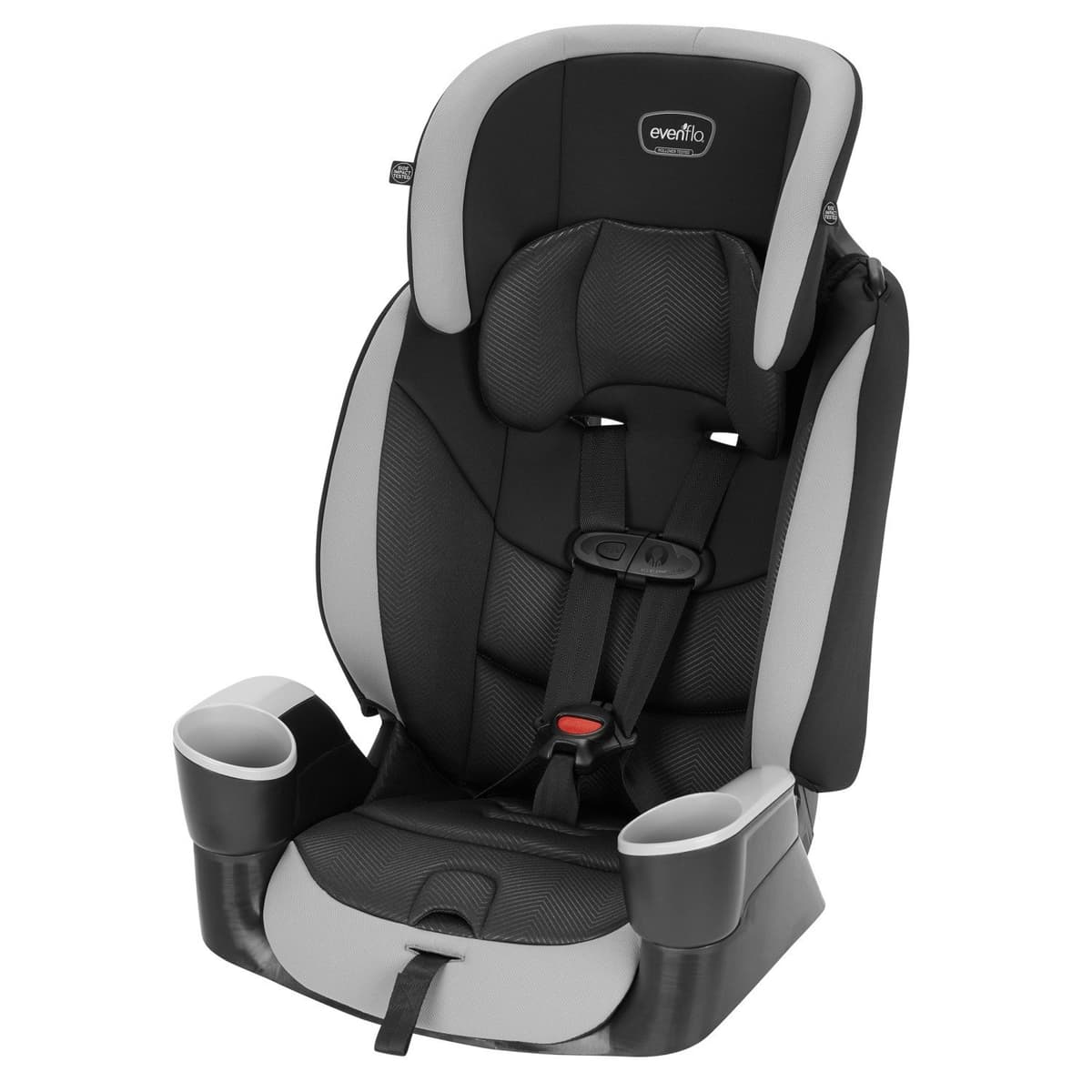
The Evenflo Maestro Sport is FAA accepted in five-point harness mode (30–65 lb) for aircraft use. Booster mode is prohibited on aircraft per 14 CFR 121.311. At 9.7 lb and $100, it is a capable budget combination seat.
Flying with a car seat? Our Certified Child Passenger Safety Technicians are ready to help.
They'll walk you through every step — from choosing a seat that's safe for your child and convenient for your family, to getting it from the car, to the gate, and onboard the plane.
FAA Acceptance
Yes, FAA-Accepted
This restraint is approved for use when used with the internal five-point harness. It is not approved for use in five-point harness mode.
yesChild Range
Up to 100 lb and 57 in
Harness mode 30–65 lb; booster mode 40–100 lb and between 44–57 in
yesBooster on Aircraft
Prohibited
This restraint is not certified for use on aircraft in booster mode.
noSeat Width
19 in
This restraint fits in most economy seats with one armrest raised.
variesVelivolo Video
yes
Learn how to install the Evenflo Maestro Sport on the airplane. Watch our Velivolo instructional video below.
yesEvenflo Maestro Sport Specifications
The Evenflo Maestro Sport is a budget-friendly combination seat covering 30–100 lb from harness to booster for approximately $100. It is FAA accepted for aircraft use exclusively in five-point harness mode — booster mode is prohibited in flight. At 19 inches wide, it requires armrests up on most economy seats. For families who drive primarily and fly occasionally, the Maestro Sport is a practical one-seat solution with an 8-year lifespan. Frequent flyers may prefer a lighter, dedicated travel seat.
- The Evenflo Maestro is accepted for use on aircraft in five-point harness mode only (30–65 lb on aircraft); booster mode is prohibited in flight.
- The Maestro Sport weighs 9.7 lb, is 19 inches wide
- The top tether must always be used in forward-facing vehicle installations; the top tether cannot be used on aircraft.
- The Maestro Sport expires 8 years from date of manufacture; the date-of-manufacture label is on the back of the seat shell.
Evenflo Maestro Sport Specifications
Important — Car Seat Information
Child restraint information changes frequently. Airline policies, seat dimensions, and compatibility requirements are updated on an ongoing basis. For the most current and accurate information, please consult with one of our Certified Child Passenger Safety Technicians (CPSTs) inside the Velivolo app before you fly.
FAA Acceptance & Booster Mode Prohibition
- Confidence:
- Medium (manual narrative)
- Label location:
- Back or side of seat shell (Evenflo standard label location for combination seats)
- Regulatory:
- 14 CFR 121.311 / FAA AC 120-87C — harness mode only; booster mode prohibited per 14 CFR 121.311(b)(2)(ii)
- FMVSS 213:
- Yes
- FMVSS 213a:
- not published
Airworthiness note
Per FAA AC 120-87C and 14 CFR 121.311, the Maestro Sport is certified for aircraft use only when used in its five-point harness mode. The booster (belt-positioning) mode cannot be used in flight because aircraft seats provide only a lap belt, and belt-positioning boosters require a shoulder belt for upper-body restraint. Families must confirm the seat is in harness mode before boarding and must not convert it to booster mode during flight.
Aviation Fit & In-Flight Use
Per FAA AC 120-87C, the Maestro Sport may be used on aircraft in forward-facing five-point harness mode only. At 19 inches wide it exceeds standard economy seat width on American (16.7 in), Delta (17.2 in), and United (17.3 in) narrowbodies, so armrests must be raised for installation. Booster mode is prohibited in flight. The seat installs via the aircraft lap belt routed through the forward-facing belt path with the five-point harness in use. For wider seats, it will fit with the armrest raised.
The Maestro Sport fits aircraft seats in harness mode only with armrests raised — a practical, budget-friendly option for families who drive primarily and fly a few times per year.
- Install Method
- Lap belt only — forward-facing five-point harness mode; booster mode prohibited on aircraft
- Economy Fit
- Fits (armrests as noted)
- Gate-Check
- Recommended for base/large seat
- Recline-Friendly
- No
How to Install the Evenflo Maestro Sport
Complete Installation Walkthrough
Watch our full guide for installing the Evenflo Maestro Sport
Velivolo Travel Score
19-inch width requires armrests up on most US economy seats; harness mode only — booster mode is prohibited in flight.
9.7 lb is manageable; gate-check is free on all major US carriers. No folding, so a padded bag is recommended.
LATCH and top-tether vehicle install is straightforward. The 30–100 lb range covers most car-seat ages in a single seat.
Does not fold; 19 inches wide at 9.7 lb. Not designed as a portable travel seat — plan to gate-check or check through at ticket counter.
Velivolo Score
FAA accepted in harness mode only; 19-inch width requires armrests up on most economy seats.
Straightforward lap-belt-only install for aircraft; LATCH and tether in vehicles. No integrated lock-off.
LATCH and top-tether vehicle install; 19-inch width limits three-across in most sedans.
FMVSS 213 certified; no active NHTSA recalls as of May 2026. FMVSS 213a status not independently confirmed.
30–100 lb harness-to-booster range gives approximately 6–10 years of use at $100 street price.
At 9.7 lb and 19 inches wide, gate-checking is the practical airport approach for most families.
Pros & Cons
- FAA accepted in five-point harness mode — one seat covers the airplane and the destination rental car across the 30–65 lb harness window.
- 30–100 lb harness-to-booster range delivers a fairly long lifespan of use from a single $100 purchase.
- At 9.7 lb it is lighter than most all-in-one convertibles, making airport travel less burdensome when gate-checked.
- Aircraft installation is supported with a straightforward routing, confirmed by the Velivolo installation video.
- Belt-positioning booster mode (40–100 lb) extends the seat's useful life well into the school-age years without requiring a second purchase.
- Booster mode is prohibited on aircraft.
- At 19 inches wide, the Maestro Sport requires armrests up on most US economy seats.
- Aircraft lap belt buckle may rest on child's back, causing slight discomfort for some children.
- Only harnesses to 50lbs - then child must convert to booster
Best For
Drive-primarily, fly-occasionally families
The Maestro Sport earns its value for families who use the seat every day in the car and fly two to four times per year. The FAA acceptance in harness mode covers air travel without buying a separate travel seat, and the $100 price leaves room in the budget for other travel gear.
Budget-conscious travelers who need one seat for everything
At $100, the Maestro Sport is one of the most affordable FAA accepted combination seats available. Families who need a car seat for daily driving, occasional flights, and ground transport at the destination can cover all three scenarios with a single purchase.
Grandparents' car for visiting grandchildren who fly in
The Maestro Sport's long 30–100 lb weight range means a single seat installed in a grandparent's car works for children across a wide age span.
Key Features
Five-Point Harness with FAA Acceptance
The Maestro Sport is certified for use in motor vehicles and aircraft when in five-point harness mode. The harness covers children 30–65 lb and 44–54 inches. On aircraft, the lap belt routes through the forward-facing belt path.
Two Cup Holders
The Maestro Sport features two cup holders. The cup holders must be screwed in before use, and the screws are provided when the seat is purchased new in box. The dual cupholders give children an extra space for snacks while traveling.
LATCH and Top-Tether Vehicle Installation
The Maestro Sport supports LATCH lower-anchor installation (to a combined 40 lb child-plus-seat limit) plus mandatory top tether in forward-facing mode. Above 40 lb combined weight, the vehicle lap-and-shoulder belt plus top tether is used. Th No integrated lock-off is present, so a locking clip may be needed in vehicles with non-locking belts.
Tall Harness Height
The Maestro sport features a high harness height at 18.5 inches, which is useful for taller children.
Real-World Scenarios
Domestic flight in harness mode with 35-lb child
Install in harness mode with the aircraft lap belt. Raise one aircraft armrest — the 19-inch seat requires them up on most narrow-body economy seats. Secure the harness snugly. The seat works well and provides a familiar restraint for the child. Rating docked one point for the armrest requirement on most carriers.
Rental car at travel destination
LATCH or belt-plus-tether install works in most rental fleet vehicles. The 19-inch width fits comfortably in midsize sedans and SUVs. Locate the rental vehicle top tether.
Airport navigation without a dedicated travel bag
At 9.7 lb carrying the Maestro through the airport is fairly simple. Use luggage straps to attach the car seat to your roller carry-on, or get a backpack-style carry bag.
How It Compares
Per Graco's published documentation, the 4Ever DLX covers children from 4 to 120 lb across four modes, adding a rear-facing convertible stage the Maestro Sport lacks. At $200–280 it costs twice as much, but the broader lifecycle offsets the premium for families with newborns. The Maestro Sport wins on price if the child is already over 30 lb.
Per Britax's published documentation, the One4Life covers children from 5 to 120 lb with ClickTight belt installation. It is heavier at 28 lb versus the Maestro Sport's 9.7 lb and costs four times as much. For families who value the ClickTight installation system and want one seat for a decade, the One4Life is worth the premium. For budget-conscious travelers, the Maestro Sport covers the same aircraft-use window at a fraction of the cost.
Per WAYB's published documentation, the Pico is FAA accepted, weighs 8 lb, and folds flat into a carry bag. It covers 22–50 lb in five-point harness forward-facing mode — a narrower window than the Maestro Sport's 30–100 lb. The Pico is purpose-built for travel at four times the Maestro Sport's price. Frequent flyers who value portability and fold-flat design should choose the Pico; drive-primarily families should choose the Maestro Sport.
Read full reviewPer Safety 1st's published documentation, the Grow and Go Sprint is a similarly priced all-in-one convertible covering rear-facing infants through booster mode. It is FAA accepted in harness mode. The Sprint adds rear-facing coverage the Maestro Sport lacks; the Maestro Sport is narrower at 19 inches versus the Sprint's approximately 19 inches. Both are budget-tier options; the Sprint is better for families who need rear-facing coverage.
Airport & In-Flight Tips
Use Luggage Straps for transport
If you're traveling with a carry-on roller suitcase, use luggage straps to attache the Maestro to your carry-on for easy transport. You may also consider purchasing a dust bag (like the J.L. Childress bag) with back pack straps to transport it easily.
Raise one Armrest Before Installing
The 19-inch seat shell exceeds standard economy seat width. Before installing on aircraft, raise the center seat armrest for easier installation. FAA Regulation allows the armrest to remain raised throughout the duration of the flight to accommodate a child restraint system.
Frequently Asked Questions
Is the Evenflo Maestro Sport FAA accepted for airplanes?
The Evenflo Maestro Sport is certified for use on aircraft when used in its five-point harness mode with children 30–65 lb and 44–54 inches. The approval label reads 'This Restraint is Certified for Use in Motor Vehicles and Aircraft.' However, the booster mode is categorically prohibited on aircraft per 14 CFR 121.311(b)(2)(ii).
Can I use the Maestro Sport in booster mode on the plane?
No. Per 14 CFR 121.311(b)(2)(ii), belt-positioning booster seats are prohibited for use on aircraft.
What are the Maestro Sport's weight limits for aircraft use?
Per Evenflo's published specifications, the Maestro Sport's five-point harness mode covers children 30–65 lb and 44–54 inches tall. On aircraft, only harness mode is permitted, so the effective aircraft weight range is 30–65 lb. Children who have outgrown the harness mode (above 65 lb or 54 inches) cannot use the Maestro Sport on aircraft, as the booster mode is prohibited in flight.
How do I install the Maestro Sport on an airplane?
Watch the Velivolo installation video for instructions. Install the Maestro Sport on aircraft in five-point harness mode by routing the aircraft lap belt through the belt path on the seat, buckle the aircraft belt, and pull excess webbing to tighten until the seat does not move more than one inch in any direction. Then place the child in the harness, buckle the harness chest clip, and tighten the harness straps until snug. The Velivolo installation video at the linked URL demonstrates aircraft installation.
Does the Maestro Sport fit in an airplane seat?
The Maestro Sport's 19-inch shell (from cup holder to cup holder) is wider than most economy seats. Simply raise one armrest to accommodate this seat installation. You may keep the armrest raised throughout the duration of the flight.
What is the weight limit for LATCH installation in a car?
The Maestro Sport's LATCH lower-anchor connectors should be used only up to a combined child-plus-seat weight of approximately 40 lb. The seat itself weighs 9.7 lb, which means LATCH is appropriate only when the child weighs approximately 30 lb or less. Above this combined weight threshold, install using the vehicle lap-and-shoulder belt plus the mandatory top tether. The top-tether anchor must always be used in forward-facing vehicle installations regardless of whether LATCH or the seat belt is used for the lower anchor.
When should a child transition from harness to booster mode?
Children should remain in the five-point harness mode of the Maestro Sport until they reach the harness weight or height limit — whichever comes first — which is 65 lb or 54 inches. At that point, the seat transitions to belt-positioning booster mode (40–100 lb / 44–57 inches). Velivolo CPSTs recommend keeping children in a harness as long as possible before transitioning to a booster. Remember that booster mode cannot be used on aircraft.
Does the Maestro Sport require a top tether?
Per Evenflo's published manual, a top-tether strap is required for all forward-facing vehicle installations with the Maestro Sport, regardless of whether LATCH or the vehicle seat belt is used for the lower anchor. The top tether significantly reduces head excursion in a crash by limiting forward movement of the seat. On aircraft, the top tether cannot be used because most economy seat-backs do not have a tether anchor. This is permitted by FAA AC 120-87C — the top tether is not required for aircraft installation.
How long does the Maestro Sport last before it expires?
The Maestro Sport expires 8 years from its date of manufacture. The date-of-manufacture label is on the back of the seat shell.
Sources
- 1FAA Advisory Circular AC 120-87C — Use of Child Restraint Systems on Aircraft (2015) — Regulatory baseline for CRS use on US commercial aircraft, prohibited restraint modes, economy seat guidance. Source
- 214 CFR 121.311 — Seats, Safety Belts, and Shoulder Harnesses (2026) — Federal regulation prohibiting belt-positioning booster seats during taxi, takeoff, and landing on Part 121 carriers. Source
- 3Evenflo Product Page — Maestro Sport High-Back Booster (2026) — Manufacturer specifications, weight and height limits, harness-to-booster transition, expiration policy. Source
- 4NHTSA Child Safety Seats Recall Database (2026) — Recall verification for Evenflo Maestro Sport — no active recalls as of May 2026. Source
- 5Simple Flying — US Airline Economy Seat Width Reference (2026) — Economy seat widths for American 737-800 (16.7 in), Delta A321neo (17.2 in), Southwest 737 MAX 8 (17.8 in), United 787-9 (17.3 in), JetBlue A321 (17.8 in). Source
Last updated: 2026-07-14

Velivolo Editorial Team
Family Travel Experts
Our editorial team combines certified child passenger safety technicians, frequent-flying parents, and automotive safety researchers to deliver independent, data-driven car seat reviews for traveling families.
Related Car Seats & Travel Restraints
.webp&w=3840&q=75&dpl=dpl_inqJ4L7UrVUMh9KgfmfeaAUpUNKq)
Legal Disclaimer
The car seat information provided on this page is intended for general informational purposes only and is subject to change without notice. Velivolo makes no representations or warranties, express or implied, regarding the accuracy, completeness, or timeliness of any car seat data, airline compatibility information, or related recommendations displayed on this platform.
Velivolo is not liable for any damages, injury, loss, or harm arising from reliance on incorrect, outdated, or incomplete car seat information or recommendations. Parents and caregivers are solely responsible for verifying all child restraint information with the relevant airline, the car seat manufacturer, and a Certified Child Passenger Safety Technician (CPST) before travel.
Affiliate Disclosure: Some product links on this page may be affiliate links. Velivolo may receive a commission if you make a purchase through one of these links, at no additional cost to you. This does not influence our content, recommendations, or editorial decisions.
Use of this information does not constitute professional child passenger safety advice. For personalized guidance, consult a Certified Child Passenger Safety Technician (CPST) through the Velivolo app.
Ready to Find the Right Car Seat for Your Family's Flights?
Velivolo reviews every FAA accepted car seat so you can travel confidently — from budget combination seats like the Maestro Sport to fold-flat travel harnesses and aviation-only devices.