
BubbleBum Inflatable Booster: The 1-Pound Packable Travel Booster
Per BubbleBum's documentation, the Inflatable Booster fits children who weigh between 40–100 lbs, weighs 1 lb, and is FMVSS 213 certified — but prohibited on US aircraft per 14 CFR 121.311.
.webp&w=1200&q=75&dpl=dpl_inqJ4L7UrVUMh9KgfmfeaAUpUNKq)
Flying with a car seat? Our Certified Child Passenger Safety Technicians are ready to help.
They'll walk you through every step — from choosing a seat that's safe for your child and convenient for your family, to getting it from the car, to the gate, and onboard the plane.
FAA Acceptance
Not approved
This restraint is not certified for use on aircraft. Carry deflated on board; use only in taxis and rental cars at the destination
noChild Range
40–100 lbs and 41–57 inches
Minimum age 4, although Velivolo CPSTs recommend waiting until the child is at least 5 and developmentally mature enough to sit upright throughout the duration of the trip.
yesPacked for Travel
1 lb deflated
Inflates by mouth in 30 seconds; deflated dimensions approximately 12 × 6 × 4 inches. Easy to pack in personal item or carry on.
yesBubbleBum Inflatable Booster Specifications
The BubbleBum Inflatable Booster is the go-to packable booster for traveling families with older children; 1 pound deflated, FMVSS 213 certified, and fits in a daypack. At $40, it fits children who weigh 40–100 lbs in taxis, rideshares, and rental cars at the destination. It cannot be used during flight. A properly used booster is always safer than none, and BubbleBum fills a real travel gap where families often choose to go without.
- The Inflatable Booster weighs approximately 1 lb deflated and inflates by mouth in 30–60 seconds.
- The BubbleBum covers children 40–100 lbs and 41–57 inches tall.
- Not certified for use on aircraft.
- Per BubbleBum's guidance, the seat expires 4 years from first use — shorter than the 8–10 years typical for rigid boosters.
BubbleBum Inflatable Booster Specifications
Important — Car Seat Information
Child restraint information changes frequently. Airline policies, seat dimensions, and compatibility requirements are updated on an ongoing basis. For the most current and accurate information, please consult with one of our Certified Child Passenger Safety Technicians (CPSTs) inside the Velivolo app before you fly.
FAA Status & Aircraft Rules
- Confidence:
- Not applicable (seat not FAA accepted)
- Regulatory:
- 14 CFR 121.311(b)(2)(ii) / FAA AC 120-87C — booster seats prohibited on US commercial aircraft
- FMVSS 213:
- Yes
- FMVSS 213a:
- not applicable
Airworthiness note
Per 14 CFR 121.311(b)(2)(ii), booster seats cannot be used on US commercial aircraft because aircraft lap belts do not provide the three-point restraint geometry required for proper booster function. The BubbleBum's inflatable design does not change its regulatory classification as a booster. Carry it deflated in your carry-on and use it exclusively in ground vehicles at the destination. No FAA exemption exists for inflatable boosters.
Flying With the BubbleBum
Per 14 CFR 121.311(b)(2)(ii) and FAA AC 120-87C, booster seats are prohibited on US commercial aircraft. The BubbleBum Inflatable Booster cannot be used during flight on any US carrier regardless of its inflatable form factor. The seat's travel advantage is portability at the destination — it deflates to 1 lb and fits in a daypack for use in taxis, rideshares, and rental cars after landing. Carry it deflated in your personal item or carry-on, inflate on arrival, and use it in the ground vehicle at your destination. Do not attempt to use it as an in-flight restraint. For wider seats, it will fit with the armrest raised.
The BubbleBum is the premier packable booster for traveling families — not for in-flight use, but for destination ground transport in taxis, rideshares, and rental cars.
- Install Method
- Not used on aircraft — 14 CFR 121.311(b)(2)(ii) prohibits all booster seats on US commercial aircraft. Vehicle installation: route seatbelt under both red side clips, shoulder belt through positioning clip.
- Economy Fit
- Does not fit standard economy
- Gate-Check
- Cabin-carry preferred
- Recline-Friendly
- No
How to Install the BubbleBum Inflatable Booster
Complete Installation Walkthrough
Watch our full guide for installing the BubbleBum Inflatable Booster
Travel Score
Cannot be used in the aircraft cabin during flight. Carry deflated in a personal item — it weighs 1 lb and packs to a small rectangle.
No gate check required. Deflated BubbleBum fits inside a daypack or personal item — no oversized fees, no checking, no waiting at baggage claim.
The BubbleBum's core use case: inflates in 30 seconds in any taxi, rideshare, or rental car with a three-point belt. FMVSS 213 certified for vehicle use.
1 lb deflated, 11.8 × 5.9 × 3.9 inches, includes carry bag. Lightest and most compact FMVSS 213 certified booster available.
Velivolo Score
Prohibited on aircraft per 14 CFR 121.311(b)(2)(ii). But very convenient to bring onboard in your backpack or carryon luggage.
Inflates by mouth in 30 seconds; lap belt routes under both red clips with no tools required.
At $40, it is a lower-priced FMVSS 213 certified travel booster; 4-year expiration from first use is shorter than rigid alternatives.
Deflates to 1 lb and fits in a daypack side pocket — the most packable FMVSS 213 certified booster available.
Pros & Cons
- Weighs 1 lb deflated and packs to roughly 12 × 6 × 4 inches — fits in a daypack for true backpack-carry travel.
- Inflates by mouth in 30–60 seconds with no pump required; arrive at the rental car desk ready in under a minute.
- At approximately $40, it is a budget-friendly option.
- At only 12 inches wide, it fits 3-across well.
- Carry bag included for travel.
- Not certified for use on aircraft.
- Expires 4 years from first use — shorter than the 8–10 years typical for boosters.
- Lap belt must be re-threaded through both red side clips at every use.
Best For
Families flying to a destination who need a booster for taxis and rentals
The BubbleBum excels at its core use case: carry it deflated to the destination, inflate in 30 seconds, and use in any rideshare or rental car with a three-point belt. At 1 lb and $40, it is the most practical solution for short-trip ground transport.
Families with older children (age 8-12) for occasional carpooling
The BubbleBum is recommended as a secondary or backup booster for occasional rides — not a daily driver. For a 9-year-old who still needs belt positioning, it fits in a backpack between uses.
Three-across situations during travel
At 12 inches wide, the BubbleBum is a good no back booster option for tight 3-across situations in rideshares and rental car vehicles.
Key Features
Inflatable Backless Design
The Inflatable Booster is made from durable PVC with a double-sealed valve. It inflates by mouth in approximately 30–60 seconds with no pump required. When deflated, it measures approximately 11.8 × 5.9 × 3.9 inches and weighs about 1 pound. The design uses the same FMVSS 213 belt-routing geometry as rigid backless boosters — the lap belt runs under both red side clips and the shoulder belt routes through a positioning clip.
FMVSS 213 Certification
The Inflatable Booster is certified to FMVSS 213, the US federal standard for belt-positioning booster seats.
Ultra-Compact Travel Form Factor
The deflated booster fits in a carry bag measuring approximately 11.8 × 5.9 inches — small enough for a backpack side pocket, personal item, or checked luggage. At 1 pound, it adds essentially no weight to a travel kit.
Real-World Scenarios
Taxi from the airport to hotel with an 8-year-old at 62 lbs
The BubbleBum's core use case. Pull it from your daypack, inflate in 30–60 seconds, route the lap and shoulder belt correctly, and the child is in an FMVSS 213 certified restraint within a minute of entering the cab.
Economy flight and Rideshare with 4-year-old at 41 lbs
At this age and weight, a child fits safely in a forward-facing harnessed car seat that can be used on the aircraft and at the destination. Velivolo CPSTs recommend maxing out the five-point harness before transitioning to a no back booster.
Rental car trip across three cities with 9-year-old
Ideal for multi-city rental itineraries. Inflate at each pickup, deflate between trips, carry in the same daypack as the rest of the luggage. No gate-check costs, no luggage fees, no oversize surcharges.
3-across seating in a compact sedan with two kids and a toddler
A 1-pound, 12-inch-wide inflated BubbleBum enables 3-across well. Best used in the center position where three-point belts are available.
How It Compares
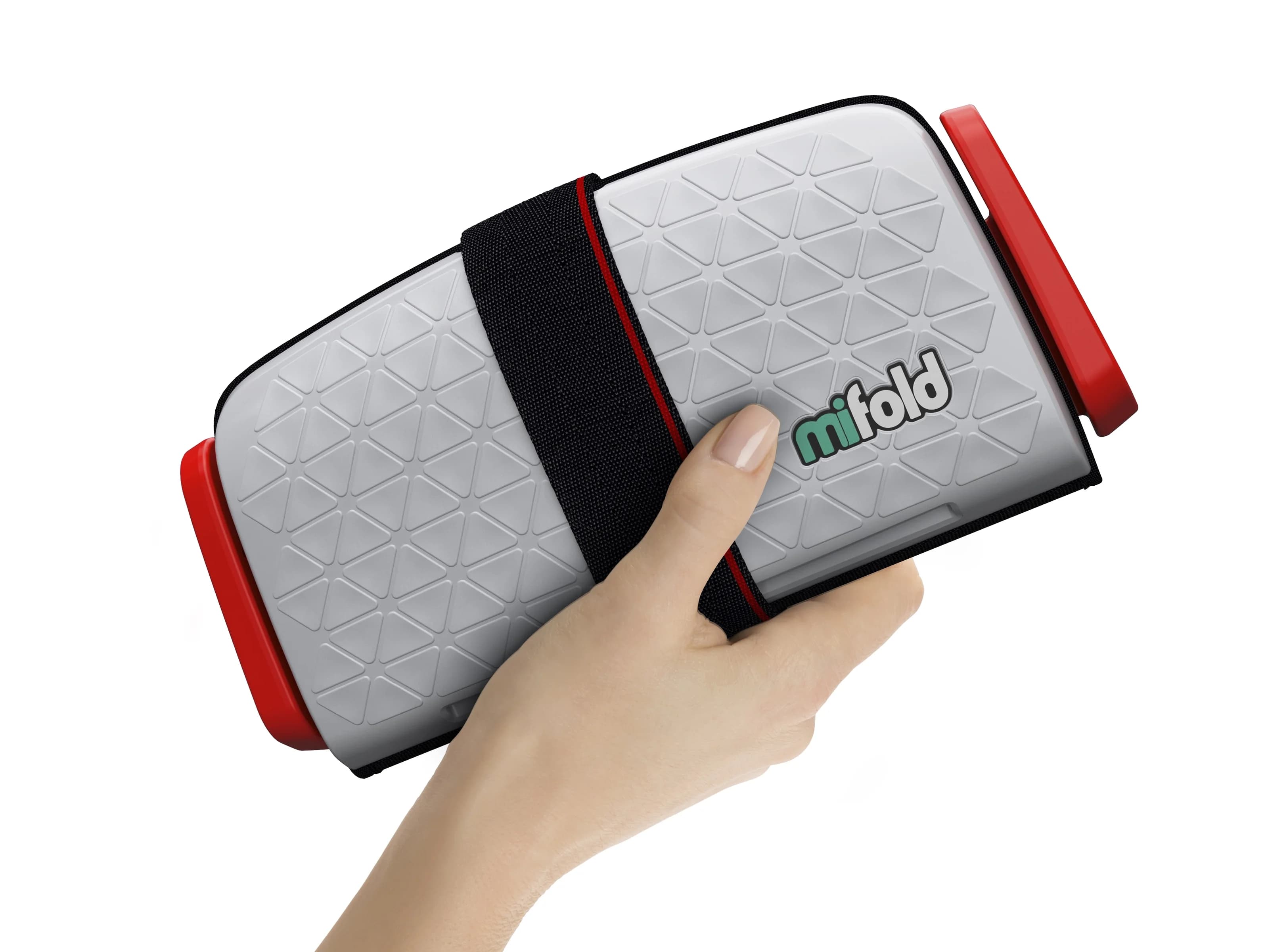
Per Mifold's published documentation, the Comfort Booster is a folding belt-positioning booster that packs small but weighs approximately 3 lbs — heavier than the BubbleBum at 1 lb. The mifold Comfort is a rigid design with a foam pad and is IIHS Check Fit rated. Choose the BubbleBum for the lightest possible pack weight; choose the mifold Comfort for firmer seating and a more structured form factor.
Read full reviewPer Hiccapop's published documentation, the UberBooster is also an inflatable backless booster at a similar $30–40 price point. Both are FMVSS 213 certified and pack flat. The BubbleBum has a longer track record, Consumer Reports and BabyGearLab endorsements, and an IIHS historical Best Bet rating (withdrawn 2022). Choose the BubbleBum for proven third-party reviews; consider the UberBooster as a lower-cost alternative.
Read full reviewPer Hifold's published documentation, the Fit-and-Fold is a rigid adjustable highback booster that folds for travel and weighs approximately 3.5 lbs. It provides more upper-body support and an adjustable headrest, making it suitable for longer drives and sleeping children. The BubbleBum at 1 lb and $40 wins on portability and price; the Hifold wins on side support, headrest coverage, and suitability for primary or semi-regular use.
Read full reviewPer WAYB's published documentation, the Pico is an FAA accepted 5-point harness travel seat weighing approximately 8 lbs that works both on aircraft and in vehicles for children 22–50 lbs. The BubbleBum at 1 lb and $40 is dramatically lighter, cheaper, and more packable — but limited to ground vehicles and children 40–100 lbs only. Choose the WAYB Pico for FAA accepted in-flight restraint with dual air+car use; choose the BubbleBum for destination-ground-only travel with older, booster-ready children.
Read full reviewTravel Tips
Inflate Only at the Destination
Deflate the BubbleBum after every use and store it in its carry bag. Do not leave it inflated in a hot car — heat-induced deflation is a known issue acknowledged by BubbleBum customer service. Inflate fresh at the pickup point each time to maintain structural integrity.
Track the 4-Year Expiration
Per BubbleBum's published guidance, the seat expires 4 years from first use — not from the manufacture date. Write the first-use date inside the carry bag or user manual the moment you first inflate it. This 4-year window is shorter than the 8–10 years typical for rigid boosters, so parents using it infrequently may be surprised when it needs replacement.
Re-Thread the Belt Every Use
The lap belt must be routed under both red side clips at every installation. After deflating and re-inflating, verify the belt path is correct before the child sits down. Misrouting the lap belt above the clips — the most common error — eliminates the positioning benefit the seat provides.
Pack in Your Personal Item
At 1 lb and carry-bag size, the deflated BubbleBum fits in most personal-item bags and smaller backpacks. Pack it in a quickly accessible pocket so you can inflate it immediately at the rideshare pickup or rental car desk. Keeping it accessible cuts the transition time from plane to vehicle to under 2 minutes.
Frequently Asked Questions
Can I use the BubbleBum on the airplane?
No, the BubbleBum inflatable booster is not certified for use on aircraft.
What are the weight and height limits for the BubbleBum?
The Inflatable Booster covers children weighing 40–100 lbs and measuring 41–57 inches tall, generally corresponding to approximately ages 4 through 11. The 40 lb minimum is the lower bound of the belt-positioning booster category under FMVSS 213 — children below this weight should remain in a forward-facing harness seat. Velivolo recommends children max out their five-point harness before transitioning to a booster seat.
When does the BubbleBum expire?
Per BubbleBum's published guidance, the Inflatable Booster expires 4 years from the date of first use. This is notably shorter than the 8–10 years typical for rigid plastic booster seats. The 4-year clock begins at first use, not at the manufacture date — so parents who purchase the seat but store it for a year before first use still receive 4 years of usable life from the first inflation, not from purchase. Write the first-use date inside the carry bag immediately after first inflation. Do not purchase used BubbleBum seats, as the inflatable bladder degrades with heat cycles and age, and the prior first-use date may be unknown. Check the date-of-manufacture label on the seat body before purchasing from third-party sellers.
Is the BubbleBum appropriate as a daily primary seat?
Velivolo CPSTs recommend the BubbleBum Inflatable Booster as a travel and secondary booster for older children — not a primary daily seat.
Sources
- 1BubbleBum Inflatable Booster Product Page (2026) — Weight limits, height limits, inflation instructions, expiration policy. Source
- 214 CFR § 121.311 — Aircraft Seating and Safety Belts (2024) — Federal regulation prohibiting booster seats on US commercial aircraft. Source
- 3FAA Advisory Circular AC 120-87C (2019) — FAA guidance on use of child restraint systems on aircraft, CRS categories. Source
- 4NHTSA — National Child Restraint Use Special Study (NCRUSS) (2015) — Backless booster misuse rate data (24%), observational methodology. Source
Last updated: 2026-09-03

Velivolo Editorial Team
Family Travel Experts
Our editorial team combines certified child passenger safety technicians, frequent-flying parents, and automotive safety researchers to deliver independent, data-driven car seat reviews for traveling families.

Legal Disclaimer
The car seat information provided on this page is intended for general informational purposes only and is subject to change without notice. Velivolo makes no representations or warranties, express or implied, regarding the accuracy, completeness, or timeliness of any car seat data, airline compatibility information, or related recommendations displayed on this platform.
Velivolo is not liable for any damages, injury, loss, or harm arising from reliance on incorrect, outdated, or incomplete car seat information or recommendations. Parents and caregivers are solely responsible for verifying all child restraint information with the relevant airline, the car seat manufacturer, and a Certified Child Passenger Safety Technician (CPST) before travel.
Affiliate Disclosure: Some product links on this page may be affiliate links. Velivolo may receive a commission if you make a purchase through one of these links, at no additional cost to you. This does not influence our content, recommendations, or editorial decisions.
Use of this information does not constitute professional child passenger safety advice. For personalized guidance, consult a Certified Child Passenger Safety Technician (CPST) through the Velivolo app.
Ready for the Most Packable Travel Booster?
Velivolo helps traveling families pick the right child restraint for every leg of the journey — from in-flight harnesses to destination ground-transport boosters — so your child rides safely from gate to hotel.