
Mifold Hifold: Foldable Highback for Traveling Families
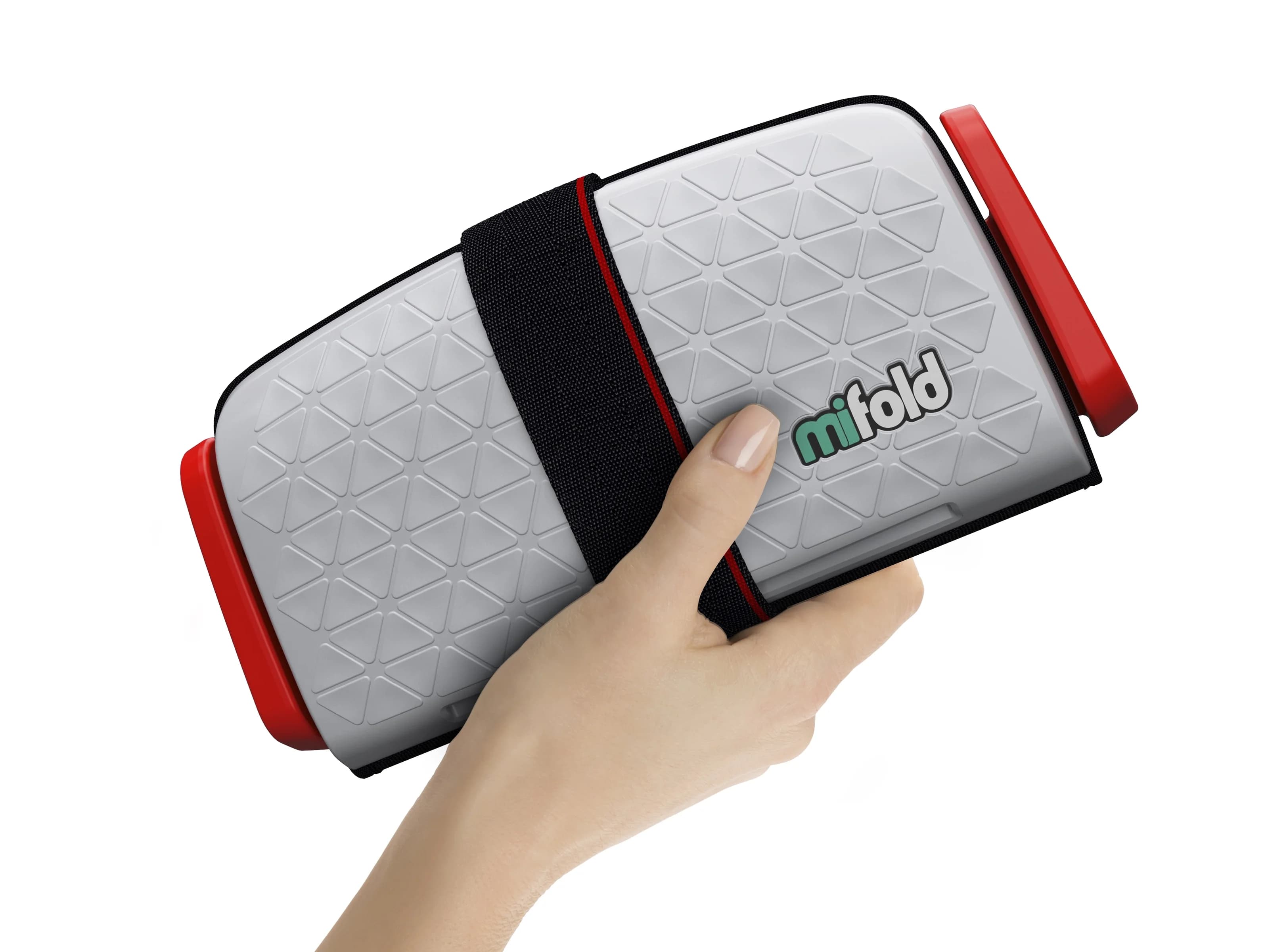
The Mifold Hifold fit-and-fold Booster is not FAA approved; it covers children 40–100 lbs and folds to one-quarter its size at 7.5 lbs for ground travel.

Flying with a car seat? Our Certified Child Passenger Safety Technicians are ready to help.
They'll walk you through every step — from choosing a seat that's safe for your child and convenient for your family, to getting it from the car, to the gate, and onboard the plane.
FAA Acceptance
No, not FAA-accepted
Cannot be used during flight on US commercial carriers; destination use only
noChild Range
40–100 lbs and 43.5–59 in
Child must be at least 4 years old, but Velivolo recommends children be at least 5 years old and developmentally mature enough to use the restraint correctly.
yesBooster Type
Highback belt-positioning booster
Child restrained by vehicle lap-and-shoulder belt, not a harness
yesFolded for Travel
Yes
MultiFold system collapses to one-quarter of deployed size for carry-on or checked luggage 9.8 × 13.5 × 13.5 in / 7.5 lbs
yesNHTSA Ease of Use
Not rated
Consumer Reports reviewed and flagged the torso adjustment mechanism as difficult to reach
variesHifold Fit-and-Fold Specifications
The Mifold Hifold fit-and-fold Booster is a highback belt-positioning booster for children 40–100 lbs that folds to one-quarter its size via the MultiFold system — making it the most packable full-featured highback booster available. At 7.5 lbs and 9.8 × 13.5 × 13.5 inches folded, it fits in an overhead bin or under an airline seat as carry-on to destination. It is not FAA approved and cannot be used during flight. We recommend it specifically for rideshare and rental-car families who need a full-featured highback they can actually pack.
- Per Hifold's published documentation, the Fit-and-Fold covers children 40–100 lbs and 43.5–59 inches in height.
- The MultiFold system collapses the seat to approximately 9.8 × 13.5 × 13.5 inches — roughly one-quarter its deployed volume — at 7.5 lbs.
- The Hifold is not FAA approved and cannot be used during flight on US commercial carriers under 14 CFR 121.311(b)(2)(ii).
- Per Hifold's documentation, the seat has a useful life of seven years from the date of manufacture.
- Hifold offers 243 individual adjustment settings across four parameters: seat width, body width, head width, and height.
Hifold Fit-and-Fold Specifications
Important — Car Seat Information
Child restraint information changes frequently. Airline policies, seat dimensions, and compatibility requirements are updated on an ongoing basis. For the most current and accurate information, please consult with one of our Certified Child Passenger Safety Technicians (CPSTs) inside the Velivolo app before you fly.
FAA Status & Aircraft Use
- Confidence:
- Not applicable (seat not FAA accepted)
- Regulatory:
- 14 CFR 121.311(b)(2)(ii) / FAA AC 120-87C — booster seats prohibited on US commercial aircraft
- FMVSS 213:
- Yes
- FMVSS 213a:
- not applicable
Airworthiness note
The Hifold Fit-and-Fold is a belt-positioning highback booster seat certified to FMVSS 213 for motor-vehicle use. Booster seats are not approved for aircraft use under 14 CFR 121.311(b)(2)(ii), which prohibits use of booster-type child restraints on US commercial flights regardless of any motor-vehicle safety certification. No FAA airworthiness label exists for this seat category. Families may carry the Hifold folded to the destination for ground-transport use only.
Flying with the Hifold
Per 14 CFR 121.311(b)(2)(ii) and FAA AC 120-87C, the Hifold Fit-and-Fold cannot be used on US commercial aircraft during any phase of flight. As a belt-positioning booster, it falls within the category of restraints explicitly prohibited from aircraft cabin use regardless of FMVSS 213 certification. Families flying with children in the 40–100 lb range should use the standard aircraft lap belt — the aircraft seatbelt is FAA accepted for this weight range. The Hifold's travel value is at the destination: its MultiFold system lets families pack a full-featured highback as carry-on or checked luggage. For wider seats, it will fit with the armrest raised.
The Hifold cannot be used in flight; its travel value is as a packable ground-transport booster at the destination — a role it performs better than any other full-featured highback.
- Install Method
- Not used on aircraft — 14 CFR 121.311(b)(2)(ii) prohibits booster seats on US commercial flights. Vehicle use only: belt-positioning via vehicle lap-and-shoulder belt.
- Economy Fit
- Does not fit standard economy
- Gate-Check
- Cabin-carry preferred
- Recline-Friendly
- No
How to Install the Mifold Mifold Fit-And-Fold
Complete Installation Walkthrough
Watch our full guide for installing the Mifold Mifold Fit-And-Fold
Velivolo Travel Score
Cannot be used on aircraft per 14 CFR 121.311(b)(2)(ii). Carry folded in overhead bin for destination use.
Not gate-checked for use on board — but the 7.5-lb folded seat can be checked as luggage or carried on without the gate-check hassle associated with bulkier boosters.
Fits any sedan, SUV, or minivan with lap-and-shoulder belts; three-across capable; the foldable format installs and stows faster than any rigid highback.
9.8 × 13.5 × 13.5 in at 7.5 lbs — the most compact full-featured highback booster for ground travel, fits in most overhead bins.
Velivolo Score
Not approved for aircraft use — boosters are prohibited under 14 CFR 121.311(b)(2)(ii).
243 individual settings provide precise fit but require adjustment every time the seat is folded and unfolded.
Narrow enough for three-across in compact cars; fits best in upright, moderately contoured seatbacks.
FMVSS 213 certified; six impact-protection zones; no NHTSA or CPSC recalls on file.
Seven-year lifespan; $250 street price reflects premium adjustability but sits at the top of the booster category.
Folds to 9.8 × 13.5 × 13.5 in at 7.5 lbs — the most compact full-featured highback booster for ground travel.
Pros & Cons
- Folds to approximately one-quarter its size (9.8 × 13.5 × 13.5 in) via the MultiFold system — the most compact full-featured highback booster for travel.
- At 7.5 lbs, lighter than most comparable highback boosters; fits in most airline overhead bins for carry-on transport to the destination.
- 243 individual adjustment settings across seat width, body width, head width, and height provide a precise fit for children across the full 40–100 lb range.
- Fits three-across even in compact cars at the narrowest body width of 16 inches.
- Six-zone, four-layer impact-protection system with memory foam headrest.
- Removable, machine-washable covers with breathable airflow fabric,
- Not FAA approved — cannot be used during flight on US commercial carriers under 14 CFR 121.311(b)(2)(ii); destination use only.
- At $250, it is one of the most expensive boosters in the travel category — significantly more than the BubbleBum inflatable ($30–40) or mifold Comfort ($60–80).
- The four-area adjustment system requires re-calibration every time the seat is folded and unfolded, creating risk for misuse.
- The torso-adjustment mechanism behind the seatback can be awkward to reach, and the belt-routing process as more complex than standard highbacks.
- Requires a vehicle headrest at or above the child's ears — seats without adequate headrests are not compatible.
Best For
Families who drive rental cars or road-trip frequently
The Hifold's MultiFold system makes it the only full-featured highback booster parents can realistically pack for a rental-car trip. At 7.5 lbs and 9.8 × 13.5 × 13.5 in folded, it goes in checked luggage or a carry-on bag and deploys in minutes at the destination.
Carpooling parents with multiple children in different vehicles
The 243-position adjustment system lets one seat serve children of different sizes across multiple vehicles. The fold feature means parents can carry it in a tote bag between cars without a dedicated storage solution.
Families needing three-across in a compact sedan
At its narrowest body width of 16 inches, the Hifold fits three-across in compact sedans where larger highbacks cannot. For families with three children sharing a rear bench, the adjustable width is a meaningful advantage.
Children 40–100 lbs outgrowing a harness seat
The Hifold's 40-lb floor aligns with the minimum booster transition weight recommended by CSFTL and the American Academy of Pediatrics. For a child ready to move out of a harness who will also travel, the Hifold covers the full booster phase in one seat.
Key Features
MultiFold Compact Travel System
Per Hifold's published documentation, the MultiFold system folds the seat to approximately 9.8 × 13.5 × 13.5 inches — roughly one-quarter of its deployed volume — in a few steps. At 7.5 pounds, the folded seat fits in most airline overhead bins, large backpacks, or the optional Hifold carry bag. No other full-featured highback booster in the US market matches this deployed-to-folded compactness ratio.
243-Position Multi-Fit Adjustment
Per Hifold's documentation, the Fit-and-Fold offers 243 individual settings adjusted across four independent parameters: seat width, body width, head width, and height. This level of adjustability allows the same seat to correctly fit a slender 4-year-old at 40 lbs and a broad-shouldered 10-year-old at 90 lbs. Per Car Seats For The Littles, caregivers must re-verify all four parameters each time the seat is redeployed after folding.
Six-Zone Impact Protection
Per Hifold's published documentation, the Fit-and-Fold is built with six impact-protection zones using a four-layer construction that includes high-density viscous memory foam inside the headrest and side rests. This foam absorbs and distributes crash energy. The seat meets or exceeds FMVSS 213 and is certified for the US, EU, UK, and Canadian markets. Because the minimum weight threshold is 40 lbs, the seat is exempt from FMVSS 213a side-impact testing requirements.
Lap-and-Shoulder Belt Routing System
Per Hifold's installation instructions, the shoulder belt routes over the armrest while the lap belt routes through guides on both sides of the seat bottom. This routing geometry — different from most standard highbacks — is designed to position the vehicle's seatbelt optimally across the child's body at the 40–100 lb range. Consumer Reports notes that the routing requires deliberate attention. A vehicle lap-and-shoulder belt is mandatory; lap-belt-only positions are not compatible.
Machine-Washable Covers
Per Hifold's documentation, the Fit-and-Fold features removable covers with breathable airflow fabric that are machine washable. For traveling families who use the seat in rental cars, on road trips, or in multiple vehicles, this washability is practical — spills and crumbs that would be difficult to clean in a fixed highback are addressed by removing and laundering the cover set. Replacement covers are available separately.
Real-World Scenarios
Fly-and-drive trip with a 6-year-old at 55 lbs
This is the Hifold's core use case. Fold the seat, pack it in the overhead bin or checked luggage, arrive at the destination, deploy and adjust in the rental car. At 7.5 lbs, it adds minimal luggage weight. Cannot be used during the flight — child uses the aircraft lap belt.
Daily school commute as primary booster
The Hifold works mechanically as a daily booster, but at $250, the price is hard to justify versus a Graco TurboBooster 2.0 Highback ($35–50) for fixed home use. The folding feature adds no value in a single dedicated vehicle.
Three-across configuration in a Toyota Camry
At its narrowest body width of 16 inches, the Hifold is one of the few highback boosters that genuinely fits three-across in a compact sedan. The independently adjustable body width lets each seat be dialed for the individual child.
Carpool with different children at different sizes
The 243-position adjustment system covers children from 40 to 100 lbs in one seat. Caregivers must re-verify all four parameters when switching between children of different sizes — per Car Seats For The Littles, this is the #1 misuse risk and requires discipline.
Road trip with children at 45 and 75 lbs
Two Hifolds in the rear row cover both children across the full range. Both seats fold flat for the outbound flight, are checked or carried on, and deploy in the rental car at the destination. The compact fold is the primary differentiator on this trip type.
International flight with the Hifold in the aircraft cabin
The Hifold cannot be used during any flight. International carriers follow ICAO standards that mirror FAA AC 120-87C's booster prohibition. The seat may be packed as carry-on luggage and used only after deplaning. Children 40+ lbs use the aircraft lap belt during flight.
How It Compares
Per WAYB's published documentation, the Pico is an 8-lb FAA accepted forward-facing harness seat that works both on aircraft and in vehicles, covering children approximately 22–50 lbs. The Hifold at $250 is less expensive but is aviation-only ground-use and covers a higher weight range (40–100 lbs). Choose the Pico for in-flight use with younger children; choose the Hifold for packable destination ground transport for older, booster-ready children.
Read full reviewThe BubbleBum Teleport is a compact backless booster targeting the same travel use case at a fraction of the Hifold's $250 price. The Hifold wins on headrest protection, precise adjustability, and the full-highback side-impact foam system. The Teleport wins on price, weight, and absolute pack size. For children who need a headrest or ride in taxis with poor seat geometry, the Hifold's structural superiority matters; for low-cost trip logistics, the Teleport is hard to beat.
Read full reviewPer Mifold's published documentation, the Comfort is a compact backless belt-positioning booster that folds flat at approximately 1.5 lbs — dramatically lighter and more compact than the Hifold. The Hifold provides a full highback with side-impact protection and head support, which the Mifold Comfort lacks. For children who behaviorally require head support or travel to destinations with less predictable vehicle seat geometry, the Hifold's structure is worth the premium.
Read full reviewThe BubbleBum Inflatable deflates to nearly nothing at under 0.5 lb — the absolute lightest and smallest travel booster. The Hifold weighs 15× more folded and costs 7× as much, but provides a full highback structure, head support, and six impact-protection zones the inflatable cannot offer. For 40–100 lb children who still need headrest support on long drives, the Hifold's structure matters; for occasional carpool backup duty, the BubbleBum Inflatable is unmatched for cost and pack size.
Read full reviewPacking & Travel Tips
Pack in the Overhead Bin
The Hifold folded to 9.8 × 13.5 × 13.5 inches fits in most airline overhead bins when placed lengthwise. Use the optional carry bag to protect the seat and make it shoulder-slingable through the terminal. This avoids gate-check fees and keeps the seat available immediately upon arrival.
Re-Adjust All Four Parameters After Folding
Per Car Seats For The Littles, the most common Hifold misuse is failing to re-adjust all four settings — seat width, body width, head width, and height — after the seat has been folded and redeployed. Practice the full adjustment sequence at home before the first trip so the process takes under 2 minutes at the rental car counter.
Verify Vehicle Has Headrest
Per Hifold's installation requirements, the seat requires a vehicle headrest at or above the top of the child's ears in the occupied position. Confirm the rental car's rear-seat headrests meet this requirement before booking. Most modern sedans and SUVs comply; some older economy-rental vehicles have minimal rear headrests.
Child Uses Aircraft Lap Belt
The Hifold cannot be used during flight. On the aircraft, children 40+ lbs in the booster-transition age range are restrained by the standard aircraft lap belt. The lap belt is FAA accepted for children in this weight range. Pack the Hifold as carry-on or checked luggage and use it only after deplaning.
Check Weight Before Each Trip
The Hifold's 7-year expiration is measured from date of manufacture, not purchase date. Check the date-of-manufacture label on the underside of the seat base before each trip season. A seat purchased second-hand may have significantly less remaining service life than a new one.
Frequently Asked Questions
Is the Mifold Hifold approved for use on airplanes?
Per 14 CFR 121.311(b)(2)(ii) and FAA Advisory Circular AC 120-87C, booster seats, including the Mifold Hifold , are not approved for use on US commercial aircraft during any phase of flight.
How small does the Mifold Hifold fold?
The Mifold Hifold collapses the seat to approximately 9.8 × 13.5 × 13.5 inches — roughly one-quarter of its deployed volume. At 7.5 pounds, the folded seat fits in most airline overhead bins when placed lengthwise, or in a large backpack or suitcase. The optional Hifold carry bag (sold separately) converts the folded seat into a shoulder-slingable package for easier terminal navigation. This folded form factor is significantly smaller than any comparable full-featured highback booster, which typically measures 17–20 inches wide even when not deployed.
What weight and height does the Mifold fit?
The Mifold Hifold is rated for children weighing 40–100 lbs and measuring 43.5–59 inches in height. The minimum weight of 40 lbs aligns with the American Academy of Pediatrics' booster-transition guidance and the NHTSA FMVSS 213 minimum for highback belt-positioning boosters. The 100-lb maximum and 59-inch height ceiling cover most children through approximately age 10–12, depending on build. Hifold recommends that children be at least 4 years old and mature enough to sit properly without slouching for the duration of a trip before transitioning to a booster. Velivolo recommends using a five-point harnessed car seat until the child is older than five, and developmentally mature enough to use a booster seat.
What is the Hifold's expiration date?
The Mifold Hifold Fit-and-Fold has a useful life of seven years from the date of manufacture. The date of manufacture is printed on a label located on the underside of the seat base and on the product registration card. This seven-year lifespan applies regardless of the purchase date — a seat purchased from a resale marketplace may have significantly less remaining service life than a newly purchased seat. Mifold recommends registering the seat at purchase so the manufacturer can contact owners in the event of a future safety notice. Never use a seat that has exceeded its printed expiration date.
Can the Hifold fit three across in a sedan?
The Mifold Hifold Fit-and-Fold is designed to fit three-across even in compact cars, owing to its minimum body width of 16 inches when adjusted to the narrowest setting. At its narrowest configuration, the Hifold is among the slimmest full-featured highback boosters in the US market. Actual three-across feasibility depends on the specific vehicle's rear bench width, seatbelt buckle placement, and transmission tunnel height. The Toyota Camry, Honda CR-V, and Subaru Outback are cited by CPSTs and families as vehicles where three-across configurations with the Hifold are achievable.
How do I install the Hifold correctly?
Per Hifold's installation instructions, the Fit-and-Fold requires a vehicle lap-and-shoulder belt and a vehicle headrest at or above the child's ear height. Installation sequence: (1) unfold the seat and adjust all four parameters — seat width, body width, head width, height — for the specific child; (2) place the child in the seat; (3) route the shoulder belt over the armrest through the shoulder-belt guide; (4) route the lap belt through the lap-belt guides on both sides of the seat bottom. The most common error is routing the shoulder belt incorrectly and failing to re-verify all four settings after the seat has been folded and redeployed. Practice the sequence at home before the first trip.
How does the Hifold compare to the WAYB Pico?
Per WAYB's and Hifold's published documentation, the two seats address different traveler needs. The WAYB Pico is an 8-lb FAA accepted forward-facing harness seat covering children approximately 22–50 lbs; it can be used during flight on US commercial carriers with the aircraft lap belt. The Hifold is a 7.5-lb highback belt-positioning booster covering 40–100 lbs; it cannot be used during flight. Choose the Pico for in-flight restraint with younger children who still need a harness. Choose the Hifold for older, booster-ready children where the travel value is ground transport at the destination — the Hifold covers the 50–100 lb upper range where the Pico ends. The Hifold costs $250 versus the Pico's $349–399.
What vehicles is the Hifold NOT compatible with?
The Fit-and-Fold is not compatible with vehicle seat positions that lack a headrest at or above the child's ear height. Beyond headrest requirements, the seat underperforms in vehicles with deeply reclined seatbacks, pronounced side bolsters, or very soft cushioning — conditions that prevent the seat base from making full contact with the vehicle seat surface. This category includes some luxury sedans, older minivan captain's chairs, and vehicles with aggressive seat contouring.
Is the Hifold safe for daily use or just for travel?
The Fit-and-Fold is certified for daily use and meets or exceeds FMVSS 213 for all US vehicle applications. The seat is not restricted to travel use by its certification. However, for families who will use the seat exclusively in one vehicle, the $250 price and the multi-step adjustment protocol are harder to justify compared to a standard highback booster at $35–80 that provides comparable FMVSS 213 crash protection in a simpler package. CPSTs familiar with the hifold and note the complexity of the adjustment system — while unique — adds steps that standard highbacks do not require. The seat's premium is most defensible when the fold feature is actively used.
Sources
- 1Hifold Fit-and-Fold Product Page (2026) — Specifications, weight range, folded dimensions, certifications. Source
- 2Hifold FAQ Page (2026) — Expiration policy, adjustment settings, installation requirements. Source
- 3FAA Advisory Circular AC 120-87C (2019) — FAA guidance on child restraint systems; booster prohibition 14 CFR 121.311. Source
- 4NHTSA Recalls Database (2026) — Recall status verification for Hifold Fit-and-Fold. Source
- 5NHTSA NCRUSS DOT HS 812 157 (2015) — National misuse rates for highback boosters (16%) and backless boosters (24%). Source
Last updated: 2026-07-14

Velivolo Editorial Team
Family Travel Experts
Our editorial team combines certified child passenger safety technicians, frequent-flying parents, and automotive safety researchers to deliver independent, data-driven car seat reviews for traveling families.
Related Travel Boosters & Seats
.webp&w=3840&q=75&dpl=dpl_inqJ4L7UrVUMh9KgfmfeaAUpUNKq)
Legal Disclaimer
The car seat information provided on this page is intended for general informational purposes only and is subject to change without notice. Velivolo makes no representations or warranties, express or implied, regarding the accuracy, completeness, or timeliness of any car seat data, airline compatibility information, or related recommendations displayed on this platform.
Velivolo is not liable for any damages, injury, loss, or harm arising from reliance on incorrect, outdated, or incomplete car seat information or recommendations. Parents and caregivers are solely responsible for verifying all child restraint information with the relevant airline, the car seat manufacturer, and a Certified Child Passenger Safety Technician (CPST) before travel.
Affiliate Disclosure: Some product links on this page may be affiliate links. Velivolo may receive a commission if you make a purchase through one of these links, at no additional cost to you. This does not influence our content, recommendations, or editorial decisions.
Use of this information does not constitute professional child passenger safety advice. For personalized guidance, consult a Certified Child Passenger Safety Technician (CPST) through the Velivolo app.
Ready to Pack a Booster for Your Next Trip?
Velivolo helps traveling families choose the right ground-transport booster for rental cars, road trips, and international destinations — so children ride safely whether the journey ends in a sedan or an SUV.